
In this article
- The discrete coherent construction
- What the SMM/DTT distinction contributes
- One complete step
- The DTT comparison
- Where novelty could appear
- A further conceptual benchmark


A quantum walk gives a concrete example of discrete updates that preserve coherence and generate propagation. It is a useful benchmark for DTT’s inner operations and outer records. The comparison reveals what a discrete rule establishes, what spatial structure it assumes and why a clock calibration is needed before an update speed becomes physical.
A coined quantum walk uses an internal state and a position register. A unitary coin changes internal amplitudes, and a conditional shift moves them to neighboring positions. The original quantum-walk proposal shows how coherent alternatives differ from a classical random walk. The lattice and its adjacency are model inputs, so the walk alone does not explain why space has that geometry. This is exactly where SMM/DTT’s stronger spatial-emergence ambition becomes relevant. [1]
SMM begins with one nonspatial generative source. DTT distinguishes its inner production from the outer order in which completed results become accessible. The six inner levels are nested functional dependencies within that production; the seventh denotes outer completion. They are not six independent clocks, six spatial directions, or six simultaneously occupied temporal axes. This distinction makes the framework more specific than a general claim that everything changes: it asks how a world of persistent relations can be generated before its spatial representation is taken for granted.
A discrete sequence can describe a continuous-looking process without deciding whether reality itself is discrete. Film frames, sampled signals and numerical time steps all illustrate the distinction between a representation and its represented object. DTT gives the distinction an ontological ambition: completed moments would arise from inner generative structure, while outer observation encounters an effectively continuous world. The central question is therefore what supplies continuity across completions. Merely making the steps very short does not explain how records remain related or why a particular smooth evolution appears.
Continuity has several meanings. A trajectory can be continuous in position, differentiable in velocity, continuous in quantum probability, or phenomenally continuous to an observer. These properties are logically separable. A sequence of quantum states connected by small unitary updates can approximate a differentiable evolution even though the update label is integer valued. A sequence of unrelated images can be shown equally quickly without generating the same temporal understanding. Persistent memory and lawful correlations do much of the explanatory work usually hidden by the phrase high refresh rate. [2]
Start at position zero with coin state |0⟩. Apply a Hadamard coin, obtaining (|0⟩ + |1⟩)/√2, then shift the first component left and the second right. The result is (|−1⟩|0⟩ + |+1⟩|1⟩)/√2. A position measurement gives either endpoint with probability one half, while the unmeasured state retains coherence. Repetition allows amplitudes from different paths to interfere. Inserting a full measurement after every step changes the process, so inner updates should not automatically be identified with outer records.
DTT can use a quantum walk as a controlled model of coherent production followed by registration. Its stronger ambition requires explaining adjacency rather than assuming it. The six nested levels could constrain those relations, but a six-step coin circuit would not prove their necessity. A speed also requires distance a per shift and physical duration δ per update. The ratio a/δ is a model scale; it becomes universal only if the source theory connects the same calibration across relevant fields and observers.
A source-derived walk could impose a restricted coin, a protected dispersion relation or a relation between memory and propagation. These are concrete outputs comparable with known discrete dynamics. The strongest result would derive adjacency, clock response and the accessible cone from one update. The example also shows why discreteness need not destroy interference: the decisive distinction is between unitary updates and record-producing interventions. DTT’s dual-time language is useful when it keeps those operations separate and explains why a particular completion boundary has physical significance.
For a finite-dimensional system with bounded Hamiltonian H, let one update be Uδ = exp(−iHδ/ℏ). After n updates the state is Uδⁿψ = exp(−iHnδ/ℏ)ψ. At the sampled times t = nδ this exactly agrees with ordinary unitary evolution. The integer n therefore does not by itself predict a new effect. An alternative update, an observable restriction between samples, or a physical limit on δ would be needed to distinguish a fundamentally discrete theory. This calculation also fixes the units: Hδ/ℏ is dimensionless. A dimensionless stage number becomes seconds only after a clock calibration or an independently derived timing law.
THE SAME QUESTION, DIFFERENT STARTING POINTS
| Question | SMM/DTT | quantum walks |
|---|---|---|
| Discrete dynamics | A DTT update rule must explain how coherent propagation and completed readout arise from its source operations. | A quantum walk combines a unitary coin operation with a position shift controlled by the coin state. |
| Spatial interpretation | If a source model assumes a lattice, that example does not yet derive space from a nonspatial Monad. | A walk on a supplied graph establishes propagation on that graph; its speed in physical units also needs a clock calibration. |
KEEP THE CONNECTION
Connects this comparison with the author’s discussion of discrete.
Connects this comparison with the author’s discussion of discrete.
Connects this comparison with the author’s discussion of discrete.
Connects this comparison with the author’s discussion of discrete.
Connects this comparison with the author’s discussion of discrete.
References support the comparator and the specific mathematical or interpretive claims indicated. SMM/DTT connections are developed in the analysis above.
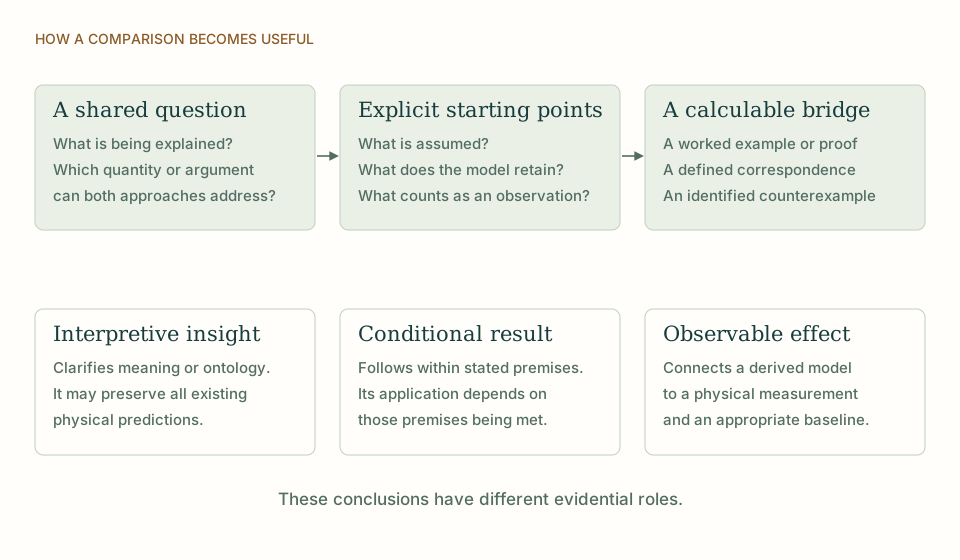
How these comparisons distinguish premises, results and physical claims
SMONAD
Share this page, or keep a clear reference to the work you are reading.
Use this reference for the explanation on this page. “n.d.” means its first publication date is not specified; the update date is recorded separately.