
In this article
- Memory as a physical relation
- What the SMM/DTT distinction contributes
- A one-bit record calculation
- What renewal must preserve
- The thermodynamic distinction
- A further conceptual benchmark


A generated world needs a way to carry history across renewal. The Time Chest can be developed as a question about retained relations, finite memory and the accessibility of past events. This essay shows how record correlations differ from an unlimited cosmic archive and why the thermodynamic cost belongs to a specified memory operation.
A record is useful because its state is correlated with something else in a reliable way. It need not contain a complete copy of the event it records. A footprint preserves selected information about a passage, while leaving most microscopic details unrepresented. For SMM/DTT, retained memory can therefore be selective: it carries the relations needed for continuity and later access. The Time Chest becomes a constructive concept when its state space, update and readout are specified. [1]
SMM begins with one nonspatial generative source. DTT distinguishes its inner production from the outer order in which completed results become accessible. The six inner levels are nested functional dependencies within that production; the seventh denotes outer completion. They are not six independent clocks, six spatial directions, or six simultaneously occupied temporal axes. This distinction makes the framework more specific than a general claim that everything changes: it asks how a world of persistent relations can be generated before its spatial representation is taken for granted.
Continuous creation is a claim about dependence: the world does not sustain itself independently of its source once an initial act is finished. SMM/DTT develops a temporal version in which observable configurations are renewed through inner generation and outer completion. This can make persistence a dynamic achievement rather than the passive endurance of an unchanged material core. The central question is how novelty and reliable continuity coexist. A renewed world must explain why yesterday’s records constrain today’s events.
Renewal has several possible meanings. An entity may remain numerically the same while its properties change. A pattern may persist through replacement of its material components. A new token may reproduce an earlier form while inheriting a causal history. A metaphysical account may hold that all three depend continuously on a source without describing replacement in physical time. DTT is most distinctive when it specifies which of these meanings belongs to its generative law and which belongs to its theological interpretation. The difference matters for conservation laws and for the identity of persons. [2]
Let X be a fair binary event and M a blank memory. After ideal copying, M = X. The Shannon entropy of either variable is one bit, their joint entropy is one bit, and their mutual information is one bit. If the memory is later randomized independently, the joint entropy becomes two bits and mutual information falls to zero. The physical systems still exist, but the memory no longer distinguishes the earlier event. This calculation shows that having a storage device is not the same as retaining a usable historical relation.
A source-generated observer does not need access to every microscopic detail of every prior completion. It needs sufficient correlations to preserve stable objects, causal expectations and an intelligible history. A finite memory can do this only over a specified range, or through compression and selective forgetting. If a model assumes an unlimited archive, that is an additional resource. DTT’s six nested levels should make clear where memory is retained and which operations can use it. Otherwise a supposedly minimal source may hide the complexity of the entire world inside an unexplained storage register.
Copying into a prepared blank memory can be logically reversible when the original is retained. Resetting an unknown memory to a standard state is a different operation. Under the usual isothermal erasure assumptions, it carries the familiar kBT ln 2 bound per unbiased bit. This does not make every act of creation a heat pulse of that size. The physical implementation, reservoir and initial correlations matter. The positive SMM research direction is a complete memory cycle that accounts for writing, retention, access and reset. That would turn the Time Chest from an evocative archive image into an explicit continuity mechanism. [1]
A river maintains a recognizable course while different parcels of water pass through it. Calling it the same river can track location, causal continuity, ecological organization or a legal identity. None requires the same water molecules to remain. Now imagine a sequence of perfectly similar rivers with no causal relation between them. Similarity alone would not supply the history of one river. The comparison shows what a renewal theory needs: an inheritance relation that explains why a later configuration continues this process. SMM/DTT can express that relation through source memory and completion. The analogy establishes a criterion for persistence, not a physical proof that the universe is recreated in discrete frames.
THE SAME QUESTION, DIFFERENT STARTING POINTS
| Question | SMM/DTT | records theory and information thermodynamics |
|---|---|---|
| Retention | The Time Chest names the dependence of completed accessibility on retained relations across renewal. | A record is a physical correlation that permits inference about another event or variable. |
| Persistence | Source memory must distinguish a continuing history from a newly produced but qualitatively identical configuration. | Reversible copying can establish a correlation; erasure and thermodynamic reset are separate operations. |
KEEP THE CONNECTION
Connects this comparison with the author’s discussion of identity.
Connects this comparison with the author’s discussion of identity.
Connects this comparison with the author’s discussion of identity.
Connects this comparison with the author’s discussion of identity.
Connects this comparison with the author’s discussion of identity.
References support the comparator and the specific mathematical or interpretive claims indicated. SMM/DTT connections are developed in the analysis above.
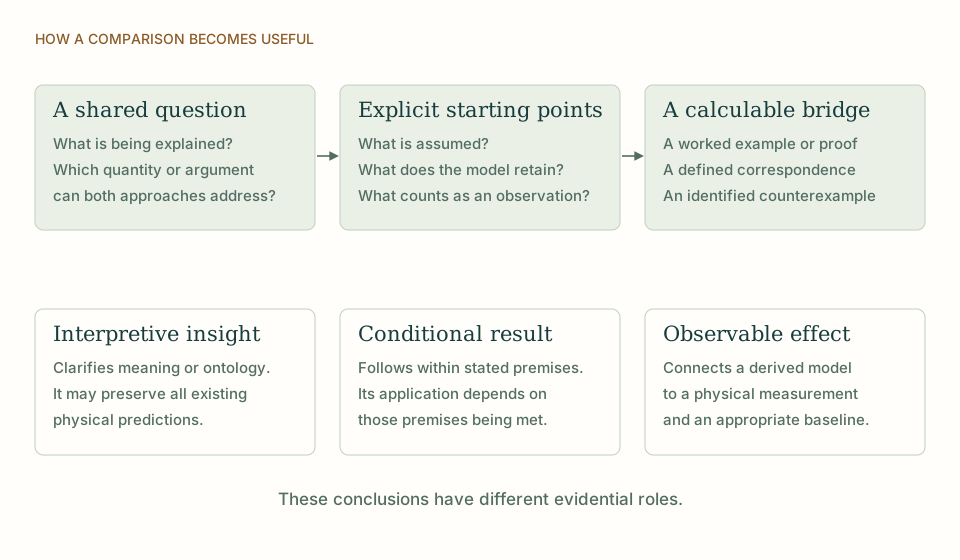
How these comparisons distinguish premises, results and physical claims
SMONAD
Share this page, or keep a clear reference to the work you are reading.
Use this reference for the explanation on this page. “n.d.” means its first publication date is not specified; the update date is recorded separately.