
In this article
- The question behind this comparison
- The SMM/DTT starting point
- How the comparator works
- The decisive comparison
- Worked benchmark
- What follows for the source programme


A stable local record can hide phase information that remains in a larger system. This comparison with standard Hilbert-space quantum mechanics calculates the purity of a decohering qubit, separates inaccessible memory from fundamental information loss, and shows how DTT’s source architecture could become testable through later interventions and recovery.
Decoherence occurs when a system becomes correlated with degrees of freedom that are not controlled in a later experiment. Relative phases can remain present in the total state while disappearing from the reduced statistics available locally. A memory is a physical correlation that persists and can influence a later operation. These concepts overlap, but neither implies the other: an environment can decohere a system while retaining information that later returns to it.
SMM/DTT’s source memory gives this distinction a natural role. Inner work may store relations absent from the completed record, and later completion can reveal some of them. The relevant question is whether the discarded variables are merely bookkeeping or have operational consequences. A theory of retained records therefore benefits from multi-time interventions that distinguish irreversible loss, temporary inaccessibility and deliberately protected phase memory. [3] [4]
The Single Monad Model begins with one nonspatial generative source. The Duality of Time Theory distinguishes the source’s inner production from the outer order in which completed records become accessible. Its six inner levels are nested functional roles of one process: a higher role organizes lower-level work. The seventh is the completion or observation interface. They are neither six independent clocks nor six additional time coordinates.
This distinction supplies a useful research question: which features of an observed world can follow from the way a source produces, retains and releases information? A concrete answer needs a state space, an autonomous update, retained memory and a rule connecting completion to an accessible measurement. In the constructions discussed here, those mathematical ingredients are stated explicitly. A successful finite example establishes what its specified mechanism can do; further arguments connect it to physical particles, spacetime or universal laws. [1]
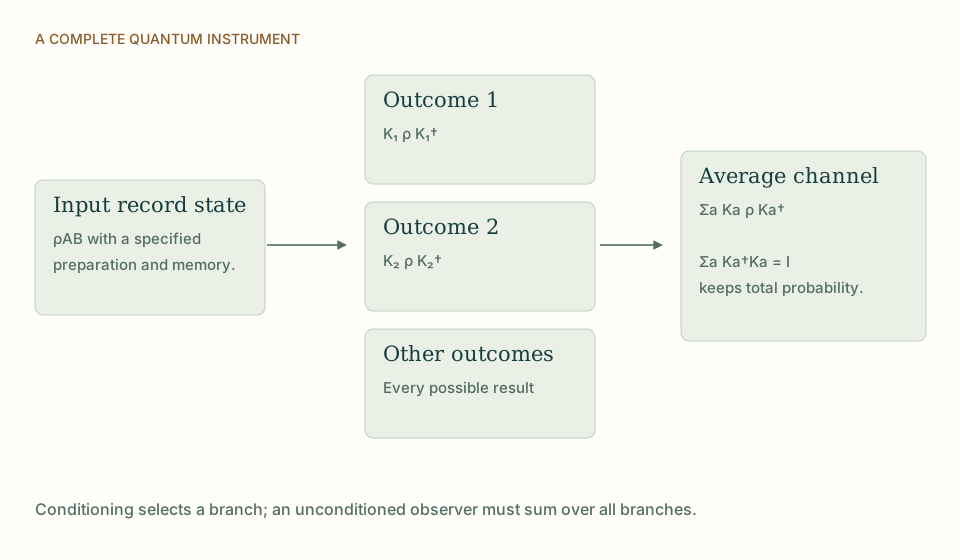
Operational quantum mechanics represents a preparation by a positive density operator of unit trace. A measurement outcome corresponds to an effect, and an instrument specifies both its probability and the conditional state left behind. Closed evolution is unitary; an open system can evolve by a completely positive, trace-preserving map. These ingredients are sufficient to calculate laboratory statistics without deciding whether the wavefunction describes an ontic object, a relation or an agent’s expectations.
The instrument language is especially close to DTT’s distinction between production and accessible records. An unobserved interaction and a registered outcome are mathematically different objects. Yet an ordinary instrument does not itself contain a hidden generative time, nor does a sequence of instruments derive the space in which laboratories operate. It provides a precise interface against which a proposed inner process can be tested: if the process reproduces exactly the same instruments, the difference is explanatory or structural unless another accessible measurement distinguishes it. [2]
Standard open-system quantum mechanics can represent hidden source memory by enlarging the state space and then tracing out the inaccessible register. DTT’s inner-versus-outer distinction gives this operation an ontological interpretation: the inner state contains correlations that the completed archive need not retain. The calculable agreement is the reduced channel and, when memory persists, the full intervention-dependent process.
This correspondence becomes informative when a particular source architecture restricts the possible memory kernels or recovery times. Simply introducing an arbitrary hidden environment can reproduce almost any admissible reduced dynamics and therefore explains little about why a measured law has its form. The overlap example shows exactly what is accessible in one reduced state: purity and fringe contrast depend on |γ|. They do not reveal where the missing phase is stored. A DTT model needs a later controlled probe or a resource theorem to connect that storage to observable consequences. Its distinctive value would then be a constrained relation between record formation and memory recovery, rather than the already familiar fact that ignoring part of a quantum state produces a mixed description. [2] [3] [4]
Start with (|0⟩+|1⟩)|e⟩/√2 and let an interaction correlate the alternatives with normalized environment states |e₀⟩ and |e₁⟩. The reduced system state has diagonal entries 1/2 and off-diagonal entries γ/2, where γ=⟨e₁|e₀⟩. Its eigenvalues are (1±|γ|)/2 and its purity is [1+|γ|²]/2.
If |γ|=0.6, the purity is 0.68. If the environmental alternatives become orthogonal, purity falls to 1/2 and the system looks maximally mixed. A controlled reversal of the joint interaction can nevertheless restore the original pure state when all relevant degrees of freedom remain coherent. This is why a completed local archive cannot be identified with the full microscopic state. The entropy of its reduced description measures inaccessible correlations under a chosen partition; it is not, by itself, evidence that information has been fundamentally destroyed. [3] [4]
γ is the environment overlap. The total state in this example remains pure and evolves unitarily.
The practical value of a source-memory model is that it can predict when a simple one-time description fails. If every future intervention depends only on the retained density operator, an ordinary channel is enough. If different preparation histories with that same operator produce different responses, a larger memory or process tensor is required. The additional structure becomes explanatory when its organization constrains those responses, instead of merely storing a complete list of previously observed outcomes. [3] [4]
THE SAME QUESTION, DIFFERENT STARTING POINTS
| Question | SMM/DTT | standard Hilbert-space quantum mechanics |
|---|---|---|
| Starting structure | One nonspatial source, retained memory and six nested inner functions with an outer completion interface. | Density operators, effects and instruments on a specified Hilbert space. |
| Observable connection | The source update and readout must generate the measured records and their calibrated relations. | A registered outcome is a conditional instrument output. |
| Decoherence and memory | This correspondence becomes informative when a particular source architecture restricts the possible memory kernels or recovery times. | Standard open-system quantum mechanics can represent hidden source memory by enlarging the state space and then tracing out the inaccessible register. |
| Status of the claim | A constructive research programme; a specified finite model establishes only its stated conditional results. | Operational quantum mechanics is a predictive formalism; its ontology is not uniquely fixed. |
KEEP THE CONNECTION
Connects this comparison with the author’s underlying construction.
Connects this comparison with the author’s underlying construction.
Connects this comparison with the author’s underlying construction.
Connects this comparison with the author’s underlying construction.
Places the comparison alongside the programme’s published results, assumptions and open targets.
References support the comparator and the specific mathematical or interpretive claims indicated. SMM/DTT connections are developed in the analysis above.
How these comparisons distinguish premises, results and physical claims
SMONAD
Share this page, or keep a clear reference to the work you are reading.
Use this reference for the explanation on this page. “n.d.” means its first publication date is not specified; the update date is recorded separately.