Quantum gravity and granular spacetime: SMM/DTT and Causal dynamical triangulations
Can a finite process generate quantum geometry while preserving the long-distance behavior of matter, clocks and gravitational fields? This article compares the source-based construction with Causal dynamical triangulations, identifies their strongest point of contact, and works through a concrete example that separates a valid mathematical result from the further physical relation needed to explain observations.
Granularity has several inequivalent meanings. A lattice has discrete locations. A quantum geometric operator can have discrete eigenvalues even when no fixed spatial lattice exists. A causal network may contain finitely many elements in a bounded region without possessing a global grid. A temporal update can be discrete while its observable state space is continuous. Mixing these meanings turns a useful analogy into a false identification.
The central physical question is how quantum amplitudes for alternative geometries are assigned and how ordinary geometry appears in suitable states. A picture of tiny cells leaves that question open. So does a minimum tick if no Hilbert space, composition law, matter coupling or relational observable accompanies it. At large scales, the relevant object is a distribution of measurable geometric correlations and their fluctuations, not merely the count of microscopic ingredients. [1][2][3]
02The SMM/DTT contribution
DTT gives granularity a generative interpretation: an accessible configuration is produced and completed rather than assumed to exist independently of its production. The six nested inner levels can organize preparation, relational distinctions and retention; outer time orders accessible completions. This is more specific than saying that spacetime is made of atoms, because the completed record and the process that produces it play different roles.
A finite autonomous model can express that distinction with a joint state of source, memory and completion flag. Coherence belongs to amplitudes before readout, while retained outcomes depend on a specified instrument. Whether the microscopic update is unitary, dissipative or constrained is an additional mathematical choice. None of these choices follows solely from naming a Single Monad, and different choices can produce physically different continuum behavior.
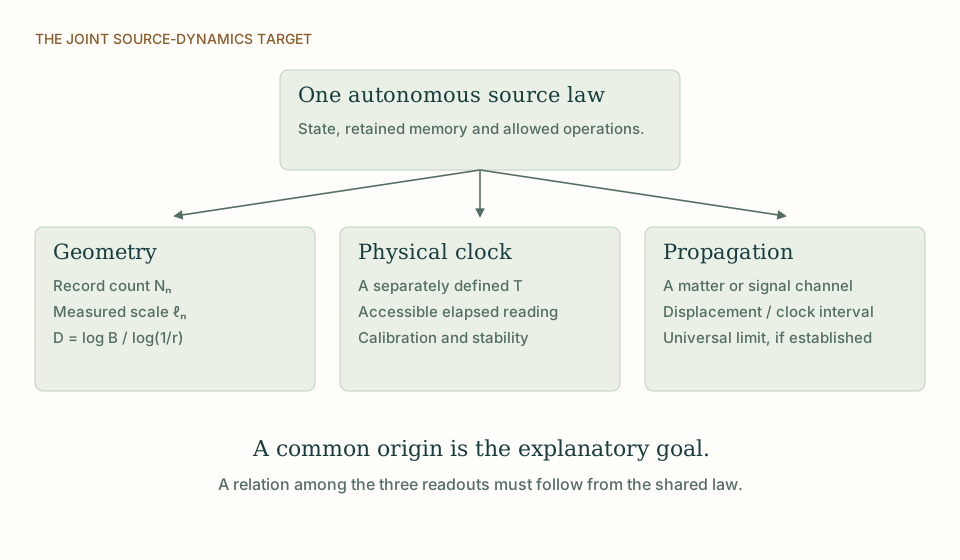
Geometry, clocks and propagation as independent readouts. A single source model should explain the relation between separately defined measurements. Sharing a diagram does not impose that relation. View full size ↗
03How Causal dynamical triangulations frames the problem
Causal dynamical triangulations defines a sum over discretized geometries with a specified causal organization and action. Macroscopic behavior is studied through ensembles and scaling, rather than by treating one fixed triangulation as the final spacetime. Diffusion-based dimension is one useful probe of the generated ensemble. Its numerical behavior is a result inside the model.
The comparison with DTT concerns how a regulated construction produces an extended geometry with stable large-scale observables. A nested inner process is not a triangulation time coordinate, and a computational update used to sample an ensemble is not an observer's clock. Distinguishing these roles is essential when interpreting emergent temporal and spatial behavior. [4]
04Where the mechanisms agree and differ
In CDT, a triangulation is both a regulator and a member of an ensemble whose large-scale behavior is studied statistically. The existence of finite simplices is therefore not itself the final prediction of granular spacetime. DTT's completed records could play a similar regulatory role if the theory supplies a refinement family and a measure over histories. The two approaches then meet at the question of which microscopic distinctions survive coarse observation.
Their temporal variables must remain distinct. A Monte Carlo update changes a sampled configuration; it does not represent a physical event in the modeled universe. Likewise, an inner source step acquires physical significance only through a clock or record observable, not through its place in an algorithm. DTT's emphasis on autonomous generation could add something if it supplies such an operational clock while retaining the correct ensemble of geometries. The calculation of geometric fluctuations below makes this issue tangible: an ensemble becomes classical only when correlations permit suppression of uncertainty. A large number of microscopic records is insufficient if they fluctuate coherently across macroscopic distances. [4]
05Worked example: assumptions, calculation and result
A simple bounded spectrum illustrates what granularity does and does not buy. Let a geometric observable have eigenvalues 0,a₀,2a₀, with probabilities 1/4,1/2,1/4. Its mean is a₀ and its variance is a₀²/2, so the relative fluctuation is 1/√2. A discrete spectrum has not made the geometry sharply classical.
Now average M independent copies. The average still has mean a₀, but its variance becomes a₀²/(2M). At M=5000 the relative fluctuation is 1%. The independence assumption is decisive: long-range correlations can prevent this suppression. A proposed temporal granularity can therefore yield smooth geometry only if the source dynamics controls correlations as well as the microscopic step size. This calculation establishes a coarse-graining benchmark, not a universal law of quantum gravity. [1][2][3]
⟨A⟩=a₀; Var(A)=a₀²/2; ΔĀ/⟨Ā⟩=1/√(2M) for independent copies.
a₀ has the units of the geometric quantity, for example area. M counts statistically independent contributions.
06An independent operational check
The averaging example also distinguishes loss of resolution from physical decoherence. An observer can ignore small-scale fluctuations while the global state remains coherent. Conversely, an environment can suppress interference without making all geometric observables sharply peaked. A completion instrument must specify which of these operations occurs. Its probabilities should sum to one when all outcomes are included, and any selected subset must retain its success probability. Otherwise an apparently classical geometry may be an artifact of conditioning on rare outcomes. This is a concrete way to test whether the source produces stable geometry efficiently or merely permits it among many possible records.
07What follows from the comparison
A useful result would specify which observables become sharp, on which states, and how quickly their fluctuations decrease. This connects the source ontology to a reproducible macroscopic limit. The comparison also prevents a common overstatement: a finite-dimensional example may demonstrate a completion mechanism, but it cannot establish a continuum gravitational theory without a refinement family and a physical interpretation of its limiting observables.
THE SAME QUESTION, DIFFERENT STARTING POINTS
The comparison at a glance
Question
SMM/DTT
Causal dynamical triangulations
Starting physical structure
One nonspatial source; six nested inner functional levels produce records accessible through outer completion.
An ensemble of causally organized piecewise-flat geometries.
The central mechanism in this topic
A physical update needs an autonomous source and an operational completion clock.
Ensemble sampling steps are computational; geometric histories have separately defined causal structure.
How the claim is made operational
A source-to-record map must define geometry, material response and physical clocks with shared inputs.
Path-sum weights, numerical observables and refinement toward a continuum regime.
Meaning of agreement
Agreement is a compatibility result; a source-selected relation or fixed residual would add explanatory content.
The stated framework provides a benchmark within its own assumptions and established domain.
KEEP THE CONNECTION
Key ideas
The promising comparison is between generated probability measures and their physical large-scale observables.
The worked example establishes only the result stated under its explicit assumptions.
Six nested inner levels describe one generative organization; outer time orders accessible completion.
Develops the source construction or operational distinction used in this comparison.
Sources and further reading
References support the comparator and the specific mathematical or interpretive claims indicated. SMM/DTT connections are developed in the analysis above.