What a spectral action can contribute to source-generated gravity
A spectral action can turn a specified operator spectrum into an effective geometric action containing gravitational terms. This offers a concrete bridge for SMM/DTT spectral constructions. The comparison also identifies the data that must be generated before a heat-kernel expansion can be claimed as a derivation of gravity.
A source model may associate its completed observations with an algebra, a Hilbert space and a Dirac-type operator. Spectral geometry studies how such data encode geometric and physical structure. The spectral-action programme then assigns an action built from the operator spectrum and a cutoff profile.
This is a natural point of comparison for SMM/DTT: source operations could in principle generate the spectral data that enter an effective geometry. The explanatory order matters. A heat-kernel calculation performed on an already chosen four-dimensional manifold does not establish that the manifold itself emerged from the source. [2][1]
02The structure of the expansion
For a suitable positive elliptic operator D² on a compact smooth four-dimensional Euclidean geometry, consider Tr f(D²/M²). At large M, under the standard regularity assumptions on the cutoff profile, the expansion contains a term proportional to M⁴a₀, a term proportional to M²a₂ and a term proportional to a₄, with coefficients determined by moments of f.
The heat-kernel coefficient a₀ is associated with volume. The coefficient a₂ contains a curvature contribution for a Dirac-type operator. Higher coefficients contain additional curvature and gauge terms. The exact factors depend on operator conventions and field content; these must be fixed before identifying physical couplings. [2]
Tr f(D²/M²) ∼ c₄M⁴a₀ + c₂M²a₂ + c₀a₄ + …
Schematic four-dimensional heat-kernel expansion; ck are profile-dependent coefficients. The operator and its geometric domain are specified inputs.
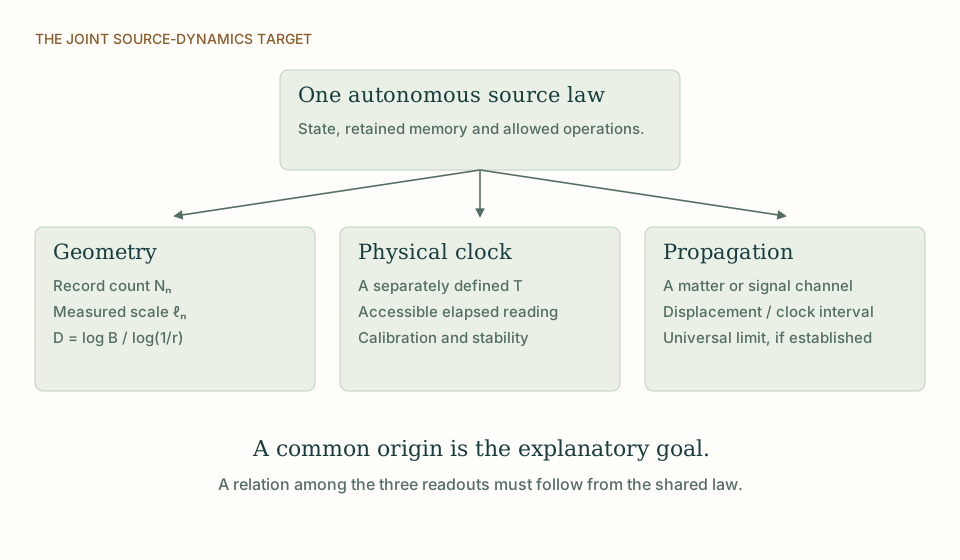
Geometry, clocks and propagation as independent readouts. A single source model should explain the relation between separately defined measurements. Sharing a diagram does not impose that relation. View full size ↗
03A scale dependence that remains visible
Suppose the curvature coefficient in a particular normalization is proportional to c₂M². Matching it to an Einstein–Hilbert coefficient relates the effective gravitational coupling to that product. If c₂ and the geometric units are held fixed while M doubles, the curvature coefficient grows by a factor of four and the corresponding G scales inversely by that factor.
Meanwhile the leading volume coefficient grows by a factor of sixteen. These are simple consequences of the powers of M. They show why the cutoff scale and profile are not disposable notation. A source-based derivation of gravitational and vacuum couplings must explain their physical selection or show which predictions remain independent of them.
M → 2M ⇒ M² coefficient ×4, M⁴ coefficient ×16
This scaling statement holds with the profile moments, operator normalization and other inputs fixed.
04What must precede the expansion
The source must supply an algebra of observables, a physically meaningful representation, an operator with the required locality and spectral behavior, and an action-selection rule. If it supplies only an abstract sequence of eigenvalues, geometric reconstruction may be nonunique. The same spectrum need not determine every distance or global feature without additional information.
It also matters whether the source is fundamentally finite, discrete or noncommutative. A continuum asymptotic expansion can approximate an appropriate limit, but one must establish the regime in which its assumptions hold. Applying smooth-manifold formulas to a finite source without controlling that limit leaves the physical bridge incomplete. [3]
05Euclidean spectral data and Lorentzian observation
The convenient positivity of D² and the usual heat-kernel machinery belong to a Euclidean or appropriately elliptic setting. Physical relativistic propagation concerns a Lorentzian causal structure. An analytic continuation or reconstruction procedure requires its own conditions and does not automatically follow from calling inner time imaginary.
SMM/DTT can use its two temporal roles to motivate the distinction between generative structure and completed causal observations. To establish a physical theory, however, it must provide the map that yields causal evolution, a positive physical state interpretation and the required matter coupling. Those properties are not consequences of the heat-kernel coefficients alone.
06A two-eigenvalue example exposes the inputs
Take a finite self-adjoint operator with positive eigenvalues m and 2m and choose the smooth profile f(x) = exp(−x). The spectral action at scale M is then exp(−m²/M²) + exp(−4m²/M²). At M = m it is exp(−1) + exp(−4), whereas increasing M changes both weights. The calculation is determined by the spectrum, the scale and the selected profile together.
This finite example contains no spacetime curvature, but it shows what a source-based spectral construction would have to select. A source interaction might generate an operator and a retained spectral probe; the question is then whether its large-system behaviour produces the required geometric terms and their relative coefficients. Changing the smoothing function or normalization can change those coefficients without altering a verbal claim of spectral emergence. Making these choices explicit turns the comparison into a calculation of a definite model. The additional Lorentzian and dynamical questions can then be addressed at their proper stage.
07The positive connection
The spectral-action approach supplies an explicit mathematical mechanism by which a sufficiently rich operator geometry can organize gravitational and gauge terms together. That is valuable for a programme seeking a common source of geometry and matter. It identifies a target richer than a numerical fit to a single constant.
The strongest SMM/DTT contribution would derive the spectral triple, admissible cutoff or action law and physical reconstruction from its source operations. A partial result that derives one of these previously independent ingredients is still useful. The comparison makes clear which geometric structure is generated and which is currently imported into the calculation. [2]
THE SAME QUESTION, DIFFERENT STARTING POINTS
The comparison at a glance
Question
SMM/DTT
Noncommutative spectral geometry
Spectral data
The source should generate the algebra, carrier and operator.
A spectral action starts from specified operator geometry.
Gravity
An effective curvature term can provide a concrete matching target.
Its coefficient depends on scale, profile and normalization.
Physical interpretation
Recover causal outer observations and universal matter coupling.
A Euclidean heat-kernel expansion alone is not a Lorentzian dynamical reconstruction.
KEEP THE CONNECTION
Key ideas
Spectral actions provide a calculable route from operator geometry to effective action terms.
The underlying geometry, operator, cutoff and action rule are substantive inputs.
Source-generated gravity requires controlling both geometric emergence and physical causal interpretation.
Connect geometry with matter transport and gauge fields.
Sources and further reading
References support the comparator and the specific mathematical or interpretive claims indicated. SMM/DTT connections are developed in the analysis above.