


A static response remains unchanged when its source and stiffness are transformed together. The same symmetry still permits different response strengths, showing why covariance alone cannot select a physical coupling or constant.
Transform the complete description
Represent a real finite state by a vector x. Under an orthogonal change of components x′=Rx, a quadratic energy xᵀKx/2 has the same meaning if K′=RKRᵀ. A source term fᵀx must similarly use f′=Rf. Transforming one symbol while keeping the others fixed usually changes the model rather than merely changing its description.
This principle is especially useful for SMM/DTT. A source carrier, its completion tests and its physical readouts must transform together. Agreement of two formulas written in different frames is meaningful only after their states, parameters and measurements have been translated consistently.
Derive an invariant capacity
Assume K is positive definite and minimize E(x)=xᵀKx/2−fᵀx. Differentiation gives Kx=f, so the equilibrium response is x*=K⁻¹f. The scalar C=fᵀK⁻¹f measures the response in the applied-source direction.
C′=f′ᵀK′−1f′=fᵀK⁻¹f=C.
The equality follows from RᵀR=I. It is exact and does not depend on K being isotropic. An anisotropic system can have a coordinate-independent description because the apparatus orientation and its response matrix are transformed together.
Worked example: a quarter-turn changes components
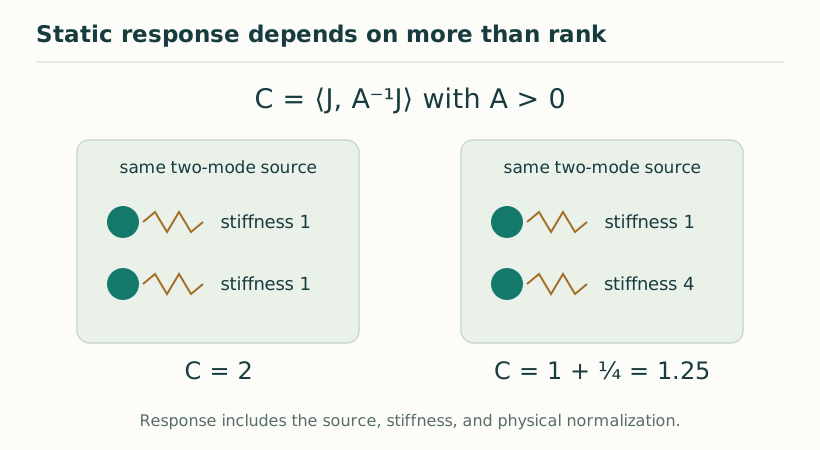
Take K=diag(1,4) and f=(1,1). The capacity is 1+1/4=5/4. A quarter-turn R maps f to (−1,1) and K to diag(4,1). Repeating the calculation gives 1/4+1=5/4.
Now replace K by the identity while keeping the physical source fixed. The capacity becomes two. This second operation changes the stiffness, not the coordinate basis. Equal carrier dimensions therefore do not imply equal response. A physical constant cannot be inferred from a mode count without selecting the source, the stiffness and their normalization.
One invariant need not determine the whole object
The matrices diag(1,3) and diag(2,2) both have trace four, yet their determinants are three and four and their spectra differ. Trace is invariant under similarity, but it is not a complete description of a matrix. Choosing a limited family of invariant tests can merge physically distinct possibilities.
The same issue occurs for completed records. A loop trace, a determinant degree or a total mode count retains particular information. The source programme must establish which invariant its apparatus measures and whether that invariant suffices for later predictions. More invariants may be required without changing the proposed unity of the source.
Transport between receivers differs from one fixed representation
A receiver may depend on an auxiliary flag: a line inside a plane inside a three-dimensional readout. Rotations can transport the entire receiver and its response data between flags. This can define a covariant family even when no single fixed receiver carries the stronger rotation action one might have expected.
The linked rank-137 construction gives a precise example. Under its unoriented-flag convention, three conjugate half-turns would need equal characters in any fixed SO(3) representation, but their natural stabilizer traces are 1,−7,−7. That obstructs the fixed representation. A transported scalar capacity can nevertheless remain flag independent when the base response data satisfy the required stabilizer conditions.
What the surviving symmetry leaves unfixed
Even full rotational isotropy allows a positive stiffness K=κI with any κ>0. It removes directional preference without fixing the magnitude of the response. In a d-dimensional model with a source of squared norm d, the capacity is d/κ.
For SMM/DTT constants work, this distinction preserves the meaning of structural integers. A receiver rank such as 137 can be exact within its selected construction while its physical response depends on an independently supplied κ. Symmetry can constrain the form of the law before it constrains, or fails to constrain, the remaining scale.
A stronger invariant prediction
The next useful result would derive a relation among independently measured responses from one source update. For example, the same microscopic parameter might control stiffness, clock rate and a transport coefficient, leaving a dimensionless ratio fixed as the parameter varies.
The six nested inner roles could contribute by enforcing a shared resource or composition identity, while outer completion defines the readable quantities. The calculation should transform all apparatus data consistently, then change a physical parameter and show which prediction remains. This separates a universal relation from an invariant rewriting of a model whose coefficients were freely chosen.
Continue with the articles
- Trace-sector response and the Schur complement
Allowing hidden traceless modes to relax changes the stiffness seen by a trace source. The Schur complement gives the exact reduced capacity and exposes the normalization still needed for an inverse-rank coupling.
- The conditional ideal value one over 137
The ideal model value 1/137 requires a selected record count, a trace-response law, and an additional absolute normalization. A hydrogen-like calculation checks their consistency without deriving the measured fine-structure constant.
- A flag-independent response without one fixed rotation action
A response can be transported consistently between construction flags even when the natural stabilizer action cannot extend to one fixed rotation representation. Its invariant capacity still leaves different stiffness laws possible.
- Two phase actions and determinant closure
The inherited polynomial phase and a selected common output phase act differently on the same receiver. Their determinant exponents are 612 and 137, so closure claims depend on which action and physical source are chosen.
- A dependency map for physical constants
A common constants program must connect dimensionless source outputs to response, matter, and geometry through one physical dictionary. A dependency map separates those deductions from supplied scales and empirical calibration.
- What the holonomy Hessian does and does not contain
The singlet-loop response near identity holonomy is proportional to tr(X²), with no independent [tr(X)]² term at quadratic order. Explicit carrier weights then give a conditional relation among response coefficients, with physical coupling normalization still to be supplied.