

An interdisciplinary argument can change its meaning without changing its vocabulary. “Observer,” “dimension,” “information” and “energy” travel between ordinary speech and technical work. The connection becomes productive when we identify what each word denotes before carrying a conclusion across the boundary.
A word is not a shared definition
Consider the sentence “observation requires an observer.” In a laboratory model, an observer might be a detector that distinguishes and stores a result. In an account of experience, the word might refer to a conscious subject. The sentence has not established that these two meanings coincide.
A stronger argument would define both roles and explain their relationship. It might show that a particular person's report depends on a detector record. That would connect the roles without identifying the record-forming mechanism with the experience of reading it.
| Word | One technical use | A question before transferring a claim |
|---|---|---|
| Observer | A specified preparation, interaction and readout role | Is conscious experience also being assumed? |
| Dimension | The number of independent coordinates in a stated space | Which space: positions, states or parameters? |
| Information | A quantity defined from a probability distribution or communication task | Is the claim about distinguishability, uncertainty or meaning? |
| Energy | A physical quantity defined within a dynamical framework | What are its units, measurement procedure and conservation conditions? |
Which space has the dimension?
One particle's position in ordinary three-dimensional space can be represented by three coordinates. Two particles require six position coordinates to specify their joint configuration. That does not turn the surrounding physical space into a six-dimensional room.
Likewise, a quaternion has four real coefficients. Unit quaternions satisfy a constraint and represent rotations of three-dimensional vectors. The coefficient space, the constrained parameter space and the space of those vectors play different roles.
The quaternion essay makes the distinction calculable. Whenever an argument moves from a number of algebraic components to a number of physical dimensions, identify the map connecting them and the measurements that give it spatial meaning.
Information and meaning
Take a binary variable whose two values are equally likely. Its Shannon entropy is one bit. We can label the values 0 and 1, “open” and “closed,” or two arbitrary symbols without changing that entropy. Changing the assigned meanings does not change the stipulated probabilities.
Meaning still matters to a reader or a control system. If 1 means “door open,” the interpretation determines what action is appropriate. The point is that the one-bit calculation and the semantic convention describe different aspects of the arrangement.
The entropy essay develops the further distinction between a probability distribution and the multiplicity of a coarse description. A shared word does not supply a conversion between all the quantities called information or entropy.
“Inner time” as a case study
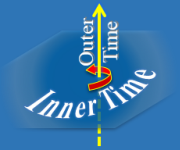
In ordinary conversation, “inner time” might mean how long an experience feels. In SMM/DTT it names a proposed generative role distinct from outward availability and evolution. A reader could find the analogy suggestive while still needing an argument to connect the two.
Try replacing the phrase with its local definition. “The reported duration felt longer” and “the generative construction required additional internal operations” now make visibly different claims. They could be related in a model, but neither statement alone entails the other.
This substitution is especially helpful when one paragraph moves between a book's metaphysical account, an operator calculation and a psychological example. Write the relevant meaning at each transition. If the definitions differ, make the proposed connection a sentence of its own.
Make the connection inspectable
A useful connection supplies a map, a reason for using it and a consequence. For instance, a model can identify a counted cycle with a laboratory duration through a specified clock calibration. The calibration explains how an abstract count becomes a measured interval. It also tells us what to compare when two clocks disagree.
An analogy can be valuable at an earlier stage. It highlights a structural question: perhaps both an experience and a measurement record depend on retained relations. The next step is to identify which relations, under which operations, and with which evidence. The analogy has then helped formulate work that can actually be done.
Keep a working glossary
For each central term, record its definition in the current passage, its mathematical object if any, and the evidence used to apply it. Add a separate entry when another discipline uses the word differently. This is more useful than forcing every occurrence into one universal meaning.
The existing SMONAD glossary supplies a starting directory. The essays on translation and proof and physical models show how the same discipline supports textual and mathematical work.
Sources and further reading
The coordinate-counting and binary-label examples are teaching constructions. Their quantities and conventions are stated explicitly above.
- SMONAD glossary of concepts and notation.
- Which complex algebra belongs to which temporal role?: a detailed example of why a multiplication rule matters.
- Consciousness and observation; duration and order.