
In this article
- Two kinds of temporal comparison
- Equal duration, different experience
- State change without visible motion
- Why inner time is not a synonym for private experience
- A constructive conceptual bridge
- Reading the distinction responsibly
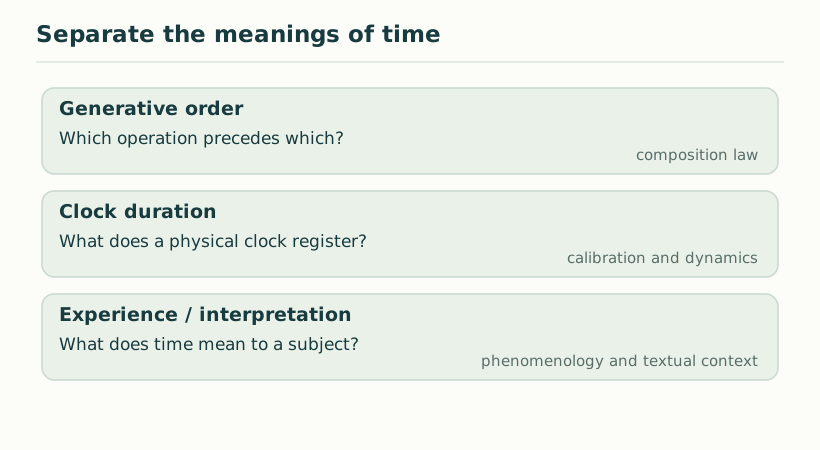
Natural time compares bodily motion, while spiritual time describes changes of state within the source tradition. This distinction clarifies different accounts of experience without identifying DTT’s generative inner time with consciousness.
The source article distinguishes natural time, used to compare bodily motion, from spiritual time, used to compare changes of knowledge or spiritual state. In its reading of Ibn al-Arabi, the latter is not limited to the motions of material bodies. This distinction belongs to a metaphysical and experiential account, and it should be explained in those terms before any comparison with physics is attempted.
A modern reader can recognize a related distinction between public clock duration and lived duration. The resemblance is informative, but spiritual time is not exhausted by a psychological experiment, nor does the resemblance establish a second physical clock dimension.
Two people can spend the same measured hour in very different experiences. One is absorbed in a meaningful task; another repeatedly checks for an uncertain result. The clock comparison can agree while the remembered or anticipated duration differs. Attention, memory and the organization of activity all matter to the experience.
This example shows why disagreement about felt duration is not automatically a disagreement about physical time. If the question concerns a physical clock, the relevant evidence is the clock’s records and comparisons. If it concerns experience, first-person reports and the conditions producing them belong to the inquiry.
A person reading silently may appear almost motionless while their understanding changes substantially. Conversely, an object can move mechanically without acquiring knowledge. The distinction between physical displacement and a transition of understanding helps explain why spiritual writers use temporal language for changes that are not described adequately by a trajectory through space.
One should not infer that such transitions occur outside all physical processes. The point is conceptual: a description of bodily position and a description of acquired meaning answer different questions. Connecting them requires an account of the relevant states and relations, not simply declaring one to be the other.
In DTT, inner time concerns generative organization and outer time concerns completed observable order. These terms do not mean subjective versus objective, or mind versus matter. A model may assign inner operations to processes with no conscious observer at all. Likewise, an outer record may be produced by an ordinary detector.
Confusing these distinctions would make the framework less precise. A proposed connection between consciousness and temporal completion would require additional assumptions about experience and its physical correlates. It cannot be established merely because both discussions use the word inner.
The useful common theme is that access to change depends on the state of the receiver. A device can register one distinction and ignore another; a learner can recognize a relationship that was previously unnoticed. In each case, what becomes available depends on capacities and retained context. The mathematical and experiential cases remain different, but the relational pattern can guide questions.
For example, DTT can ask how an observer acquires stable records of completed events, while an account of lived time asks how records and expectations enter experience. The first problem may inform the second only after a bridge between physical records and experiential organization has been supplied.
Physical, psychological and spiritual descriptions need not compete for a single vocabulary. Their claims should be evaluated in relation to their objects. A measured time dilation is a clock comparison; a report of an unusually expansive experience is a report about experience; a theological claim about divine knowledge belongs to a metaphysical account.
The SMM/DTT connection becomes clearer when these levels remain visible. The framework can be motivated by a broad philosophy of manifestation while developing a sharply defined physical model. Such a model may eventually illuminate questions of observation, but it should not present the interpretation of spiritual experience as an already demonstrated consequence of its equations.
KEEP THE CONNECTION
Scope of the argument. Interpretive discussion; no spiritual experience is presented as evidence of relativistic or hidden-time dynamics.
Historical public topic address, redirected to this edition’s revised explanation. It identifies the topic’s provenance; the revised page supplies its own reading locators and claim scope.
Source register →