
In this article
- Two different relations between cosmos and time
- Why motion is not already a clock
- The puzzle of the present
- The SMM/DTT comparison
- What the comparison can establish
- Recurrence does not settle the whole history
Greek discussions connect time with cosmic order, motion and number. Plato and Aristotle provide contrasting ways to frame the later distinction between the generation of events and the measurement of change.
Plato and Aristotle offer contrasting ways to connect time with the ordered world. In the Timaeus, temporal order belongs to the becoming of the cosmos and its regular motions. In Physics IV, Aristotle examines time through change, before and after, and the activity of counting. His discussion does not simply identify time with a moving object. These differences remain useful because they separate the existence of an order from the processes by which that order is measured.
The public article uses this contrast to introduce Ibn al-Arabi’s position. A careful comparison should retain the distinction between a created temporal order and the measurement of change without turning either ancient account into a premature version of general relativity.
A stone falling, a wheel turning and a tree growing all change. Their changes are not automatically comparable. To use one as a clock, we need a repeatable feature and a rule for counting it. The question is not whether there is motion, but why a chosen process supplies a useful measure for other processes.
Consider two wheels that rotate at different rates. One revolution of the first is not the same duration as one revolution of the second. Their ratio can be determined by repeated comparison. This simple example explains why a philosophy linking time with motion still needs an account of measure, regularity and comparison.
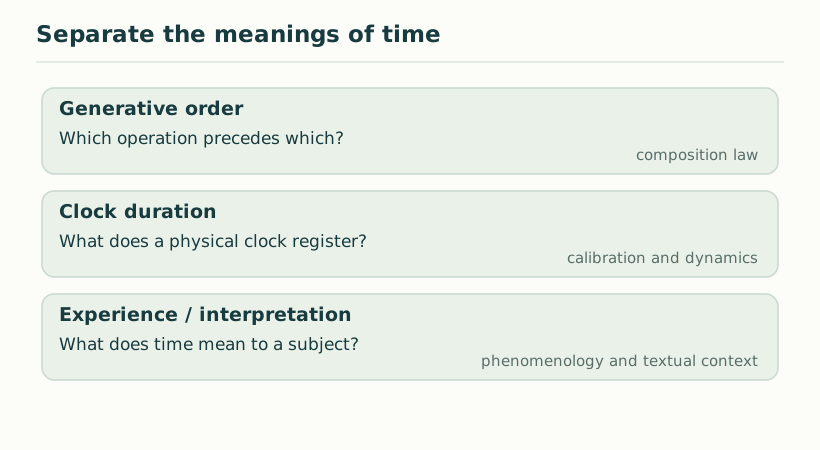
Aristotle’s discussion also exposes the difficulty of treating time as a collection of existing pieces: the past has passed, the future has not arrived, and the now functions as a boundary. This is a conceptual problem about what kind of reality belongs to temporal relations. It is not settled by observing that a clock has moving hands.
A boundary can organize an interval without constituting a finite piece of that interval. In mathematics, an interval is not formed by adding the lengths of its endpoints. This observation blocks a simple inference from the apparent lack of duration of an instant to the impossibility of duration. A discrete theory instead needs an explicit unit or transition rule.
SMM shares with creation-centred accounts an interest in the dependence of temporal order on the world’s coming to manifestation. DTT makes the distinction operational by separating generative organization from completed records. The outer sequence is something the model seeks to reconstruct, not merely a universal parameter supplied in advance.
At the same time, the Aristotelian emphasis on comparison remains relevant. Once records appear, a physical clock must be identified among the possible processes. A sequence of completed states may establish before and after, while leaving open how equal durations are selected. The modern clock-selection problem therefore sharpens, rather than bypasses, the older philosophical difficulty.
Historical comparison is strongest when it identifies a shared problem and different proposed answers. Plato’s cosmological production, Aristotle’s analysis of measured change and DTT’s completion order all illuminate relations between temporal structure and the world. Their mathematical and evidential commitments are nevertheless different.
One can use the comparison as a diagnostic. Does a proposed DTT argument derive only succession, or also a uniform clock? Does a circular internal phase imply recurrence of records, or merely recurrence of one component? Does a present record determine future evolution? These questions turn a broad philosophical resemblance into a precise research agenda without claiming that ancient cosmology has already supplied the required physical laws.
A rotating pointer can return to its initial mark while a counter beside it increases by one. The pointer’s phase repeats, but the combined system does not return to its initial state. This example helps compare ancient cyclic imagery with a modern completion model. Internal recurrence and an advancing record can coexist without contradiction. The important question is which variables are included in the state and which are observable. A statement about the circularity of one variable should therefore never be promoted directly into a claim that the whole universe repeats.
KEEP THE CONNECTION
Scope of the argument. Historical and conceptual comparison; no claim of ancient anticipation of modern relativity.
Historical public topic address, redirected to this edition’s revised explanation. It identifies the topic’s provenance; the revised page supplies its own reading locators and claim scope.
Source register →