
The six inner roles describe nested dependencies; the seventh is an outer completion interface. Neither nesting nor event count fixes elapsed physical time.
What you will learn
- Describe the difference between ordering, completion and duration.
- Calculate nested counter counts at a selected radix.
- Explain why a return requires a completion certificate and retained memory.
Before you begin: Lesson 01. You should understand a state, an update and a retained record.
An episode has internal work
Imagine preparing a document for release. Letters become words, words become checked sentences, and the finished document becomes available. These operations depend on earlier work, but readers need not observe every intermediate draft. DTT uses an analogous distinction between generative activity and completed observable configurations. The physical version must specify what performs the work and what makes the result available.
Three ideas require different tests. Order asks which operation came first. Completion asks whether the declared task is finished. Duration asks how much a calibrated clock advanced. Three completed documents might require three different preparation times. Likewise, counting completed source episodes does not establish that each episode occupies one equal physical tick.
Six dependencies and one interface
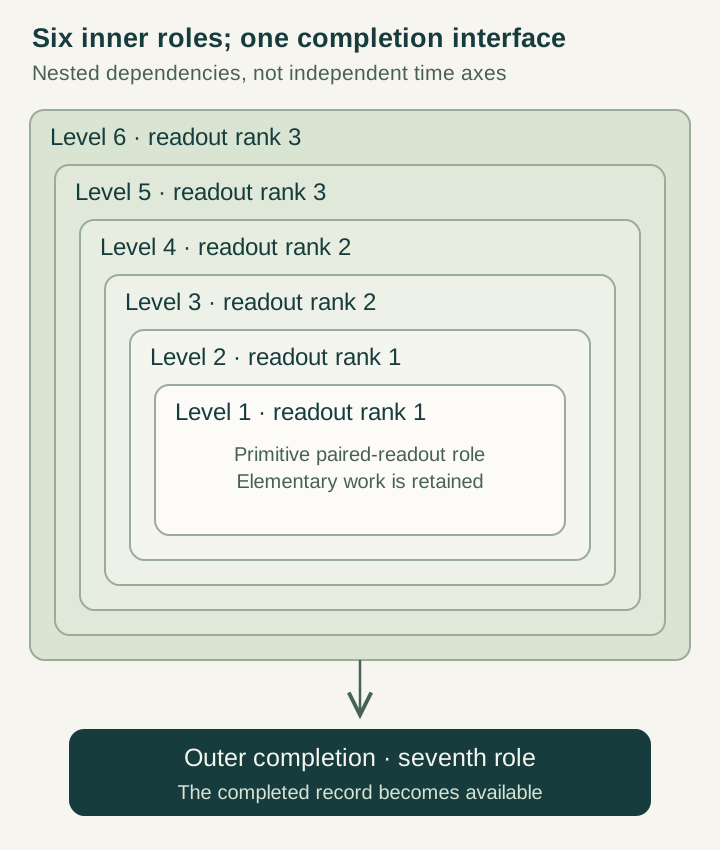
The six inner roles in the nested formulation are organized so that higher roles depend on completed lower work. The seventh role exposes or certifies the assembled result. It is an outer completion interface, not another inner digit. This is the sense in which six inner roles can belong to one action rather than six freely adjustable temporal coordinates.
A useful picture is a counter with carries. The lowest digit advances first; a higher digit advances when a lower cycle is exhausted. All digits belong to one state and one update rule. The picture illustrates dependency, while the number and physical function of the stages must still be selected by an actual source model.
Open the full-size diagram →
A single update with nested periods
Choose a radix q, an integer at least two. Each digit da ranges from zero to q−1. In a six-digit counter the address is n=d1+qd2+q²d3+q³d4+q⁴d5+q⁵d6, with d1 changing fastest. Incrementing n performs all necessary carries.
Beginning from zero, the first qa addresses exhaust every combination of the first a digits while higher digits stay zero. Thus the first two binary digits visit 00, 10, 01 and 11 in that least-significant-first notation. The four-state block has a precise boundary. A different initial address can encounter a carry sooner, so the initial preparation matters to the claimed hierarchy.
Worked example with the nested-generation demo
Open the nested-generation demonstration. Select radix two and role four. Four binary digits give 2⁴=16 addresses. The supplied paired readout has rank two because the first and second digits contribute opposite changes along one direction, while the third and fourth contribute along a second. At role six the count becomes 2⁶=64 and the rank becomes three.
Move to role seven. The count stays 64 and the rank stays three; the archive becomes marked as published. Now use radix three at role four: 3⁴=81 addresses still have rank two. More internal states do not automatically add a spatial direction. Lesson 04 derives the rank and explains exactly which readout assumptions make this statement true.
A return is useful when it certifies work
Suppose a phase marker returns to its starting position. That recurrence alone cannot establish that the record has passed a check: an unrelated rotating marker would also return. A completion mechanism must couple the flag to the actual work. One finite design computes a required parity, verifies it against a stored target and exposes a success bit only when they agree.
The model must also describe rejection and incomplete work. If failed attempts take time, a clock counting every attempt differs from an archive counting successes. Even perfect return to the same internal address does not retain the number of episodes. To distinguish the fifth completion from the sixth requires memory, a counter or another persistent record outside the resetting address.
What the calculation does and what comes next
The counter proves that one update can have nested periods and a separate publication boundary. It does not choose the length of a clock second, derive the supplied spatial frame or show that every physical clock ignores internal branch activity. These are specific next questions rather than defects in the exact counting result.
Compare a device that advances once per accepted archive with one that advances once per elementary counter operation. They agree on the order of completed archives but assign different readings during unfinished work. To turn either into a material clock, state its dynamics and calibration. Continue to observational equivalence to determine when the published record retains enough information to predict later tests.
Try the exercises
Work through each question, then open the answer to compare the steps.
Exercise 1
At radix three, how many addresses occur at roles two, five and seven? State the paired-readout rank at each.
Show the worked answer
Role two uses 3²=9 addresses and the first pair gives rank one. Role five uses 3⁵=243 addresses and has opened the third direction, so rank three. Role seven publishes all six digits: 3⁶=729 addresses and rank three. It adds a completion status, not a seventh digit, so 3⁷ is not the relevant count.
Exercise 2
An episode visits eight internal addresses and succeeds independently with probability one half. With recoverable failure, how many attempts and internal visits are expected per success?
Show the worked answer
With fresh, independent retries and complete recovery, the attempt count has probabilities (1/2)ⁿ for n=1,2,… and mean 1/p=2. Each attempt visits eight addresses, giving expected visits 8×2=16. A successful-episode counter advances once. Converting these counts to duration still requires a measured cost per visit and any reset or verification time.
Continue with the articles
- One action, two temporal roles
Inner generation and outer record order can be roles of one process. A completed return becomes an observable advance only when its action respects the retained records and their tests.
- Six inner stages and one publication interface
A six-digit nested counter with paired signed readout realizes ranks 1, 1, 2, 2, 3, 3 before one completion interface. Its exact counts reveal sampling bias and the restricted assumptions behind the six-channel bound.
- What spatial readout forgets
Different inner states can share one spatial readout and still have different successors. A concrete counterexample and a kernel-preservation criterion identify the memory needed for autonomous completed evolution.