


The answer in brief
A shared logarithmic encoder and a protected clock can produce a clock ratio equal to record dimension. Deriving that encoder, its endpoints and the clock selection from one interaction remains the central task.
Go to the research challengeA joint law should connect independent measurements
A central SMM/DTT target connects record geometry, inner generative activity, physical clocks and matter propagation. In a self-similar record model one seeks Nₙ=Bⁿ, ℓₙ=Lrⁿ, D=log B/log(1/r), a clock ratio Δu/Δτ=D and, under a suitable propagation identification, c=vgD.
The geometric count and scale can be established without defining a clock. The clock comparison is therefore the substantive bridge. If u is simply named D times τ, the equality carries no new information. A stronger model gives separate procedures for measuring branching, contraction, activity, duration and matter response, then proves a relation among their readings.
The joint clock–band article provides a conditional construction. This discussion identifies its positive result, its remaining adjustable interfaces and the kind of source theorem that would strengthen it.
The record dimension follows from count and scale
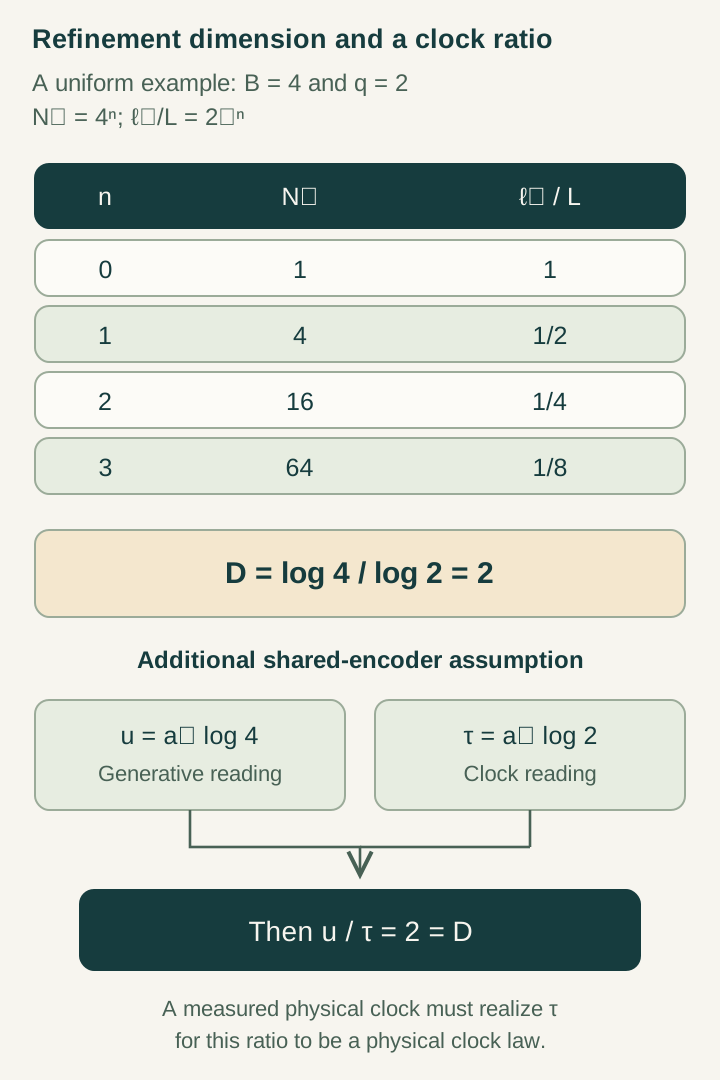
Let q=1/r>1. Suppose independently distinguishable child records number B at each refinement, and independent scale comparisons give a factor q between a parent and child. At depth n, multiplication gives Nₙ=Bⁿ and ℓₙ=Lq⁻ⁿ. Their logarithmic ratio is D=log B/log q.
This is a dimension of the declared record geometry when its metric and limiting construction support the corresponding covering argument. It does not automatically describe the dimension of a smooth propagation manifold. That physical identification needs the additional tests discussed in the comparison of dimensional probes.
For q=2, the branch counts B=4,6,8 give D=2, log₂6≈2.585 and 3. These settings form a useful finite comparison family because branching varies while the contraction standard remains fixed. A single chosen setting could conceal a fitted ratio that fails elsewhere.
A common logarithmic encoder gives a conditional bridge
Suppose a source transducer converts a measured positive displacement ratio z into phase η log z. Let a separate common calibration convert that phase to an activity reading with coefficient a. A capacity contact terminates at a displacement ratio B, while a resolution contact terminates at ratio q. The two readings are then u=a log B and τ=a log q.
The ratio is u/τ=log B/log q=D because the same conversion appears in numerator and denominator. This is an exact consequence of the stated endpoint laws and common encoder. Its merit is that B and q can be checked independently at their respective interfaces, rather than inferred from the final ratio.
The endpoint laws and common conversion are nevertheless physical premises. A phase-conservation statement alone does not prove that a capacity contact stops at B or that a scale contact stops at q. A stronger source dynamics should generate those contact conditions and protect their calibration across the chosen refinement family.
A different material clock exposes the remaining freedom
Let a protected material clock read T=τ, while matter evolves during branch activity through exp(−iuHm/ℏ). Rewriting the same evolution against T gives exp(−iTDHm/ℏ). A band coefficient vg defined per unit u is therefore multiplied by D when expressed per unit T.
Now use an ungated clock A=u+τ. Nothing changes in the record geometry or matter Hamiltonian. The conversion factor becomes u/A=D/(D+1). At B=4 and q=2, the protected factor is two, while the ungated factor is two-thirds. The ratio differs because the clock coupling differs.
The source theorem must therefore select or characterize the relevant clock class. The physical-clock discussion explains the associated protection requirement. One controller running both clock laws demonstrates compatibility of several responses; it does not make them equivalent.
A band coefficient is not automatically a universal signal front
The calculation vclock=Dvg concerns the specified matter band and material clock. A group velocity describes the slope of a dispersion relation. A strict support front describes the earliest possible influence. A broad finite-range bound can be larger than either observed coefficient. The source model must state which one is denoted by c.
If c is intended as a universal limiting speed, additional work must show that all relevant channels respect one cone and that the selected signal realizes its boundary in the stated regime. A finite band conversion does not establish that universality. This is a concrete extension of the joint-law target, not a reason to discard its exact conditional content.
The comparison should hold vg, the source interaction and the clock calibration fixed as B and q vary. Retuning one of them after observing the result would reintroduce the independent freedom the common-source programme aims to remove.
Test the relation with a finite error budget
Let measured activities be u+eᵤ and τ+eτ, with ideal u=Dτ and |eτ|<τ. Subtracting D from their measured ratio gives (eᵤ−Deτ)/(τ+eτ). Taking absolute values yields a useful bound: the ratio error is at most (|eᵤ|+D|eτ|)/(τ−|eτ|).
This estimate distinguishes a meaningful approximate relation from an unexplained mismatch. The endpoint uncertainty, phase conversion, completion window and clock disturbance should contribute separately to eᵤ and eτ. Uncertainty in B and q belongs in the independently estimated D. A common error source may correlate those estimates and should be retained in a more detailed analysis.
For an ideal u=2 and τ=1, bounds |eᵤ|≤0.01 and |eτ|≤0.005 give a ratio uncertainty no larger than 0.02/0.995, approximately 0.0201. A measured ratio of 1.99 is consistent with those bounds, while 1.90 is not. This finite calculation turns the proposed equality into a falsifiable comparison within the specified apparatus errors.
The next deliverable is a fixed source interaction tested over several refinement settings, together with an ungated-clock countermodel and a proof identifying what excludes or reinterprets it. The strongest advance would derive one previously independent endpoint or clock-protection law from that interaction. Such a result would make the geometry–clock relation less freely adjustable while preserving the independence of its measurements.
Develop the argument
Questions to take further
- Can one fixed interaction generate both independently checked logarithmic endpoints?
- What physical restriction selects the protected clock and survives changes of B and r?
A concrete next step
Derive one missing interface law
Keep one source interaction, clock calibration and matter Hamiltonian fixed across several refinement settings; include an alternative clock coupling.
What to share
A proved endpoint or protection law, independently defined measurements and an error-controlled comparison of the joint relation.
I welcome collaboration with experts in physics, mathematics and philosophy. Get in touch with a question or proposal.