
A record order requires a retention mechanism; a thermodynamic arrow requires a state and entropy balance. DTT can connect them through controlled reduction, while cosmic expansion alone supplies neither proof.
Name the observable that defines each arrow
A record arrow orders which completed events are available to an observer. A thermodynamic arrow describes entropy production under specified macroscopic conditions. A causal orientation distinguishes allowed future influence, while an expansion arrow labels increasing cosmic scale factor. These statements refer to different objects and can be studied independently.
SMM/DTT connects them through a proposed generative process and its retained observations. To make that connection explanatory, one must show which mechanism aligns their orientations. Giving every one the name outer time does not establish the alignment or account for their different assumptions.
A reversible return does not choose a future
Let a reversible group act on a phase space and let o be a chosen completion root. The returns fixing o form a subgroup: identity, products, and inverses all fix the root. Thus a rule based only on returning to the completion phase accepts a return and its inverse equally.
A circular inner process can provide a period but not a preferred temporal orientation from this information alone. Restricting return labels from all integers to nonnegative integers introduces an additional forward condition that a source model must physically explain.
A growing archive gives an operational order
Suppose completed events write accessible records into a protected archive. Let A≤B mean that every distinction available in A remains available in B. A permitted forward operation preserves this order and does not reduce current availability. Such operations compose to form a positive monoid, even when their physical inverses exist in a larger description.
For an archive level n, writing one new record changes n to n+1. Reversing that write decreases availability and is excluded from the chosen forward class. The asymmetry is now located explicitly in preparation, retention, and access. Blank capacity, protected memory, and the treatment of overwritten records are physical ingredients.
Open the full-size diagram →
Reduced entropy can grow under globally reversible evolution
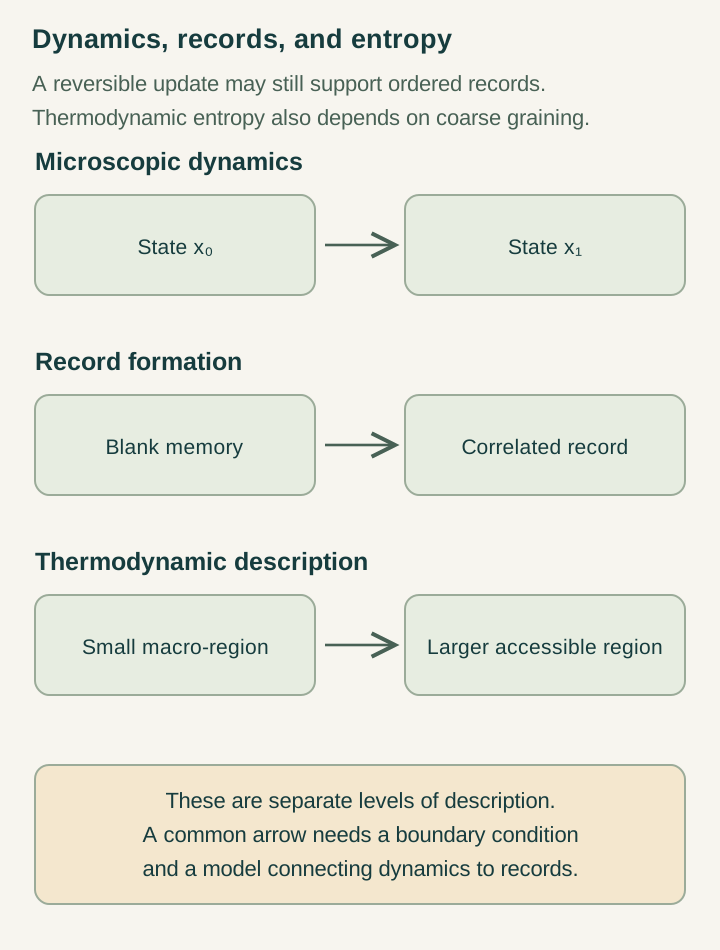
Take a system bit with probabilities one half for zero and one, and a memory initially fixed at zero. A reversible controlled copying operation maps (x,0) to (x,x). The memory’s marginal entropy grows from zero to log2, while the joint entropy remains log2. The final system and memory are correlated.
This worked example shows that a record can become available without increasing the fine-grained entropy of the closed joint description. It does not make record preparation thermodynamically free: initializing, protecting, and resetting memory require their own physical model. It prevents the simple identification of every new record with global entropy creation.
A monotone reduced functional needs explicit conditions
The article collection studies a reduced law q̇=J∇H−M∇Ψ, with antisymmetric J and positive semidefinite M. If the reversible term preserves Ψ, meaning ∇Ψ·J∇H=0, differentiation gives Ψ̇=−(∇Ψ)TM∇Ψ≤0. Antisymmetry alone does not supply that compatibility for arbitrary Ψ and H.
For Ψ=kq²/2 and scalar M=m>0 without a reversible term, q(t)=q0e−mkt and Ψ falls as e−2mkt. This is an exact descent example. Identifying Ψ with a thermodynamic free energy or relating its decrease to entropy requires a reservoir, temperature, and operational coarse graining.
Hidden dynamics can leave a calculable memory
In the published temporal-asymmetry model’s reading guide, observed x couples to hidden y through ẋ=−ax+by and ẏ=−λy+kx, with λ>0. Eliminating y produces a term bk∫0te−λ(t−s)x(s)ds, plus a contribution from y(0). The observed state remembers its history because x alone is incomplete.
The kernel’s existence does not guarantee relaxation: signs and magnitudes still matter. The published two-parameter formulation and the later nested six-role formulation must be compared through their actual variables and maps. Neither can inherit the other’s theorem simply because both use dual-time terminology.
Expansion need not produce comoving entropy
An ideal adiabatic radiation fluid has energy density proportional to T⁴ and entropy density proportional to T³. Conservation gives T proportional to a−1, so its entropy in a comoving volume, proportional to T³a³, remains constant while the universe expands. Expansion and positive entropy production are therefore distinct even in a simple cosmological model.
Real irreversible processes can generate entropy within an expanding universe, but their rates depend on interactions and nonequilibrium conditions. Explaining the overall arrow also requires a specification of the cosmological state and boundary conditions. A monotone scale factor cannot replace those ingredients.
A joint arrow from one source mechanism
A strong SMM/DTT construction would generate stable accessible memory and a justified reduced dynamics from one retained state. It would identify the origin of any low-entropy preparation, state where discarded information goes, and calculate when the observer’s record order aligns with thermodynamic relaxation.
The six nested inner roles can organize that dependence without becoming six independent entropy parameters. Outer completion should publish outcomes whose memory and energy costs are accounted for. A useful first result is a finite model in which record fidelity, entropy balance, and duration can all be computed, including the regime where recurrences or exhausted memory invalidate the effective arrow.
Continue with the articles
- The Principle of Ever-renewed Creation
Ever-renewed creation motivates an account of persistence through changing states. Update rules, invariants and retained memory show what SMM/DTT must specify for renewed records to support recognizable objects and continuous histories.
- Why recurrence alone does not select a future
Reversible recurrence admits both a return and its inverse, so a phase root alone cannot select the future. An observable arrow needs additional record, preparation, or clock structure.
- From available records to a temporal arrow
Completed returns that preserve or increase accessible records form a positive monoid. Under additional separation and clock conditions, this supplies an effective forward order without proving thermodynamic irreversibility.
- The information cost of preparing locality
Preparing a geometric memory with appreciable probability requires relative entropy when geometry is rare in the reference ensemble. The bound quantifies information resources without automatically identifying them with work or elapsed time.
- A monotone structural functional
A structural functional decreases when the reversible flow preserves it and the reduced response matrix is positive. This conditional Lyapunov result does not by itself identify the functional with thermodynamic entropy.
- Temporal asymmetry: reading the published model
The temporal-asymmetry model connects projected dynamics with memory and path dependence. A solvable hidden-mode example distinguishes those effects from dissipative stability and from evidence for a second observable clock.