
In this article
- The question behind this comparison
- The SMM/DTT starting point
- How the comparator works
- The decisive comparison
- Worked benchmark
- What follows for the source programme


Continual generation does not by itself select the negative pressure that accelerates an expanding universe. This comparison with quantum field theory vacuum calculates an illustrative acceleration threshold and fluid evolution, then asks how a DTT source action could determine a conserved equation of state and connect it to independently observable cosmological structure.
Dark energy names the component or effective modification used to account for the observed late-time expansion history within a cosmological model. A cosmological constant has pressure p=−u and constant energy density u. A dynamical component can have a changing equation-of-state ratio w=p/u, but expansion data constrain an integrated history rather than directly measuring an inner generative process.
DTT can ask whether the cost, retention or completion of source activity produces an effective negative pressure. Continual production alone does not determine that sign: ordinary matter creation can have many different stress-energy laws. The bridge must connect source dynamics to a conserved effective energy and pressure, then calculate distances and structure. The distinctive opportunity is to derive an equation of state or a relation among its evolution and other observables. [3] [4]
The Single Monad Model begins with one nonspatial generative source. The Duality of Time Theory distinguishes the source’s inner production from the outer order in which completed records become accessible. Its six inner levels are nested functional roles of one process: a higher role organizes lower-level work. The seventh is the completion or observation interface. They are neither six independent clocks nor six additional time coordinates.
This distinction supplies a useful research question: which features of an observed world can follow from the way a source produces, retains and releases information? A concrete answer needs a state space, an autonomous update, retained memory and a rule connecting completion to an accessible measurement. In the constructions discussed here, those mathematical ingredients are stated explicitly. A successful finite example establishes what its specified mechanism can do; further arguments connect it to physical particles, spacetime or universal laws. [1]
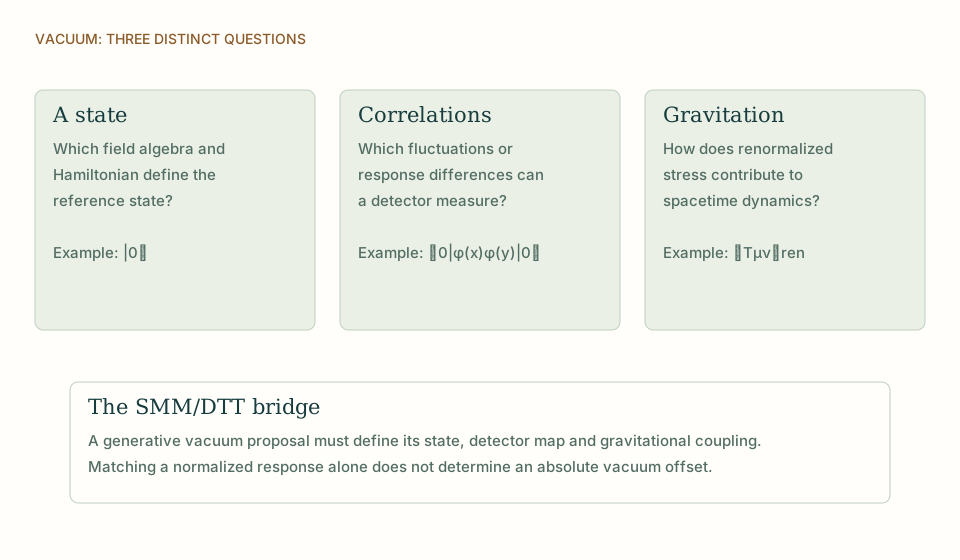
In quantum field theory a vacuum is a state associated with the field algebra and a choice of dynamics. In stationary settings it is often characterized as a lowest-energy or positive-frequency state. In curved or time-dependent spacetime, different physically motivated notions of particles need not select one universal vacuum. Correlation functions, detector responses and renormalized stress-energy are the quantities that connect this language with observations.
The SMM proposal goes one explanatory level deeper by treating the vacuum as an outcome of generative activity rather than as an already specified field state on an already specified geometry. That ambition is distinct from a standard vacuum calculation, but a proposed replacement must recover its operational content. A constant shift of the nongravitational Hamiltonian changes only an overall phase; a gravitational vacuum term requires a separate coupling and renormalization discussion. The word fluctuation refers to statistical properties of observables, not automatically to short-lived particles literally borrowing energy from nothing. [2]
A QFT vacuum can have a stress tensor of the form required for a cosmological constant, but a generic state or a collection of excitations need not have w=−1. DTT’s generative vacuum therefore needs more than the assertion that fluctuations persist. Its effective pressure follows from a physical stress tensor and how source energy responds to changes in the emergent volume.
The acceleration example makes the distinction operational. The same positive energy density accelerates or decelerates the scale factor depending on pressure, and a changing density requires a consistent conservation law. If inner completion produces an exchange between source and ordinary matter, that exchange must appear in both sectors rather than be hidden in a time-dependent Λ term. DTT could add a useful prediction by deriving the equation of state from one source action. Matching a local ground-state variance would not establish that result. The comparison thus identifies a concrete bridge from vacuum ontology to cosmology: a conserved tensor whose components yield the required negative pressure and whose perturbations remain compatible with the quantum field state. [2] [3] [4]
In a spatially flat illustrative cosmology with negligible radiation today, take Ωm=0.3 and ΩΛ=0.7. The acceleration equation gives the present deceleration parameter q₀=Ωm/2−ΩΛ=−0.55. Acceleration begins when the matter contribution equals twice the constant-energy contribution, so 1+zacc=(2ΩΛ/Ωm)^{1/3}. These illustrative numbers give zacc≈0.67.
The calculation is not a fit to the latest dataset; it displays which pressure law causes acceleration. For a separately conserved fluid with constant w, energy conservation gives u(a)=u₀a^{−3(1+w)}. Setting w=−1 leaves u unchanged, while w=−0.9 gives u∝a^{−0.3}. A DTT model becomes predictive when its source equations fix w or its variation and the same solution determines the measured expansion. Merely choosing w to match a preferred distance curve supplies a phenomenological cosmology rather than a derivation from the Monad. [3] [4]
a is normalized to one today. Ω values are illustrative dimensionless fractions; u and p are energy density and pressure in the same units.
Recent dark-energy analyses are best used as targets for model comparison, not as confirmation of a broad metaphysical picture. A dataset-dependent preference for an evolving equation of state does not identify its microscopic cause. The DTT programme gains specificity by fixing a conserved effective model before fitting and by asking whether that same model also predicts perturbation growth. The dedicated DESI research guide explains the dated evidence and the distinction between a fit and a physical mechanism. [3] [4]
THE SAME QUESTION, DIFFERENT STARTING POINTS
| Question | SMM/DTT | quantum field theory vacuum |
|---|---|---|
| Starting structure | One nonspatial source, retained memory and six nested inner functions with an outer completion interface. | Field algebra, state and dynamics; geometry is usually supplied. |
| Observable connection | The source update and readout must generate the measured records and their calibrated relations. | Correlation functions and detector or material response. |
| Dark energy and accelerated expansion | The acceleration example makes the distinction operational. | A QFT vacuum can have a stress tensor of the form required for a cosmological constant, but a generic state or a collection of excitations need not have w=−1. |
| Status of the claim | A constructive research programme; a specified finite model establishes only its stated conditional results. | Field-theoretic vacuum concepts vary with state and spacetime. |
KEEP THE CONNECTION
Connects this comparison with the author’s underlying construction.
Connects this comparison with the author’s underlying construction.
Connects this comparison with the author’s underlying construction.
Connects this comparison with the author’s underlying construction.
Places the comparison alongside the programme’s published results, assumptions and open targets.
References support the comparator and the specific mathematical or interpretive claims indicated. SMM/DTT connections are developed in the analysis above.
How these comparisons distinguish premises, results and physical claims
SMONAD
Share this page, or keep a clear reference to the work you are reading.
Use this reference for the explanation on this page. “n.d.” means its first publication date is not specified; the update date is recorded separately.