
In this article
- The question behind the comparison
- The single-source and nested-time proposal
- The comparator’s explanatory structure
- The precise agreement and difference
- Worked example: what follows and what does not
- What this comparison contributes


McTaggart’s argument does not depend on time being continuous. A finite or countably ordered sequence can still be described through earlier/later relations, and its members can still be assigned past, present and future positions. The comparison develops this distinction through a worked example and explains its implications for SMM/DTT’s nested generation, completed records and account of the observable world.
A discrete sequence can describe a continuous-looking process without deciding whether reality itself is discrete. Film frames, sampled signals and numerical time steps all illustrate the distinction between a representation and its represented object. DTT gives the distinction an ontological ambition: completed moments would arise from inner generative structure, while outer observation encounters an effectively continuous world. The central question is therefore what supplies continuity across completions. Merely making the steps very short does not explain how records remain related or why a particular smooth evolution appears.
Continuity has several meanings. A trajectory can be continuous in position, differentiable in velocity, continuous in quantum probability, or phenomenally continuous to an observer. These properties are logically separable. A sequence of quantum states connected by small unitary updates can approximate a differentiable evolution even though the update label is integer valued. A sequence of unrelated images can be shown equally quickly without generating the same temporal understanding. Persistent memory and lawful correlations do much of the explanatory work usually hidden by the phrase high refresh rate.
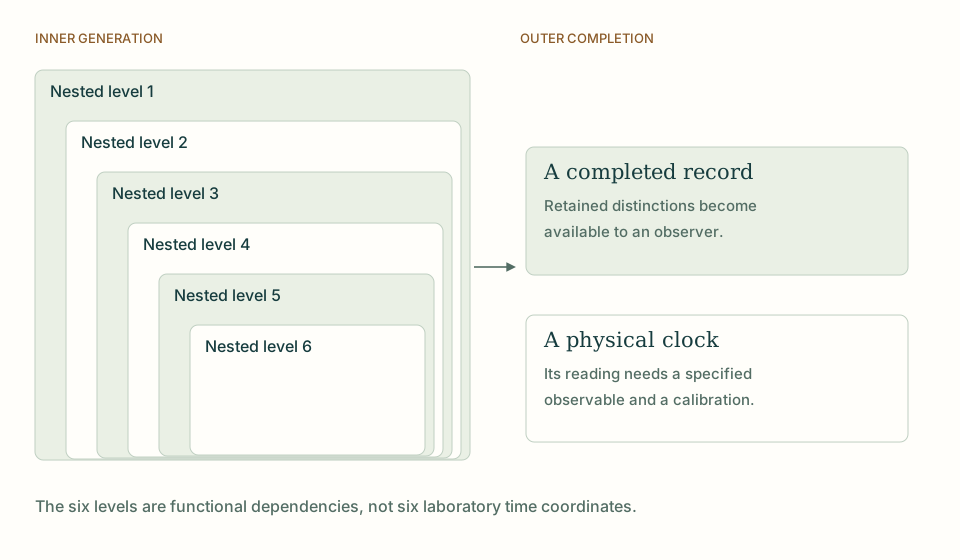
In SMM/DTT, the six nested inner levels should be understood as the organization within a completed moment, rather than six perceptual frames following one another. A physical account then needs both an internal completion map and a rule connecting successive completions. Otherwise one has described six ingredients of a snapshot without explaining motion. The constructive opportunity is to show how stable low-frequency observables emerge while rapidly varying inner distinctions remain inaccessible. That would make continuity a controlled limit with an error estimate instead of a visual analogy.
SMM begins with one nonspatial generative source. DTT distinguishes its inner production from the outer order in which completed results become accessible. The six inner levels are nested functional dependencies within that production; the seventh denotes outer completion. They are not six independent clocks, six spatial directions, or six simultaneously occupied temporal axes. This distinction makes the framework more specific than a general claim that everything changes: it asks how a world of persistent relations can be generated before its spatial representation is taken for granted. [2]
McTaggart distinguished tensed positions—past, present and future—from the relations earlier than and later than. His argument challenges the coherence of taking passage as a changing possession of incompatible temporal properties. For the comparison here, the distinction is a tool for asking what DTT’s completion adds to an ordered history. A sequence can be fully ordered without specifying which member is now present.
Consider a list of event labels A, B and C. The facts A precedes B and B precedes C do not change when a reader moves down the list. What changes is the reader’s relation to a particular entry. If a completion theory adds an objective change in actuality, it needs to say whether that change is another event, an irreducible feature of events, or a change in a meta-time. These alternatives expose the regress question without assuming that McTaggart’s conclusion is correct. His analysis is philosophical; it supplies no Hamiltonian, physical clock or information-processing mechanism. [1]
McTaggart’s argument does not depend on time being continuous. A finite or countably ordered sequence can still be described through earlier/later relations, and its members can still be assigned past, present and future positions. Consequently, replacing a continuum with DTT completion ticks does not by itself answer the A/B problem. It changes the granularity of the model, not the logical role of tense.
DTT adds an interesting possibility if discrete completion determines when an event can function as a record. The experienced continuity of passage would then require an observer whose memory integrates several completions. McTaggart’s categories help separate two claims: the continuity of that experience and the ontological passage of the events it concerns. A discrete sequence could support either an A-theoretic or a B-theoretic interpretation. The constructive gain is to model how the observer recognizes succession without presuming that successive samples are consciously unified. The philosophical gain is to avoid treating a very short timestep as a solution to an argument about temporal properties. [1]
For a finite-dimensional system with bounded Hamiltonian H, let one update be Uδ = exp(−iHδ/ℏ). After n updates the state is Uδⁿψ = exp(−iHnδ/ℏ)ψ. At the sampled times t = nδ this exactly agrees with ordinary unitary evolution. The integer n therefore does not by itself predict a new effect. An alternative update, an observable restriction between samples, or a physical limit on δ would be needed to distinguish a fundamentally discrete theory. This calculation also fixes the units: Hδ/ℏ is dimensionless. A dimensionless stage number becomes seconds only after a clock calibration or an independently derived timing law.
For experience, a different argument is required: an observer must integrate successive changes into an experienced event. The same word continuous should not make a mathematical limit do the work of a theory of perception. DTT can usefully connect the levels by modelling an observer as a record-bearing subsystem, whose accessible temporal resolution follows from its own dynamics. That is a stronger and more informative claim than saying that an invisible universal movie simply runs very quickly.
THE SAME QUESTION, DIFFERENT STARTING POINTS
| Question | SMM/DTT | McTaggart’s A-series and B-series |
|---|---|---|
| Explanatory starting point | A DTT completion can be counted as a discrete event while the observer’s accessible evolution is described by continuous variables. | Tensed positions and fixed earlier/later relations classify events without specifying their physical production. |
| Key distinction | Discrete updates reproduce ordinary unitary evolution at sampled times when each update is exp(−iHδ/ℏ); novelty requires an additional constraint. | McTaggart’s argument does not depend on time being continuous. |
KEEP THE CONNECTION
Connects this comparison with the author’s discussion of discrete.
Connects this comparison with the author’s discussion of discrete.
Connects this comparison with the author’s discussion of discrete.
Connects this comparison with the author’s discussion of discrete.
Connects this comparison with the author’s discussion of discrete.
References support the comparator and the specific mathematical or interpretive claims indicated. SMM/DTT connections are developed in the analysis above.
How these comparisons distinguish premises, results and physical claims
SMONAD
Share this page, or keep a clear reference to the work you are reading.
Use this reference for the explanation on this page. “n.d.” means its first publication date is not specified; the update date is recorded separately.