
In this article
- The question behind the comparison
- The single-source and nested-time proposal
- The comparator’s explanatory structure
- The precise agreement and difference
- Worked example: what follows and what does not
- What this comparison contributes


DTT’s completed present can be interpreted in either a presentist or a growing-block direction. If earlier physical configurations are no longer actual and only their current traces remain, renewal resembles presentism. The comparison develops this distinction through a worked example and explains its implications for SMM/DTT’s nested generation, completed records and account of the observable world.
The distinction between producing an event and having a record of it is the most useful entry into dual time. A measurement apparatus can undergo internal changes before a stable pointer value becomes available. Calling these two descriptions inner and outer is initially an explanatory distinction. The stronger DTT claim is that spatially articulated objects themselves emerge through such production, so the apparatus is already part of the resulting world rather than the ultimate source. The philosophical attraction is that becoming is placed in the constitution of events, not added afterwards to an already complete spatial inventory.
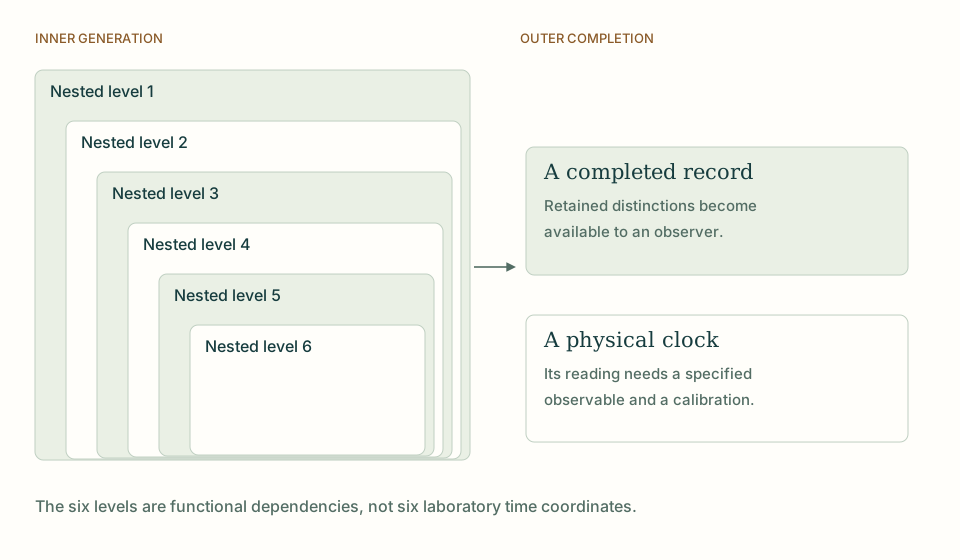
A clear account therefore separates three orders. Dependence orders the nested operations required for completion. Succession orders the accessible records. Duration compares changes with a physical clock. These orders need not coincide simply because the same symbol t appears in their description. Two operations may depend on one another without having separately measurable durations. Conversely, records may be separated by unequal clock intervals despite containing the same number of abstract updates. This distinction protects DTT from concealing a conventional external clock inside the word generation.
A constructive interpretation of the six levels treats later capabilities as presupposing earlier ones: a retained contrast can support a relation, and a sufficiently organized set of relations can support a spatial readout. That is a possible functional architecture, not a claim that any arbitrary six operations automatically make a universe. The explanatory burden is to identify operations, retained memory and a completion condition together. When those ingredients are specified, inner time can acquire content through which partial histories it distinguishes and outer time through which records it exposes.
SMM begins with one nonspatial generative source. DTT distinguishes its inner production from the outer order in which completed results become accessible. The six inner levels are nested functional dependencies within that production; the seventh denotes outer completion. They are not six independent clocks, six spatial directions, or six simultaneously occupied temporal axes. This distinction makes the framework more specific than a general claim that everything changes: it asks how a world of persistent relations can be generated before its spatial representation is taken for granted. [2]
Presentism restricts concrete temporal existence to the present; the growing-block view includes the past and present while excluding the future. The distinction is decisive for a record-based ontology. A present record of yesterday and yesterday’s continuing existence are different claims. Broad’s treatment of becoming supplies the historical growing-block comparator; the presentist alternative sharpens what an archive does and does not establish.
Suppose a stone bears an inscription describing a vanished ceremony. A presentist can treat the inscription as a current object with a history. A growing-block theorist can additionally include the ceremony itself in reality. Both can agree about what the inscription says. The disagreement therefore cannot be settled by pointing to a stored record alone. SMM/DTT gains precision by stating whether renewal preserves past events, preserves only present traces, or uses another form of persistence. Relativity adds the separate question of how a privileged present, if proposed, relates to spatially separated events. [1]
DTT’s completed present can be interpreted in either a presentist or a growing-block direction. If earlier physical configurations are no longer actual and only their current traces remain, renewal resembles presentism. If completed events themselves remain part of reality while new ones are added, the result resembles a growing block. The existence of source memory does not decide the issue: memory is a feature of a current state unless the ontology grants its represented past independent existence.
The inner/outer distinction adds something different from either position. It asks how a configuration becomes eligible for the status that the ontology calls present or past. This could provide a mechanism of actualization rather than only a rule about what exists. Its explanatory force depends on whether the completion condition is intrinsic to the source dynamics. A controller that simply announces a new present supplies no such explanation. The comparison therefore supports a precise DTT choice: distinguish the law producing records from the further commitment concerning the reality of completed history. [1]
Consider an idealized detector with a two-step preparation followed by registration. Its internal path is blank → armed → latched, while the public display changes only at the last transition. If the detector can be delayed while armed, the public record count remains unchanged even though the physical clock advances. Thus a completion count and a clock interval are independent measurements. If a proposed source law fixes their ratio without adjusting the detector separately, that is a substantive relation. If one simply defines a second time to be twice the first, the relation is a convention. The example is intentionally modest: it identifies what a dual-time mechanism must add beyond a two-stage description, without claiming that a laboratory detector is the Single Monad.
This makes the comparison answerable in a precise way. A framework may agree that events possess an internal explanatory structure while denying that this structure is temporal in the same sense as measured duration. It may also agree about record order while disagreeing about whether unrecorded possibilities already exist. The productive DTT contribution is to connect these questions through completion. Its strongest mathematical development would specify which differences among inner histories survive as different outer correlations, and which are unobservable descriptions of the same process.
THE SAME QUESTION, DIFFERENT STARTING POINTS
| Question | SMM/DTT | Presentism and the growing-block universe |
|---|---|---|
| Explanatory starting point | Inner time orders the source operations that produce an event; outer time orders the completed records available to observers. | Presentism and the growing block disagree over whether past events themselves remain real. |
| Key distinction | Different inner histories count as physically different only when their difference survives in a specified accessible correlation. | DTT’s completed present can be interpreted in either a presentist or a growing-block direction. |
KEEP THE CONNECTION
Connects this comparison with the author’s discussion of inner.
Connects this comparison with the author’s discussion of inner.
Connects this comparison with the author’s discussion of inner.
Connects this comparison with the author’s discussion of inner.
Connects this comparison with the author’s discussion of inner.
References support the comparator and the specific mathematical or interpretive claims indicated. SMM/DTT connections are developed in the analysis above.
How these comparisons distinguish premises, results and physical claims
SMONAD
Share this page, or keep a clear reference to the work you are reading.
Use this reference for the explanation on this page. “n.d.” means its first publication date is not specified; the update date is recorded separately.