
In this article
- Three questions that should remain distinct
- The source and its two temporal roles
- Worked role of antiunitarity
- What a CPT statement constrains
- Matter–antimatter asymmetry needs dynamics
- A disciplined connection to observation


The direction in which records accumulate is different from the discrete symmetry tested by time reversal and CPT. This comparison explains the antiunitary role of time reversal, states what CPT relates under its field-theoretic assumptions, and identifies what a DTT source model must derive before claiming a matter–antimatter consequence.
A thermodynamic arrow concerns the statistical direction of processes. A record arrow concerns the ordering and persistence of accessible memories. The T operation in quantum theory is a symmetry transformation with a particular action on states, observables and complex amplitudes. These concepts can be related, but none is a synonym for the others.
The CPT theorem concerns the combined charge-conjugation, parity and time-reversal operation under the appropriate relativistic local quantum-field assumptions. It does not assert that C, P or T separately must be symmetries. DTT can use temporal asymmetry as a source idea, but a claim about CPT requires an effective field theory and an explicit transformation law. [2]
The Single Monad Model begins with one nonspatial generative source. The Duality of Time Theory distinguishes the source’s inner production from the outer order in which completed records become accessible. Its six inner levels are nested functional roles of one process: a higher role organizes lower-level work. The seventh is the completion or observation interface. They are neither six independent clocks nor six additional time coordinates.
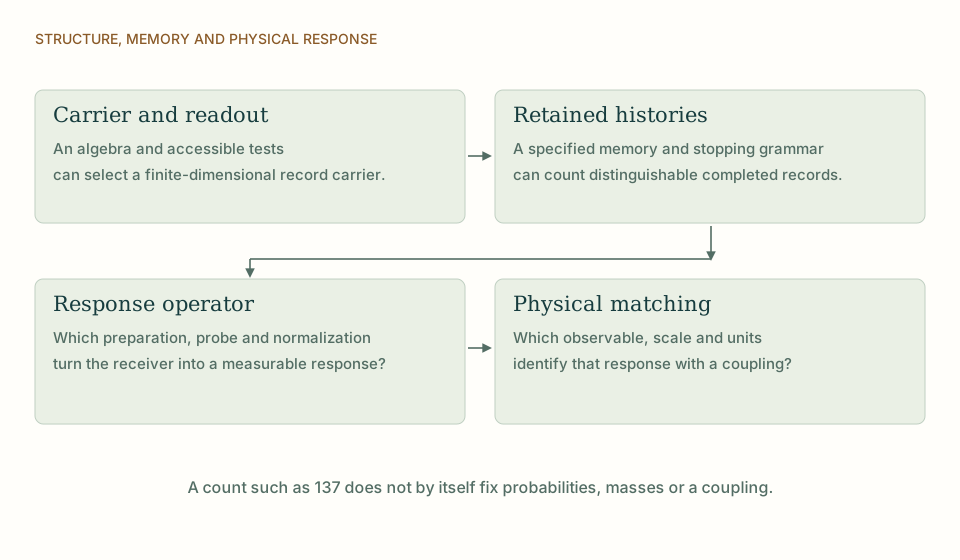
This distinction supplies a useful research question: which features of an observed world can follow from the way a source produces, retains and releases information? A concrete answer needs a state space, an autonomous update, retained memory and a rule connecting completion to an accessible measurement. In the constructions discussed here, those mathematical ingredients are stated explicitly. A successful finite example establishes what its specified mechanism can do; further arguments connect it to physical particles, spacetime or universal laws. [1]
Let U(t)=exp(−iHt/ℏ). A time-reversal operator Θ is antiunitary, so ΘiΘ⁻¹=−i. If the Hamiltonian is T-invariant, ΘHΘ⁻¹=H. Applying Θ to the evolution gives ΘU(t)Θ⁻¹=exp(+iHt/ℏ)=U(−t). The conjugation of i is essential to that identity.
This does not mean that the ordinary scalar i is a physical clock moving backward. It shows how the quantum symmetry acts on amplitudes. Replacing i with a split-complex unit j changes the algebra and does not reproduce the theorem by notation. A DTT model that uses hyperbolic temporal geometry must provide a separate map to the antiunitary symmetry of its observed quantum fields. [2] [3]
The identity assumes T invariance of H; CPT invariance does not by itself imply separate T invariance.
Within its applicable setting, CPT relates particle and antiparticle properties and appropriately transformed processes. The theorem rests on structural assumptions such as relativistic covariance, locality and the quantum-field framework, with the precise hypotheses depending on the formulation. A proposed violation must identify which assumption fails or how the effective theory lies outside that scope.
A source with a preferred inner ordering might still yield an effective CPT-invariant field theory, just as hidden bookkeeping need not appear in accessible observables. Conversely, breaking an internal exchange symmetry is not automatically a measurable CPT violation. The source-to-field dictionary must show how the exchanged variables correspond to particle, parity and time-reversed observables. This is where a mathematical temporal asymmetry becomes a physical symmetry claim. [2] [4]
A universe containing unequal matter and antimatter abundances poses a cosmological dynamical problem. It is not solved merely by observing that completed records have a direction. A model must specify the relevant charges, interactions, initial or boundary conditions and the processes that generate or preserve an asymmetry.
DTT’s single-source programme could contribute a common origin for those ingredients, but six nested roles alone do not determine a baryon-number violation rate, a CP-violating phase or a cosmological departure from equilibrium. If a proposed temporal interchange creates distinct vacuum sectors, their physical charges and transition probabilities remain to be derived. This is a positive research target: connect a source symmetry-breaking pattern to an effective action and calculate an abundance or scattering relation that can be checked. [2] [5]
An effective DTT model can first be tested for ordinary symmetry consistency: which operators implement C, P and T, which Hamiltonian terms transform, and which quantities remain invariant? These questions are finite and calculable in a specified model. They should precede claims that every arrow of time predicts unequal particle masses or altered antimatter gravity.
The deeper source interpretation can still be innovative when it explains why a symmetry exists or why a particular breaking term is selected. Its predictive value is the resulting coefficient or relation among observables, not the word asymmetry. The comparison therefore preserves DTT’s interest in temporal origin while using CPT as a precise structural benchmark that prevents distinct notions of direction from being conflated. [2] [4]
THE SAME QUESTION, DIFFERENT STARTING POINTS
| Question | SMM/DTT | CPT theorem |
|---|---|---|
| Temporal arrow | A DTT archive can have an accumulation direction without violating microscopic T or CPT. | CPT is a combined symmetry theorem with specific field-theoretic hypotheses. |
| Quantum phase | A source model must recover the antiunitary transformation of ordinary complex amplitudes. | Time reversal conjugates i; it is not a replacement by a split-complex unit. |
| Matter asymmetry | A physical asymmetry requires charges, interactions and a calculated cosmological history. | CPT alone does not determine the universe’s matter abundance. |
KEEP THE CONNECTION
Connects this comparison with the author’s underlying construction.
Connects this comparison with the author’s underlying construction.
Connects this comparison with the author’s underlying construction.
Connects this comparison with the author’s underlying construction.
Connects the comparison to the programme’s current statement of results and assumptions.
References support the comparator and the specific mathematical or interpretive claims indicated. SMM/DTT connections are developed in the analysis above.
How these comparisons distinguish premises, results and physical claims
SMONAD
Share this page, or keep a clear reference to the work you are reading.
Use this reference for the explanation on this page. “n.d.” means its first publication date is not specified; the update date is recorded separately.