C001Time and becoming
Inner generation is not simply McTaggart’s A-series, and outer observation is not simply his B-series. The A/B distinction classifies ways of ordering or qualifying events; DTT distinguishes the constitution of an event from its completed accessibility. The comparison develops this distinction through a worked example and explains its implications for SMM/DTT’s nested generation, completed records and account of the observable world.
Comparative article · 6 min read↗
C002Time and becoming
DTT’s completed present can be interpreted in either a presentist or a growing-block direction. If earlier physical configurations are no longer actual and only their current traces remain, renewal resembles presentism. The comparison develops this distinction through a worked example and explains its implications for SMM/DTT’s nested generation, completed records and account of the observable world.
Comparative article · 5 min read↗
C003Time and becoming
A block universe can contain an ordered sequence of all completed records, including every observer’s changing knowledge. DTT’s claim that records arise through inner production is therefore not contradicted merely by representing those records as a spacetime whole. The comparison develops this distinction through a worked example and explains its implications for SMM/DTT’s nested generation, completed records and account of the observable world.
Comparative article · 6 min read↗
C004Time and becoming
Thermal time and DTT both challenge the idea that a universal time parameter must be supplied before the physical system is described. The comparison develops this distinction through a worked example and explains its implications for SMM/DTT’s nested generation, completed records and account of the observable world.
Comparative article · 6 min read↗
C005Time and becoming
DTT’s inner and outer time refer to production and completion; the two-state formalism’s dual description refers to preparation and postselection around an intermediate quantum event. The comparison develops this distinction through a worked example and explains its implications for SMM/DTT’s nested generation, completed records and account of the observable world.
Comparative article · 5 min read↗
C006Time and becoming
Whitehead’s distinction between an occasion’s becoming and its achieved determination is one of the closest philosophical analogues of inner generation and outer completion. The comparison develops this distinction through a worked example and explains its implications for SMM/DTT’s nested generation, completed records and account of the observable world.
Comparative article · 5 min read↗
C121Quantum theory and records
Correlations across a sequence of measurements can reveal memory that a single final state conceals. This comparison with standard Hilbert-space quantum mechanics examines what DTT’s inner generation adds to that process, calculates a two-time qubit correlation, and distinguishes a real source-memory mechanism from merely introducing another time label.
Comparative article · 6 min read↗
C122Quantum theory and records
Correlations across a sequence of measurements can reveal memory that a single final state conceals. This comparison with Everett many-worlds interpretation examines what DTT’s inner generation adds to that process, calculates a two-time qubit correlation, and distinguishes a real source-memory mechanism from merely introducing another time label.
Comparative article · 5 min read↗
C123Quantum theory and records
Correlations across a sequence of measurements can reveal memory that a single final state conceals. This comparison with Bohmian mechanics examines what DTT’s inner generation adds to that process, calculates a two-time qubit correlation, and distinguishes a real source-memory mechanism from merely introducing another time label.
Comparative article · 5 min read↗
C124Quantum theory and records
Correlations across a sequence of measurements can reveal memory that a single final state conceals. This comparison with relational quantum mechanics examines what DTT’s inner generation adds to that process, calculates a two-time qubit correlation, and distinguishes a real source-memory mechanism from merely introducing another time label.
Comparative article · 6 min read↗
C125Quantum theory and records
Correlations across a sequence of measurements can reveal memory that a single final state conceals. This comparison with QBism examines what DTT’s inner generation adds to that process, calculates a two-time qubit correlation, and distinguishes a real source-memory mechanism from merely introducing another time label.
Comparative article · 5 min read↗
C126Quantum theory and records
Correlations across a sequence of measurements can reveal memory that a single final state conceals. This comparison with objective collapse models examines what DTT’s inner generation adds to that process, calculates a two-time qubit correlation, and distinguishes a real source-memory mechanism from merely introducing another time label.
Comparative article · 6 min read↗
C145Quantum theory and records
Ordinary quantum phase and hyperbolic time transformations preserve different mathematical structures. Comparing DTT with standard Hilbert-space quantum mechanics, this article works through real rotation and boost generators, explains how real dynamics can select a complex structure, and identifies the further steps connecting that result to observable quantum physics.
Comparative article · 5 min read↗
C146Quantum theory and records
Ordinary quantum phase and hyperbolic time transformations preserve different mathematical structures. Comparing DTT with Everett many-worlds interpretation, this article works through real rotation and boost generators, explains how real dynamics can select a complex structure, and identifies the further steps connecting that result to observable quantum physics.
Comparative article · 5 min read↗
C147Quantum theory and records
Ordinary quantum phase and hyperbolic time transformations preserve different mathematical structures. Comparing DTT with Bohmian mechanics, this article works through real rotation and boost generators, explains how real dynamics can select a complex structure, and identifies the further steps connecting that result to observable quantum physics.
Comparative article · 6 min read↗
C148Quantum theory and records
Ordinary quantum phase and hyperbolic time transformations preserve different mathematical structures. Comparing DTT with relational quantum mechanics, this article works through real rotation and boost generators, explains how real dynamics can select a complex structure, and identifies the further steps connecting that result to observable quantum physics.
Comparative article · 5 min read↗
C149Quantum theory and records
Ordinary quantum phase and hyperbolic time transformations preserve different mathematical structures. Comparing DTT with QBism, this article works through real rotation and boost generators, explains how real dynamics can select a complex structure, and identifies the further steps connecting that result to observable quantum physics.
Comparative article · 5 min read↗
C150Quantum theory and records
Ordinary quantum phase and hyperbolic time transformations preserve different mathematical structures. Comparing DTT with objective collapse models, this article works through real rotation and boost generators, explains how real dynamics can select a complex structure, and identifies the further steps connecting that result to observable quantum physics.
Comparative article · 6 min read↗
C362Connections across theories
DTT describes six nested inner functional levels and an outer completion role. Higher-dimensional physics adds coordinate or internal geometric structure of a different kind. This comparison explains where the mathematics of fibers and compact modes can help, and why counting functional levels as extra time axes changes the theory being proposed.
Comparative article · 5 min read↗
C367Connections across theories
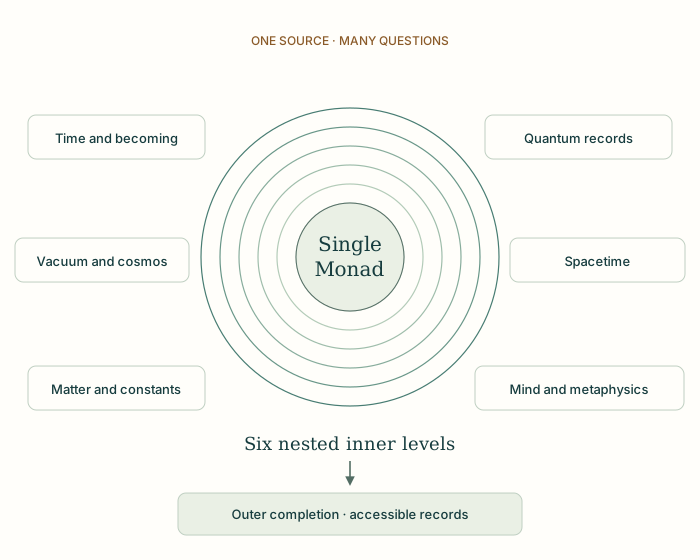
SMM/DTT’s six nested inner levels and seventh outer completion can be read as a grammar of formation. This essay distinguishes that structural claim from seven equal clock intervals, explains how nested dependencies differ from a simple cycle, and shows what a discrete model can establish about closure, repetition and retained history.
Comparative article · 5 min read↗
C369Connections across theories
Two devices can leave exactly the same visible state yet behave differently at the next intervention. This article demonstrates that fact with a two-swap memory model, explains the process-tensor description, and shows how DTT’s distinction between inner retention and outer records can become a concrete operational claim.
Comparative article · 5 min read↗
C374Connections across theories
The forward and backward branches of a closed-time contour are a calculation of one physical quantum process. This article derives their origin from density-matrix evolution, explains their usefulness for DTT source models, and distinguishes contour bookkeeping, thermodynamic arrows and genuinely different operational roles for generation and completion.
Comparative article · 5 min read↗
C376Connections across theories
A quantum history contains ordered alternatives and the operations connecting them. This comparison explains how history amplitudes differ from a classical list of past events, works through the failure of naive probability addition, and identifies the source-memory structure DTT would need to make temporal entanglement a precise physical claim.
Comparative article · 5 min read↗
C377Connections across theories
A globally stationary quantum state can contain evolving correlations relative to a clock subsystem. This article derives the conditional Schrödinger equation in the ideal clock model, explains the limits of a finite clock, and compares relational time with DTT’s distinct task of producing and releasing completed physical records.
Comparative article · 5 min read↗