One source, many materials: precision tests of equivalence
A common source of matter and time would be physically powerful if it forced different materials to respond to the same gravity. Precision tests already make that universality a demanding requirement. This guide explains what MICROSCOPE measured, separates free fall from clock redshift, and shows how a source-derived extra coupling would become a quantitative test.
The weak equivalence principle compares the free-fall acceleration of bodies with different composition. MICROSCOPE used differential accelerometers in a drag-free satellite to compare titanium-alloy and platinum-alloy test masses. Its published final result was η(Ti,Pt)=[−1.5±2.3(stat)±1.5(syst)]×10⁻¹⁵, with the statistical uncertainty stated at one standard deviation. No violation was found in that measurement.
This is a specific experimental result, not a universal bound on every possible DTT correction. The tested observable is composition-dependent differential acceleration under the mission's conditions. A clock-redshift anomaly or a high-energy dispersion coefficient is a different quantity and requires its own mapping to data. [1]
02Worked Eötvös parameter
For two nearly equal accelerations aA and aB along the measured direction, define η=2(aA−aB)/(aA+aB). If aA=g(1+εA) and aB=g(1+εB), with both corrections small, then η≈εA−εB. A common correction cancels to first order; a difference between materials is what the experiment isolates.
For an illustrative g≈8 m s⁻², a differential fraction of 10⁻¹⁵ corresponds to an acceleration difference of about 8×10⁻¹⁵ m s⁻². This is only a scale illustration, not a reconstruction of the mission's full analysis. The actual result includes orbital modulation, instrument response and systematic effects. The calculation explains why a source model must predict composition dependence rather than merely claim a universal change of gravitational strength. [1]
η=2(aA−aB)/(aA+aB)≈εA−εB; |Δa|≈g|η|.
Accelerations are projected onto the measured direction. The numerical g is illustrative, and the small-correction expansion is first order.
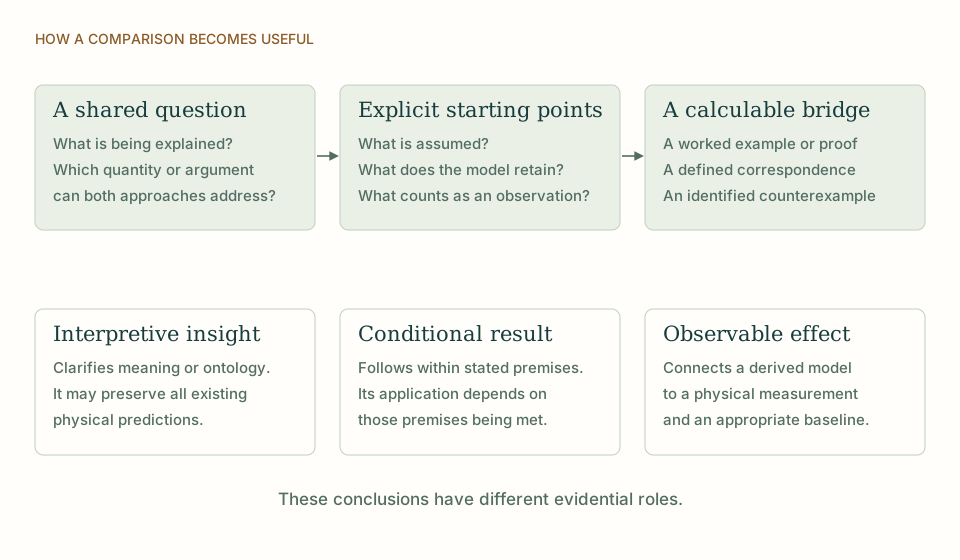
A comparison that reaches a definite conclusion. Begin with the same question, identify what each approach assumes, and compare a shared result. An interpretation, a conditional theorem and an observable deviation have different evidential roles. View full size ↗
03Why source unity does not automatically prove universality
SMM/DTT can frame this universality as a common origin of clock production and motion. The same nested generative process would determine both a completed material transition and the geometry against which that transition is compared. The seventh, outer role is the readable clock record; the six inner levels are not six separately observable clocks.
The constructive issue is protection. If the model simply assigns each species a frequency ωₛ and rescales it by a chosen function of potential, universal redshift has been assumed. A stronger model derives a common multiplicative response from a symmetry or a shared conserved source quantity, while allowing different transition energies. That would explain how clocks differ in their natural periods yet agree on elapsed proper time after calibration.
04A source-induced scalar coupling as an example
Suppose an illustrative dimensionless field φ changes a body's mass according to ms(φ)=ms0[1+dsφ], with a species-dependent coefficient ds. In a slow-motion weak-field approximation, the spatial gradient of its rest energy can contribute an extra acceleration approximately −c²ds∇φ. Two materials then differ through dA−dB.
This is not a DTT law. It is an example of how a source-generated extra variable would become observable. Even if all matter originates from one source, its effective coefficients can differ because composite bodies contain different fractions of electromagnetic, nuclear and other binding energies. A universality theorem must constrain those effective responses, not only the elementary source label.
If the source forces all relevant ds to be equal, the composition-dependent signal vanishes in this approximation. That is a substantive prediction of universality if it is derived and protected under interactions. If the source predicts a difference, the experiment constrains that difference multiplied by the actual field gradient, not ds alone.
ms(φ)=ms0(1+dsφ) ⇒ aextra≈−c²ds∇φ in the stated approximation.
φ and ds are dimensionless; ∇φ has inverse-length units. The expression neglects higher-order velocity, time-dependence and backreaction effects.
05A different observable: gravitational clock redshift
Take two identical stationary clocks separated vertically by h=1 m in a weak approximately uniform field g=9.81 m s⁻². To first order, the fractional frequency difference is gh/c². Using c≈3.00×10⁸ m s⁻¹ gives 1.09×10⁻¹⁶. Over one day this corresponds to about 9.4 picoseconds of differential elapsed time; the higher clock runs faster in this convention.
An illustrative nonuniversal model replaces the factor by (1+βₛ)gh/c² for clock species s. Comparing two species isolates (βₐ−βᵦ)gh/c² rather than the shared metric term. β is a phenomenological parameter here, not a DTT prediction. The calculation shows why a common source must constrain relative couplings: a universal rescaling can be absorbed into calibration, whereas species differences have observable content. [2][1]
Δν/ν≈ΔΦ/c²≈gh/c²=1.09×10⁻¹⁶ for h=1 m.
Weak-field, stationary-clock approximation; Φ is gravitational potential in m² s⁻². βₛ would be dimensionless.
06Free fall and clock universality are related but distinct
Free-fall tests compare trajectories of material bodies. Clock tests compare transition frequencies and their dependence on potential, motion or composition. A theory can satisfy one relation while modifying another unless its structure links them. DTT's strongest opportunity is precisely such a link: the same source law could determine both matter inertia and the rate of completed clock transitions.
Six nested inner levels should therefore produce more than a common narrative. They should constrain the effective couplings of different energy contributions and explain why those constraints survive coarse-graining. A model that reproduces one atomic redshift by choosing its oscillator frequency has not proved universal free fall. Conversely, a null differential-acceleration result does not determine the behavior of every quantum clock. [2]
07What would count as progress for DTT
A valuable source result would calculate either a protected zero for composition-dependent response or a fixed relation among several nonzero coefficients. It would identify which material properties enter and how the same parameters affect clock comparisons. Such a model can be tested against existing data without requiring a speculative new experiment.
The comparison is therefore constructive rather than merely restrictive. Precision equivalence tests identify a universal relation that a common-source theory has a natural reason to address. Explaining that relation from one autonomous dynamics would be a stronger achievement than claiming generic time-dilation anomalies without a material response calculation.
THE SAME QUESTION, DIFFERENT STARTING POINTS
The comparison at a glance
Question
SMM/DTT
MICROSCOPE and differential clock tests
Common origin
The source must constrain effective couplings of different material energy components.
A null free-fall test constrains composition-dependent acceleration.
Clock response
Outer completion should yield a universal calibrated transition law.
Clock redshift tests probe different combinations from differential accelerometry.
Prediction
A derived zero or fixed cross-observable relation can be meaningful.
Experimental bounds apply to the specified observable and source environment.
KEEP THE CONNECTION
Key ideas
The source must constrain effective couplings of different material energy components.
Outer completion should yield a universal calibrated transition law.
A derived zero or fixed cross-observable relation can be meaningful.
Develops the source construction or operational distinction used in this comparison.
Sources and further reading
References support the comparator and the specific mathematical or interpretive claims indicated. SMM/DTT connections are developed in the analysis above.