A hidden relaxation mode predicts linked amplitude attenuation and phase lag across frequency. A joint response measurement can constrain that mode, while a distinctive DTT interpretation requires a source-selected relation.
A relaxing hidden variable leaves a calculable frequency-dependent trace in the observed response. Measuring both amplitude and phase can constrain its relaxation rate and expose multimode alternatives. For SMM/DTT, the useful next step is a source-selected relation among those responses; the existence of a generic phase lag alone does not distinguish the temporal interpretation.
02A hidden mode has a frequency-dependent response
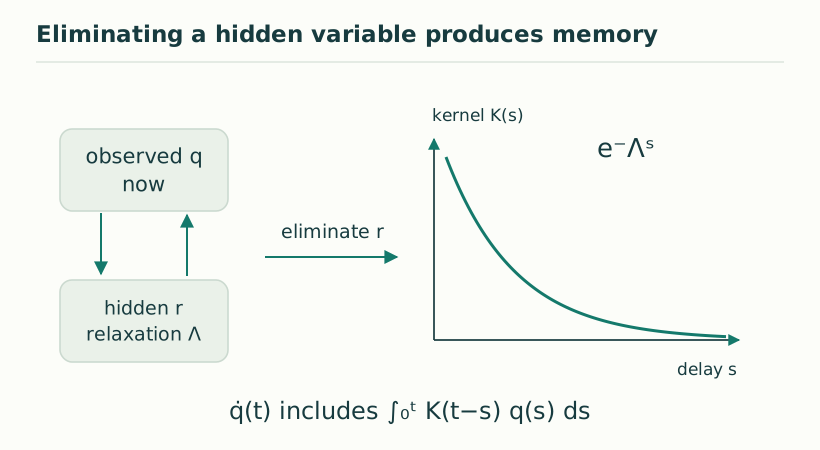
Drive a linear observable at frequency ω and let its hidden companion relax at rate λ. Solving the hidden equation in frequency space produces a factor 1/(λ+iω) for the convention e^(iωt). At low frequency the response follows almost instantaneously; at high frequency it is attenuated and lags. This is the measurable counterpart of the exponential memory kernel. It is a familiar relaxation mechanism, so a DTT interpretation needs more than the observation of a lag alone.
Figure 1. Eliminating a hidden variable produces memory. For a linear relaxing hidden sector, substitution produces a Volterra memory term. An exponentially decaying kernel is the simplest example; its fast limit can yield local effective dissipation under additional assumptions. View full size ↗
03Deriving amplitude and phase
For a forcing f(t)=Re[f₀e^(iωt)] in ṙ+λr=f(t), the steady response is r₀=f₀/(λ+iω). Its amplitude relative to the zero-frequency response is λ/√(λ²+ω²), and its phase is −arctan(ω/λ). At ω=λ the amplitude is reduced by 1/√2 and the lag is 45 degrees. Initial transients decay as e^(−λt), so a steady-frequency measurement must wait long enough or explicitly include that transient in the fit.
r₀/f₀=(λ+iω)⁻¹
relative amplitude=[1+(ω/λ)²]^(−1/2)
phase lag=−arctan(ω/λ)
04A reproducible response comparison
Measure both in-phase and quadrature components over a frequency sweep, then fit one λ to both curves. Repeat with different drive amplitudes to test linearity and with different initial preparations to detect hidden transients. An independent calibration of detector and cable delay is necessary because a fixed instrumental delay contributes a phase proportional to frequency. A single-point fit cannot reliably distinguish that delay from relaxation. The full frequency dependence and its consistency across preparations carry the useful information.
05What would make the signature specific to DTT
The model becomes discriminating if a source derivation predicts λ, coupling strength, or relationships between several channels from the same completion mechanism. Otherwise it is a flexible hidden-response description shared by many ordinary systems. A proposed linewidth change should be computed from the full observable susceptibility, including its coupling and baseline dynamics; the hidden factor alone does not determine every resonance width. Connecting phase-lag crossover to SMM/DTT therefore requires a physical map from generative variables to an independently defined apparatus, with competing relaxation mechanisms explicitly compared.
06Several hidden modes broaden the crossover
If Λ has several positive eigenvalues, the response is a weighted sum of factors 1/(λ_a+iω) rather than one ideal relaxation curve. A broad distribution can mimic fractional memory over a finite band. Measuring a single apparent power law therefore does not uniquely identify a fractal clock or a dual-time gauge sector. A useful analysis estimates how many response scales are actually resolved and checks whether the same spectral weights explain both amplitude and phase. For SMM/DTT this offers a connection between the memory-kernel and renewal-clock descriptions, while leaving their microscopic equivalence as a theorem to be proved rather than an assumed identity.
07Interpretation of an irreversible reduced law
A reduced equation can lose predictive information because several larger states share one observed state. That does not make projection alone a universal source of thermodynamic entropy. Positive hidden relaxation, a chosen initial condition or reservoir, and a condition on the reversible flow do essential work in this model. The structural functional Ψ is not automatically Boltzmann, Gibbs or von Neumann entropy. Connecting its decay to a laboratory second law requires an operational coarse-graining, thermodynamic variables and calibrated coefficients. This qualification preserves the useful mechanism while preventing a model-level monotonicity theorem from being mistaken for an unconditional derivation of time’s arrow.
A finite closed Hamiltonian system preserves information globally and can display recurrences. Replacing some of its degrees of freedom by a permanently relaxing operator requires a specified approximation, reservoir or limiting regime. The exactness claimed for hidden-variable elimination is exactness relative to the supplied coupled equations, including their positive relaxation operator. It is not an independent proof that those equations follow from a conservative temporal action. A source-based derivation should track where the discarded information resides and over which interval the reduced dissipative description remains accurate.
KEEP THE CONNECTION
Key ideas
An exponential kernel produces a calculable amplitude and phase crossover.
Scope of the argument. Generic linear-response consequence of the stated relaxation model; not a unique empirical signature of dual time.
Sources & further reading
dual_time_entropy_v4.pdf — working draftpp. 16–17 and 21–25, hidden-response equations and toy models; frequency response derived here
Source editions and catalogue entries
Working manuscript
A Dual-Time Gauge Model for Projection-Induced Memory and Irreversibility
Working manuscript. Article-level references identify the consulted sections and the scope of the interpretation. No public URL was supplied for this exact manuscript version.