A045Public article topicExpanded article5 min read
The Intertwined Days
Intertwined days organize temporal information through interleaving. An indexing model shows what a rearrangement preserves and why a quantum completion process additionally needs phase, probability and predictive consistency.
01Intertwining as a reorganization of temporal information
The source reconstructs a creative day from hours distributed across the observable week, using seven-hour intervals in its worked example. It presents tables for individual days and the complete arrangement. The key interpretive distinction is between the order in which hours are encountered and the order in which they are grouped. Intertwining therefore concerns an organized distribution across a larger cycle; it need not mean that time literally folds into a visible knot.
02A familiar example of interleaving
Imagine three messages, each consisting of four symbols. A transmitter sends the first symbol of every message, then the second of every message, and so on. A receiver initially encounters A₁, B₁, C₁, A₂, B₂, C₂. After sorting by message label, it recovers A₁, A₂, A₃, A₄ and the analogous B and C sequences.
Nothing has traveled backward in time. There are two valid orderings of the same collection: transmission order and reconstructed message order. This provides a precise conceptual analogy for why one might distinguish encountered succession from a grouping that is not locally obvious.
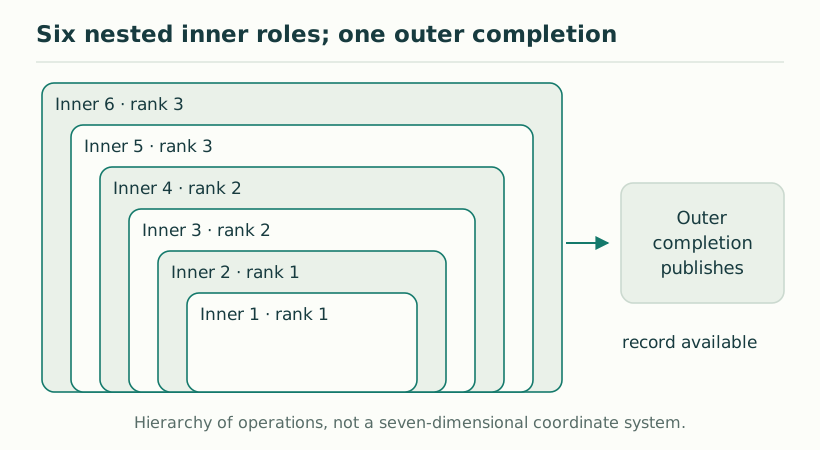
Figure 1. Six nested inner roles; one outer completion. The six inner roles are nested functional stages with readout ranks 1, 1, 2, 2, 3, 3. The outer completion publishes the resulting record. These are not seven independent time axes. View full size ↗
03Indexing the arrangement
Write each item as h(d,k), where d labels its group and k its position within that group. An observation schedule σ maps each successive record number n to a pair (d,k). If σ is one-to-one over a complete cycle, the received sequence can be rearranged without losing information. If it is many-to-one or omits entries, reconstruction requires additional assumptions.
The important property is not the visual intricacy of a grid but whether its indexing rule is complete, unambiguous and invertible where required. These conditions can be checked directly for any proposed temporal table.
04Relation to DTT completion
DTT distinguishes inner operations from completed outer records. A single record may combine contributions generated in different inner stages; conversely, one retained inner structure might influence several later records. Interleaving is therefore a helpful organizational example. It shows why the order of ingredients need not be identical to the order in which complete outcomes become accessible.
The six inner stages should still be understood as nested roles. An interleaving diagram does not license six separate laboratory times, nor does rearranging labels create spatial dimensions. Those dimensions require relations among the completed records and a demonstration of the geometry they support.
05Coherence requires more than bookkeeping
Reordering classical symbols preserves their labels. Quantum amplitudes require additional care because their relative phases affect interference. If an inner process is claimed to generate quantum records, a completion map must say which alternatives remain coherent and which become distinguishable. A mere schedule of hours or stages cannot answer that question.
This gives a productive conceptual progression: first specify the combinatorics of the schedule, next the state carried by each contribution, and finally the rule that combines contributions into observable probabilities. Each stage adds substantive content rather than assuming it from the previous one.
06Lossless and lossy completion
Take two inner histories, H₁=(a,b) and H₂=(b,a). If the completed record keeps only the unordered set {a,b}, the histories are indistinguishable at that interface. If the next process responds differently to their order, however, the retained state must still distinguish them or the model cannot predict the next record. This is a concrete example of why an observable quotient is not automatically a complete dynamical state. Intertwining can organize contributions into one record, while memory must preserve any ordering information that remains causally relevant. A DTT model therefore needs compatibility between its completion rule and its subsequent updates: equivalent records should have the same future predictions unless an additional retained variable is explicitly included.
07What the rearrangement preserves
A chronological strip and a reconstructed grouping can contain exactly the same labeled contributions. Reorganization changes which relations are prominent without changing the identity of the items. The source’s distinction between appearance and organization therefore has a precise conceptual interpretation. A physical application requires more: it must identify what information each contribution carries and how the resulting grouping determines an observable event.
Through SMM, the rearranged contributions can be interpreted as products of a common generative source. DTT then asks which internal ordering produces a completed event. A permutation illustrates the organizational idea, while a physical source model must additionally explain why that particular ordering is selected and retained.
KEEP THE CONNECTION
Key ideas
Intertwining can be understood as a change of organization.
Reconstruction needs a complete indexing rule.
Quantum completion additionally requires phase and probability rules.
Scope of the argument. Historical interpretation and original explanatory analysis; formal examples are illustrative models, not claimed deductions from scripture.
Historical public topic address, redirected to this edition’s revised explanation. It identifies the topic’s provenance; the revised page supplies its own reading locators and claim scope.