A044Public article topicExpanded article5 min read
The Taken-out Days
Taken-out days describe an arrangement that differs from ordinary chronological adjacency. A worked permutation example separates sequence, pairing and the completion rule needed for a physical interpretation.
The source's taken-out days pair daytimes and nighttimes according to a shared governing designation rather than immediate calendar succession. It explains the pairing through an exchange of generative roles and supplies a table relating the seven daytime names to partner nights. This is an interpretive arrangement within its cosmology. The interesting structural idea is that two items may belong together even when they are not neighbors in the order in which they are observed.
02Sequence and pairing are independent structures
A sequence answers which item comes next. A pairing answers which item belongs with which. The numbers 1, 2, 3, 4 can be ordered in the usual way and paired as (1, 3) and (2, 4). These structures coexist without contradiction. Confusion arises only when the pairing is mistaken for the order itself.
Similarly, a manuscript may be printed in a physical order that differs from its reading order. One must know the assembly rule to reconstruct the intended sequence. Such examples clarify the logic of reorganization without assigning physical significance to a particular historical correspondence.
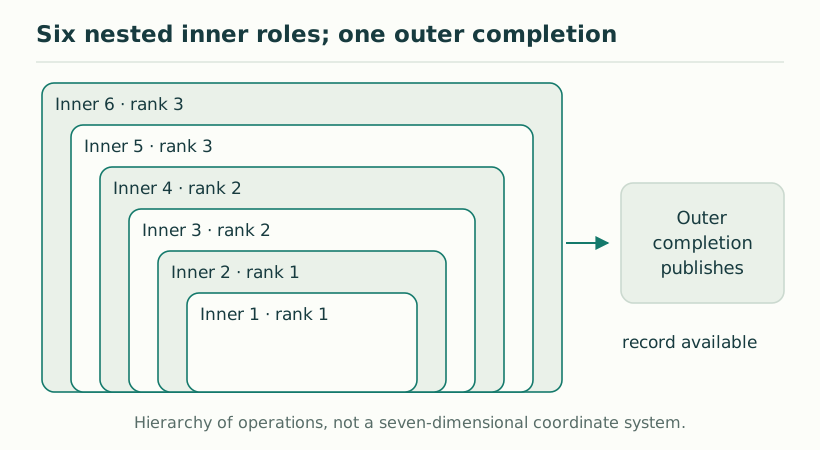
Figure 1. Six nested inner roles; one outer completion. The six inner roles are nested functional stages with readout ranks 1, 1, 2, 2, 3, 3. The outer completion publishes the resulting record. These are not seven independent time axes. View full size ↗
03A worked permutation example
Let seven labels be represented by residues 0 through 6. A rule p(k) = k + 3 modulo 7 sends each label to a partner three places farther along the cycle. Because adding three repeatedly visits every residue, the rule is reversible and produces one seven-member cycle. Its inverse subtracts three modulo seven.
This is an illustrative mathematical model of nonadjacent association, not a reconstruction of every detail in the source. It demonstrates how a definite pairing can be checked for consistency and reversed. A table or diagram is useful because it prevents an evocative phrase such as taking out from concealing an unspecified mapping.
p(k) = k + 3 (mod 7)
p⁻¹(k) = k − 3 (mod 7)
04Receptivity and generation
The historical language also emphasizes complementary roles. In a formal model, an operation and the state on which it acts are distinct ingredients. A transformation F applied to state s produces F(s); neither the symbol F nor s alone determines the result. Calling these active and receptive roles can aid explanation, provided those roles are not confused with biological sex or independently existing substances.
SMM's unity of source can then be compatible with differentiated functional relations. One underlying state may participate in different roles depending on the operation being described.
05The connection with inner and outer time
DTT uses different descriptive orders for generation and observation. The taken-out-day scheme offers a historical analogy for such a difference: the observable order need not directly reveal the generative association. To make that connection physical, a model must provide an explicit readout from inner histories to outer records.
Let H be an inner history and R(H) its observable record. If several histories share one record, the map is many-to-one. If the record preserves enough information to reconstruct a pairing, an inverse reconstruction may exist on a restricted set. Whether such reconstruction is possible is a mathematical question, not a consequence of naming two temporal levels.
06Pairing does not create duration
A permutation can rearrange seven labels without assigning any time to the rearrangement. The same permutation could be implemented rapidly, slowly or merely used as a static indexing convention. Thus a taken-out-day correspondence and a physical clock law are logically independent. To connect them, one would need a dynamical implementation and a rule relating its completion to clock readings. This is a useful safeguard in interpreting intricate tables: their combinatorial consistency can be established without assuming their physical realization. Conversely, a dynamically justified association could become physically significant even if its diagram looks simple. Complexity of presentation is not the measure of explanatory depth; the decisive issue is what follows from the stated rule.
07Three relations to keep distinct
Observed sequence, proposed association and explanatory role are separate structures. Nonadjacent entries can be associated while their ordinary sequence remains intact. This explains why the source distinguishes circulated from taken-out days. The corresponding requirement for a modern temporal model is explicit: it must provide an ordering, an association rule and a physical readout, rather than allowing one evocative term to stand for all three.
KEEP THE CONNECTION
Key ideas
Calendar order and generative association need not coincide.
A precise pairing can be represented by a reversible map.
A DTT connection requires an explicit inner-history-to-record rule.
Scope of the argument. Historical interpretation and original explanatory analysis; formal examples are illustrative models, not claimed deductions from scripture.
Historical public topic address, redirected to this edition’s revised explanation. It identifies the topic’s provenance; the revised page supplies its own reading locators and claim scope.