
In this article
- A day is a comparison procedure
- Daytime is not the whole day
- Solar and sidereal comparison
- Conventional units and physical regularity
- From the ordinary day to a cosmic day
- A useful operational checklist
A day can denote a complete rotation, its illuminated portion or a standardized duration. These distinctions clarify why a cosmic completion cycle cannot be assigned an ordinary time unit without a physical comparison rule.
A day is familiar enough to seem self-evident, yet its definition depends on what is compared. One can count the return of the Sun to a reference direction, the return of distant stars, or a fixed number of standard clock units. These procedures are closely related but not identical. The choice matters whenever precision is required.
The source article explores the relation among day, daytime and night and emphasizes the role of an observer and distinguishing celestial markers. Its broader lesson is that timing requires identifiable relations; an undifferentiated cycle does not measure itself for an observer.
Daytime ordinarily names the interval during which the Sun is above the local horizon. A full day includes both light and darkness, and its duration need not be partitioned equally between them. Location and seasonal geometry affect the division. A calendar convention can also choose a particular boundary at which the named day begins.
These distinctions are useful because a single word can refer to a whole cycle, one illuminated part, or an administrative unit. An argument about cosmic days should specify which meaning is active before drawing conclusions from the term.
In an idealized prograde rotating and orbiting system, a surface direction must turn a little farther after one rotation relative to distant stars to face the central star again. The solar return interval is therefore longer than the sidereal rotation interval. The relation follows from subtracting the orbital angular rate from the spin angular rate.
Writing the periods as P_solar, P_sidereal and P_orbit gives 1/P_solar=1/P_sidereal−1/P_orbit under these assumptions. The equation is a kinematic comparison of reference directions, not a claim that one definition of day is real and the other illusory. Each answers a different measurement question.
Dividing a chosen duration into hours, minutes and seconds supplies units. It does not create the physical regularity that makes a clock useful. A regular oscillator can be counted in different units without changing its dynamics, while a drifting oscillator remains unstable however elegantly its display is labelled.
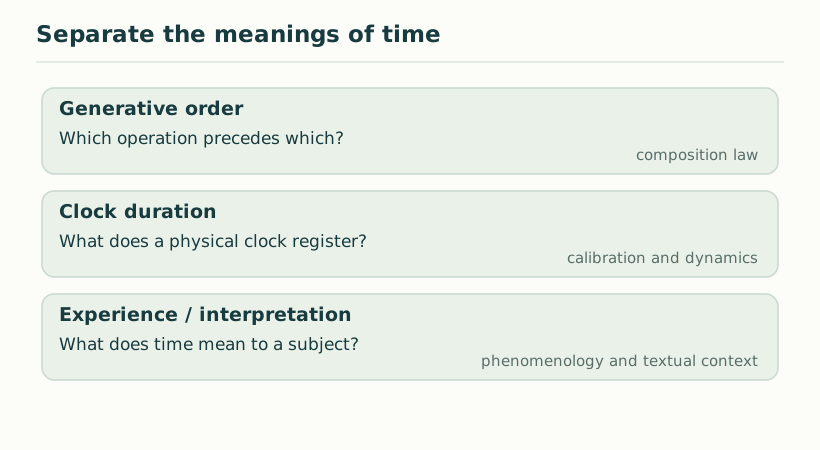
This distinction matters for DTT. A count of completions can be a natural internal coordinate, but identifying it with a measured day requires a physical clock relation. The existence of a calendar convention does not explain the source dynamics or determine an elementary completion interval.
Ibn al-Arabi’s cosmic day is not simply another name for an ordinary daylight interval. It concerns the unit and organization of manifestation within his cosmology. SMM/DTT draws inspiration from that broader sense by treating a completed generative process as an event available to observation.
The modern interpretation should state which quantities are analogous: return, closure, ordering or manifestation. It should not assume that a cosmic day has the same numerical duration as an astronomical rotation unless an explicit model establishes that relation. The analogy concerns completion before it concerns metrology.
To define any day-like cycle, identify the state that returns, the reference against which the return is recognized, the counter that retains the result, and the clock used to compare successive cycles. If one ingredient is absent, the claimed period may be underdetermined or merely conventional.
This procedure also applies to DTT inner recurrence. It clarifies how a cycle can exist mathematically, become observable through a marker, and support a public temporal record. The familiar day thus provides a concrete example of the broader programme: observable time arises through stable relations and repeatable comparisons, not through naming an invisible container.
KEEP THE CONNECTION
Scope of the argument. Astronomical comparison and interpretive bridge; no cosmic-day duration is inferred.
Historical public topic address, redirected to this edition’s revised explanation. It identifies the topic’s provenance; the revised page supplies its own reading locators and claim scope.
Source register →