
In this article
- A week as an architecture of manifestation
- Why an orientation is not a new dimension
- Nested inner stages
- A minimal mathematical translation
- What the connection illuminates
- A check on dimensional emergence
- The completion boundary
Creation in six days is interpreted as an architecture of manifestation in the source cosmology. The DTT comparison distinguishes six nested generative roles from three spatial coordinates and identifies what a physical readout must establish.
The source interprets six creative days and a seventh day of realization as an account of the formation and appearance of a world. It connects the six days with the six orientations of three-dimensional space, while the seventh concerns the experienced world. Its distinctive claim is that creation is renewed at each moment rather than completed only in a distant past. This is the historical setting of the later SMM/DTT distinction between inner generation and outer completion.
A line has two opposite orientations but one independent coordinate. A plane needs two independent coordinates and a three-dimensional region needs three. Thus the list left/right, forward/back, up/down counts six directed possibilities without giving six independent spatial dimensions. This distinction matters whenever six creative roles are related to three-dimensional geometry: an assignment of pairs is a possible organizational pattern, but a metric, adjacency relation and independence criterion are also needed to construct space.
For example, three labels x, y and z do not yet establish Euclidean geometry. One must show how displacements compose and why the squared distance is x²+y²+z² rather than some other function. Naming a direction and deriving its geometry are different stages of explanation.
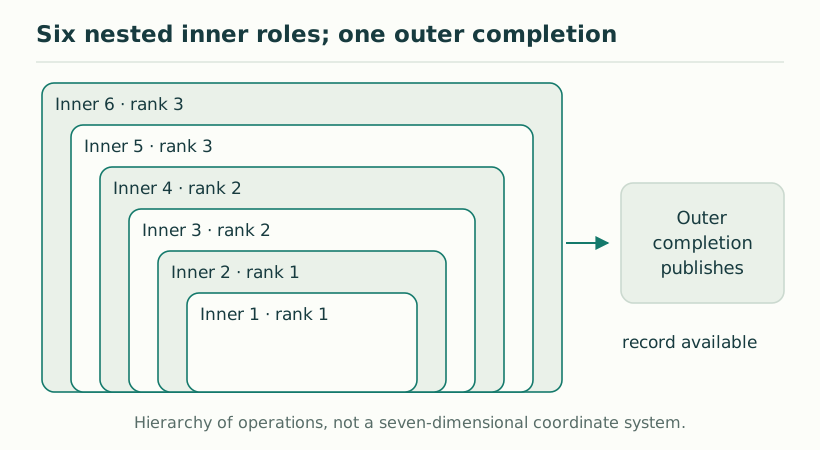
In a careful DTT reading, six inner stages are nested roles in the production of a completed record. They are not six independent laboratory clocks, and they are not automatically six intervals of equal duration. An inner operation can establish a relation subsequently used by a more inclusive operation. The final completion exposes a coherent result to the observer rather than exposing every intermediate construction as another observed event.
An arithmetic analogy is evaluating a nested expression. Intermediate results have an order of dependence, while the displayed answer has one completion label. The analogy clarifies ordering; it supplies neither a cosmic computer nor a physical duration for its operations.
Let s denote a retained source state. Suppose six maps F₁ through F₆ perform specified generative operations and R reads a completed observable record. Then rₙ = R(F₆∘F₅∘…∘F₁(sₙ)) is a precise statement of composition order. Another update must explain how sₙ determines sₙ₊₁ and how old records remain available. Without retention, there is no basis for an observer to compare two completed worlds.
This construction makes the six-plus-one distinction intelligible, but it leaves the physical content in the maps. A successful model would use one justified dynamics to determine spatial relations, clock readings and matter propagation together; merely assigning these outputs to separate stages would leave their agreement unexplained.
SMM supplies the unifying idea that many observable relations arise from one generative account. DTT adds a distinction between the order of formation and the order of experienced change. The six-day interpretation therefore asks a productive question: can what appears as an already extended spatial world be the completed result of a temporally organized construction?
The resulting research target is concrete. A candidate construction should explain why its observable records admit three local coordinates, why neighboring records support stable distances, and why independent observers recover compatible measurements. These are stronger requirements than matching the number six to six directions.
Consider records labeled by three integers (i,j,k). If the allowed elementary changes increment one label at a time, the construction supplies a three-directional adjacency pattern. But it does so because three independent labels were supplied initially. A genuine emergence argument must explain why those labels and allowed moves arise from a more primitive structure. The six signed moves then follow from the three labels; counting the moves does not reverse the argument. This simple check locates a common circularity and also identifies a positive target: derive the independent labels and their composition before interpreting their paired orientations as spatial directions. Nested inner roles may contribute to that derivation, but their number must not be used as its conclusion in disguise.
The theological account concerns dependence, creation and manifestation; its day language need not be treated as a stopwatch description. The crucial boundary is between relations being formed and a coherent record becoming available. Successive records, each internally organized, then support an observer-facing sequence. This interpretation preserves the six-plus-one conceptual architecture while leaving the physical duration and geometry to an explicit model.
KEEP THE CONNECTION
Scope of the argument. Historical interpretation and original explanatory analysis; formal examples are illustrative models, not claimed deductions from scripture.
Historical public topic address, redirected to this edition’s revised explanation. It identifies the topic’s provenance; the revised page supplies its own reading locators and claim scope.
Source register →