
Gauge covariance makes relational internal comparisons independent of local frames. Lorentz transformations preserve calibrated spacetime intervals. A common source could relate their constructions without identifying their groups or physical roles by name.
Which object is being transformed?
Attach an internal carrier Ev to each completed event v. Changing its basis alters the components used to describe an internal state. A spacetime transformation instead changes how events, durations and displacements are represented or physically related. An internal transformation can act while the event label remains fixed.
SMM/DTT aims to generate both event relations and matter carriers from one source. Their common origin makes a joint reconstruction worth pursuing, but does not make the two transformation problems identical. The same abstract group can act on different spaces with different observables and physical meanings.
Derive the internal endpoint rule
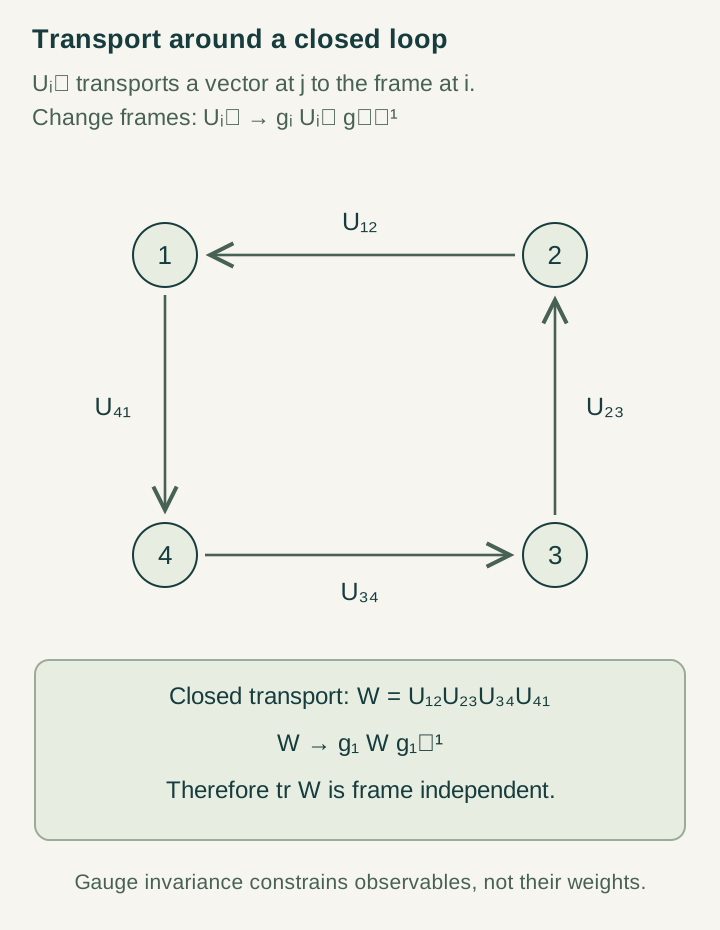
Let Uwv compare a carrier at v with one at w, and change local components by ψ′v=gvψv. Consistency of the comparison requires:
For unitary frames, the scalar ψw†Uwvψv is invariant because endpoint factors cancel. This is a relational observable built from states and a comparison map. The rule constrains the description; it does not yet assign an energy to U or prove that the comparison field propagates.
Worked example: a phase around a square
Give each of four directed links a one-component phase exp(iπ/8). Their ordered product around the square is exp(iπ/2)=i. Independent endpoint phase changes modify each link, but their contributions telescope around the closed path and leave the product unchanged.
With a higher-dimensional carrier, a frame change at the loop's base conjugates W, so its trace and eigenvalues remain invariant. A coherent comparison protocol is still needed to measure the relevant loop information. A nontrivial mathematical holonomy can remain inaccessible to a detector restricted to another carrier sector.
A spacetime interval uses different data
For a one-direction Lorentz boost, set T=ct and choose speed v=4c/5. Then γ=5/3. An event separation T=5, x=4 transforms to T′=3, x′=0, preserving T²−x²=9.
x′=(5/3)(4−4)=0.
This compares event coordinates using calibrated clocks and rulers. To interpret the transformation as a change between physically equivalent observers, the matter constituting those instruments must obey the corresponding laws. Formal interval preservation does not establish that every source-generated clock realizes the boost.
Equal group names do not identify physical sectors
SU(2) can describe the spinor cover of spatial rotations and can also act on a supplied internal two-component carrier. The matrices can be isomorphic while the transformations act on different observables. The spinor rotation law concerns orientation under rotations; an internal gauge action concerns a different local comparison structure.
If two actions operate on independent factors, their product representation can make them commute. A more coupled construction must state the compatibility law explicitly. Counting equal dimensions or recognizing familiar symbols does not derive the physical identification. This prevents a temporal reconstruction from turning a carrier analogy into an unsupported unification claim.
Completion can constrain each transformation group
Retaining Hermitian blocks of complex dimensions three and two allows U(3)×U(2) frame freedom. Retaining a nonzero product-volume tensor further imposes det A det B=1. This gives the conditional stabilizer S(U(3)×U(2)). Separately, a calibrated rank-one duration and rank-three displacement structure can support a Lorentzian reconstruction under its own order and smoothness assumptions.
These are different retained structures and different theorems. Neither follows from the number of inner temporal roles. The source must generate the relevant carriers and tensors, preserve their comparisons and establish their matter dynamics before a physical identification is justified.
A joint source problem with separate measurements
The six nested inner roles could organize both the production of an event archive and the internal comparison maps attached to it. Outer completion should retain the gauge-invariant data and the calibrated spacetime records needed for future predictions. Their compatibility must survive transport and changes of observer.
A useful next result would derive an internal loop response and a spacetime propagation law from one update, using independently defined measurements. It should then prove a relation between their coefficients or transformations that cannot be freely altered. This would connect gauge and spacetime structure through a common mechanism while preserving the distinctions that make each observable meaningful.
Continue with the articles
- Hopf geometry from a spinor doublet
A normalized complex doublet determines a direction on a sphere while retaining a circle of equivalent phase representatives. Hopf geometry organizes this relation, but its integer topology does not fix an interaction strength.
- Why light must share the same cone
Light follows the constructed null cone if its electromagnetic constitutive law uses the same metric. A countermodel with another field speed shows why common geometry does not alone establish universal propagation.
- Relational transport and gauge freedom
Unframed record carriers need relational transport, whose transformation law gives a conditional gauge-connection structure. Curvature, physical propagation, and force dynamics require additional mechanisms.
- What the holonomy Hessian does and does not contain
The singlet-loop response near identity holonomy is proportional to tr(X²), with no independent [tr(X)]² term at quadratic order. Explicit carrier weights then give a conditional relation among response coefficients, with physical coupling normalization still to be supplied.
- The conditional route to S(U(3) × U(2))
Retaining rank-three and rank-two Hermitian carriers together with a product determinant tensor selects S(U(3) × U(2)). The stabilizer calculation leaves carrier selection, chiral matter and empirical Standard-Model matching as separate requirements.
- One clock direction plus three readout directions
A rank-one duration space and a rank-three quaternionic readout combine into four record directions under stated clock and detector assumptions. A separate soldering map connects those internal directions to a smooth spacetime manifold.
- When geometric symmetries become physical boosts
A geometry can admit Lorentz transformations that its material observers cannot realize. The frame-richness argument identifies the extra reachability and clock-calibration conditions needed to turn geometric automorphisms into physical boosts.
- What Lorentzian reconstruction leaves open
Lorentzian reconstruction provides a conditional account of observer geometry without determining matter, coupling constants or gravitational dynamics. This guide identifies the source-level results still needed to connect clocks, propagation and curvature.