
A proper-time action with one energy coefficient produces both rest energy and inertial mass, giving E₀=mc². SMM/DTT must explain why its recurrent carriers realize that common action and normalization, rather than independently naming a frequency and a mass.
What the equation identifies
The mass m used here is invariant mass, and E₀ denotes energy in the system's rest frame. In another inertial frame, total energy also includes kinetic energy. A nonzero rest energy therefore does not mean that the system is moving through ordinary space; it is part of the energy–momentum structure of the persistent system itself.
DTT motivates treating persistence as repeated internal generation. That makes a stable recurrence a plausible carrier of rest energy. To become a physical explanation, the model must connect recurrence to a conserved energy and show that the same coefficient governs the system's inertial response to motion.
One coefficient generates both quantities
Assume a free localized system has action S=−ε₀∫dτ, where ε₀ is a positive energy coefficient and dτ is physical proper time. In an inertial coordinate time, its Lagrangian is L=−ε₀√(1−v²/c²). Expand at small speed:
Comparison with the ordinary kinetic term mv²/2 identifies inertial mass as m=ε₀/c². At rest the Hamiltonian equals ε₀, so E₀=mc². This is a clear conditional derivation: the common proper-time action carries the physical content. A source model should derive that action instead of assuming the desired equality under another name.
The full energy–momentum law
Differentiating the same Lagrangian gives p=γmv. Its Hamiltonian is E=p·v−L=γmc². Eliminate v using γ²(1−v²/c²)=1:
E=√(m²c⁴+c²p²).
For |p| much smaller than mc, expansion yields E=mc²+p²/(2m)+higher terms. Thus rest energy, relativistic motion and the nonrelativistic kinetic coefficient agree because they came from one action. The causal speed appearing here must be the same calibrated speed used by the physical clocks and signal sector.
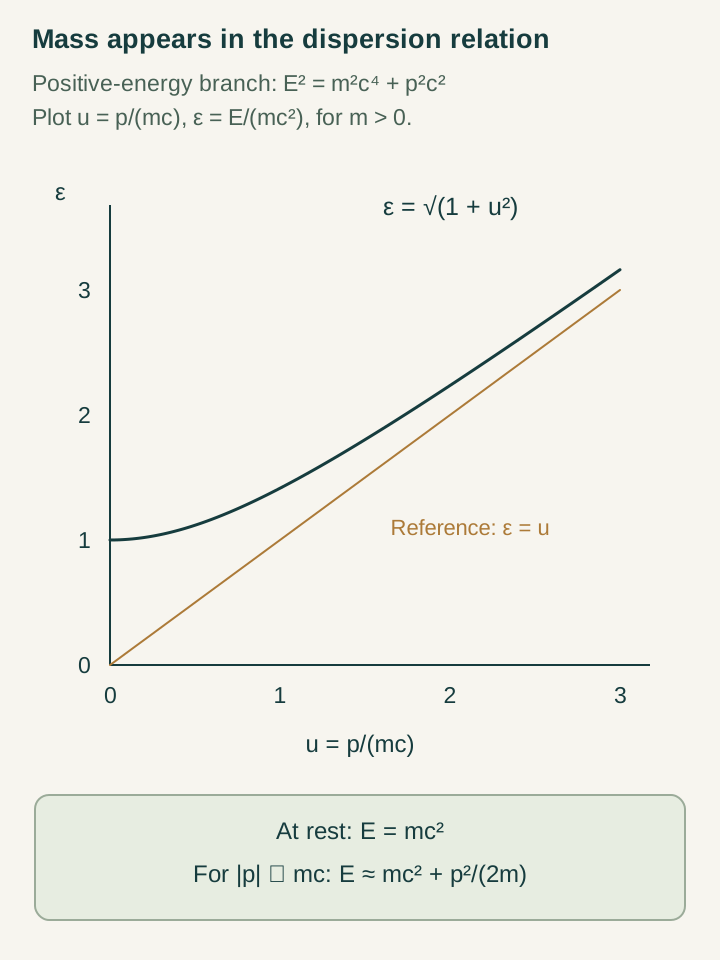
Open the full-size diagram →
Worked example: energy at a specified momentum
Take momentum p=3mc/4. The energy law gives E=5mc²/4, because √(1+9/16)=5/4. The velocity is obtained from the derivative of energy:
K=E−E₀=mc²/4.
The nonrelativistic estimate p²/(2m) would give 9mc²/32, slightly larger than the exact kinetic energy at this appreciable speed. The comparison illustrates why a mass assigned from a low-momentum expansion must be checked against the full dispersion before claiming a relativistic description over a larger momentum range.
Turning a temporal frequency into rest energy
If a stable source mode has rest angular frequency ω₀ and the physical phase–energy relation is E₀=ℏω₀, then m=ℏω₀/c² follows within the common relativistic dictionary. Frequency, action and speed play separate roles: ω₀ describes recurrence, ℏ converts phase rate to energy and c connects the temporal and spatial measurements.
The six nested inner roles could organize the production of the carrier and its mixing operations, while outer completion defines the duration against which ω₀ is measured. Their number alone fixes none of these normalizations. A numerical particle mass requires selection of the mode and the physical scales independently of the mass being fitted.
A finite model shows why the matching regime matters
For the local two-component walk in the matter guide, cos ω=cos θ cos k. Near k=0 with 0<θ<π/2, the exact expansion is ω=θ+(cot θ)k²/2+O(k⁴). Use E=ℏω/Δt, p=ℏk/ℓ and c*=ℓ/Δt.
minertial=ℏΔt tan θ/ℓ².
minertial/mrest=tan θ/θ.
They agree as θ tends to zero, but at θ=π/4 their ratio is 4/π. This exact audit shows that a finite recurrence frequency and an inertial curvature need not match relativistically outside the controlled continuum regime.
Binding and radiation contribute to system mass
For an isolated composite system in its centre-of-momentum frame, invariant mass is its total rest-frame energy divided by c². Changing internal or binding energy changes the system mass accordingly. A temporal model must therefore account for interactions and retained correlations, not merely add the masses assigned to isolated constituents.
A simple illustration uses two photons of equal energy ε moving in opposite directions. Their total momentum vanishes and their total energy is 2ε, so the pair has invariant mass 2ε/c² even though each photon has zero invariant mass. The mass belongs to the combined energy–momentum state.
The stronger SMM/DTT target
Derive a stable carrier band, its conserved energy, its momentum response and the clock calibration from one source interaction. Show that the low-momentum inertial coefficient matches the rest frequency through the same universal c, and quantify finite-resolution corrections such as the mismatch in the walk example.
Then test the relation for interacting and composite carriers. This would develop the attractive idea that matter is persistent temporal organization into a concrete statement about energy and inertia. A discontinuous spatial jump or a relabelled recurrence is insufficient; the common dynamics must supply the conservation law and the normalization that make the equivalence physically meaningful.
Continue with the articles
- The Mass-Energy Equivalence
Mass–energy equivalence provides a focused test of a temporal interpretation of familiar physics. The relativistic derivation identifies which energy, clock and propagation relations a deeper SMM/DTT construction must explain.
- The Properties of Matter
Material properties are identified through invariants and reproducible responses. Examples involving mass, weight and collective behaviour show the distinct measurement and dynamical requirements for an SMM/DTT account of matter.
- Limiting speed as update scale times projection rate
The limiting-speed factorization c=κρ combines a spatial update scale with a phase-to-clock rate. It is dimensionally consistent but does not independently select either microscopic factor or a numerical speed.
- What Lorentzian reconstruction leaves open
Lorentzian reconstruction provides a conditional account of observer geometry without determining matter, coupling constants or gravitational dynamics. This guide identifies the source-level results still needed to connect clocks, propagation and curvature.
- Four principles of quantum relativity: assumptions and consequences
A common limiting speed, Lorentz transformations, mass–energy equivalence and the equivalence principle impose distinct requirements. This guide traces their algebraic and physical dependencies and asks what one source dynamics must connect.