
In this article
- Rest energy is the quantity to explain
- A clear conditional derivation
- Why an instantaneous jump is not enough
- The temporal-frequency route
- A consistency check across sectors
- What a new derivation would add
Mass–energy equivalence provides a focused test of a temporal interpretation of familiar physics. The relativistic derivation identifies which energy, clock and propagation relations a deeper SMM/DTT construction must explain.
The mass–energy relation states that a system with invariant mass m has rest energy E₀=mc². The word rest matters: the total energy measured in a frame where the system moves also includes kinetic energy. The relation is part of the successful relativistic structure connecting energy, momentum and inertial response.
The source article explores whether renewed creation could provide a deeper explanation. Its proposed abrupt-velocity argument should not be treated as a general classical proof. Replacing a continuous integral with a discrete sum changes the dynamical assumptions; it does not by itself establish the relativistic energy law.
Assume a Lorentz-invariant energy–momentum relation E²=c²p²+m²c⁴ and choose the positive-energy branch. In the rest frame p=0, so E₀=mc². This derivation is short because the physical content is already contained in the assumed invariant relation. It is valid, but it is a conditional consequence of relativistic kinematics.
Expanding the same relation for momentum small compared with mc gives E≈mc²+p²/(2m). The second term is the familiar nonrelativistic kinetic energy, while the first remains even at zero momentum. The expansion explains how the relativistic description connects to the low-speed regime without treating rest energy as an arbitrary extra term.
If a massive object’s velocity changes discontinuously in ordinary mechanics, its acceleration is distributional or singular, and the required force and energy transfer must be specified. One cannot infer a finite universal rest energy merely by replacing a smooth acceleration with a jump. A microscopic transition model may avoid the classical picture, but then it needs its own conservation laws.
The same caution applies to photon emission. A photon is not a massive object accelerated from rest to c. Treating it as such imports an inappropriate trajectory description. A DTT model should explain emission and massive propagation through its actual state and transition rules.
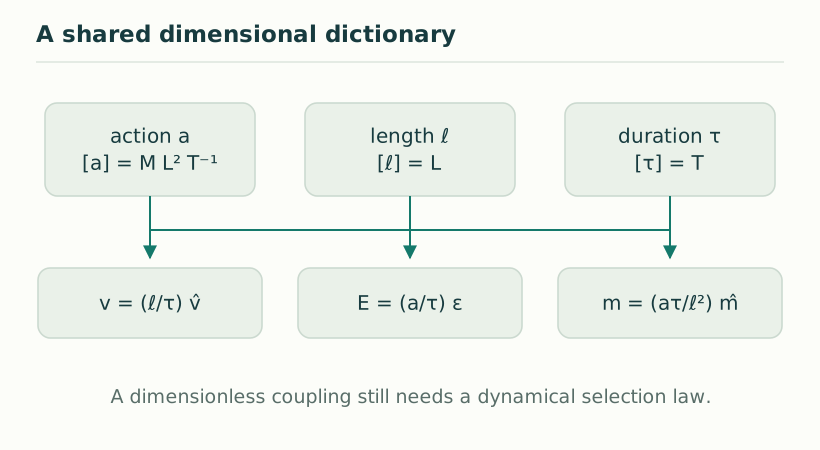
A plausible DTT strategy is to identify a stable mode with an angular frequency ω and an action scale a, giving E=aω. If a relativistic dispersion relation also emerges with the same causal speed c, the rest mode can be assigned m=aω₀/c². The two ingredients then connect temporal structure with inertial mass.
This is a useful research dictionary, but each ingredient has a separate obligation. Why does the mode carry energy aω? Why is a universal? Why does the propagation law have the required invariant form? A frequency with no physical energy calibration cannot by itself predict a mass in kilograms.
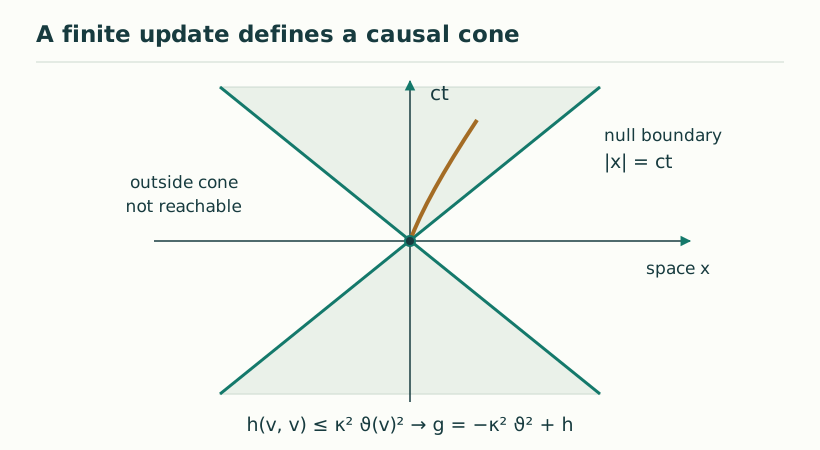
Suppose the clock sector gives a speed c_clock while a matter mode satisfies E²=c_matter²p²+E₀². Identifying m=E₀/c_clock² does not guarantee ordinary relativistic dynamics if the two speeds differ. A common-source derivation must relate the sectors, rather than make the equality true by notation.
This is why the SMM/DTT aim of jointly producing geometry, clocks and matter is important. The same completion dynamics should constrain the normalization of each observable. Otherwise the relation can be imposed separately on each sector while appearing to have been derived from temporal unity.
A deeper explanation would derive the relevant dispersion, energy scale and clock dictionary from independently stated source principles. Recovering E₀=mc² would then be a meaningful consequence of those principles. The derivation should make clear which assumptions are new and which established structures are being recovered.
The conceptual attraction of the temporal approach is that mass could express a stable mode of generative recurrence rather than an unexplained label. The remaining challenge is physical selection and normalization. Presenting the conditional chain explicitly makes that challenge sharper and avoids circularly assuming the relation that the argument sets out to explain.
KEEP THE CONNECTION
Scope of the argument. Established conditional derivation followed by an explicit SMM/DTT research route.
Historical public topic address, redirected to this edition’s revised explanation. It identifies the topic’s provenance; the revised page supplies its own reading locators and claim scope.
Source register →