
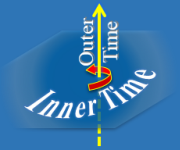

An appearance is evidence produced by a relation between a world, an observer and a means of observation. Learning what appears requires understanding that relation and finding comparisons that separate otherwise indistinguishable possibilities.
Appearance is where inquiry begins
A mountain seems small from far away. A straight stick seems bent at the surface of water. Neither observation is useless: each records a physical relation involving distance, light and the observer. Calling something an appearance should begin an investigation of that relation, rather than end the investigation by dismissing what is seen.
We often distinguish an object from its appearance because several appearances can be connected to one continuing source. Walking around a chair changes its silhouette while leaving many relations between its parts intact. That coordination supports an account of a three-dimensional object. It does not mean that every detail of the object was already contained in the first silhouette.
One view can leave several answers
Consider an original geometric example in a horizontal plane. A stationary observer is at the origin. A target has horizontal position x and positive depth z. Represent the target's direction by the slope p = x/z, which is the tangent of its bearing measured from the forward direction. This is an exact ratio in the model, not a small-angle approximation.
Two candidate positions are (1, 2) and (2, 4), in metres. Both give p = 0.5. A perfect measurement of this direction still cannot choose between them. Greater numerical precision in the same reading cannot recover a distinction that the observation rule has removed.
This is a simple inverse problem: the observation is known, and the task is to infer a possible source. When several sources give the same observation, an answer requires more information or an additional assumption. Quietly supplying an assumption can make an inference look more direct than it is.
A comparison that separates the candidates
Move the observer sideways through a known baseline b = 1 metre, keeping the viewing axes parallel. The new directional slope is q = (x − b)/z. The first candidate gives q = 0; the second gives q = 0.25. The two views together determine:
z = b / (p − q), x = pz.
With the first pair of slopes, the recovered position is (1, 2). With the second, it is (2, 4). The useful addition was a changed observation geometry. Repeating the original view would not have supplied this missing information.
The calculation assumes a stationary target, a known baseline, parallel reference axes and straight propagation in the chosen geometry. If those conditions fail, the same formula need not identify the target correctly. NASA's account of stellar parallax describes a physical application of comparing directions from separated viewing positions; the numerical construction here is an elementary illustration.
Agreement becomes stronger when tests differ
Two instruments are not automatically independent witnesses. They may share a calibration error or rely on the same assumption about the source. A photograph, a range measurement and an interaction with the object can constrain different parts of an account, but their dependencies still need examination.
It is therefore useful to ask what would change the proposed explanation. Would moving the observer alter the result in the predicted way? Would a different wavelength expose a hidden dependence? Could an alternative object reproduce all the available comparisons? These questions turn the distinction between appearance and reality into a programme of inquiry.
Manifestation and physical reconstruction
In the philosophical background of SMM/DTT, the world is understood through manifestation and dependence on a unified source. The book's discussion of renewal and continuity connects that motivation with the requirement to preserve records and correlations. It does not make an observed appearance dispensable: a physical realization must explain the relationships among observations.
The distinction matters when moving from ontology to calculation. A common source does not, without further structure, determine the projection rule, the available comparisons or their uncertainty. Those belong to the explicit reconstruction described in what a reconstruction must contain. The philosophical proposal supplies a direction for investigation; the comparison rules carry the empirical work.
What would another view reveal?
For any unfamiliar claim, separate three questions: what was recorded, which model connects that record to a source, and what further observation would distinguish competing sources? This approach respects appearances while recognizing their limits. It also explains why a richer account of reality often grows through coordinated perspectives rather than through one supposedly privileged picture.
Sources and further reading
- NASA, Stellar Parallax.
- Mohamed Haj Yousef, Renewal and continuity and What a reconstruction must contain.
- Continue with Observation and inference and What an image records.