
An invertible real skew-symmetric generator A has a unique polar factor J=A(−A²)<sup>−1/2</sup>, with J²=−I. This provides phase on the dynamic sector; probabilities and physical time calibration require further structure.
Start with generation rather than a scalar convention
The Single Monad programme asks whether the structures used to describe physical multiplicity can arise from a common generative process. Complex numbers are an important test case. Instead of declaring a complex state space at the outset, begin with real amplitudes and a norm-preserving evolution. Ask whether that evolution supplies an operation that can consistently play the role of multiplication by the imaginary unit.
This is a narrower, tractable question than deriving every quantum postulate. DTT interprets the reversible flow as one representation of inner generation. Completed observations require a later interface. The six inner levels remain nested dependencies in that interpretation; a matrix coordinate is not automatically one of those levels or an independently readable time.
What an admissible phase must satisfy
Let V be a finite-dimensional real inner-product space. A real-linear operator J defines ordinary complex scalar multiplication when J²=−I. Requiring J to preserve the inner product gives the compatible skew-symmetry condition Jᵀ=−J. Define (a+ib)v=av+bJv; the complex multiplication rules then follow by direct substitution.
If the source also carries a family of symmetry operations U(g), one additionally asks JU(g)=U(g)J. All operators commuting with the representation form its commutant. This compatibility condition prevents a scalar convention from changing when the same physical operation is described through an allowed symmetry. Existence, multiplicity of choices, and dynamical selection are separate questions.
The finite polar calculation
Take an oriented orthogonal flow U(t)=exp(tA), with Aᵀ=−A and no zero eigenvalue. Orthogonality follows because the derivative of U(t)ᵀU(t) vanishes. The matrix −A²=AᵀA is positive definite. Its unique positive square root Ω commutes with A because both are functions of the same real normal matrix. Now remove the magnitude of the generator:
Commutation gives J²=A²Ω−2=−I. Transposition gives Jᵀ=−J, and therefore JᵀJ=I. The positive polar magnitude fixes this J uniquely for the supplied invertible A. If A commutes with all U(g), then Ω and J do too. The proof selects a phase for this dynamics, rather than selecting the dynamics itself.
Open the full-size diagram →
One plane, two possible orientations
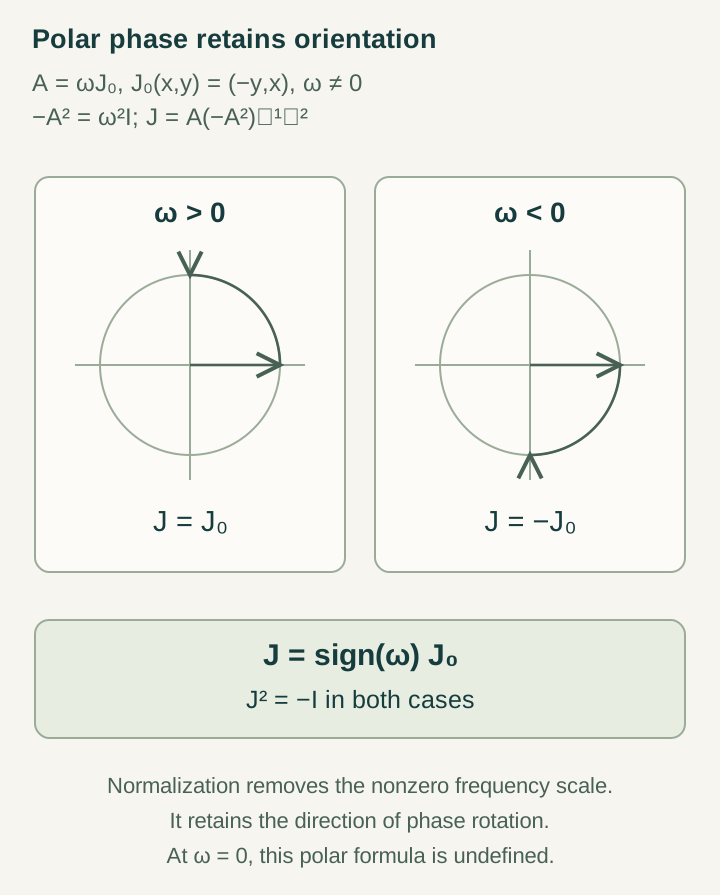
On a real plane define J₀(x,y)=(−y,x) and choose A=ωJ₀ with ω>0. Then Ω=ωI and J=J₀. Starting from (1,0), the flow produces (cosωt,sinωt). Changing ω changes the speed around the circle while preserving the selected phase orientation.
Reversing the flow changes A to −A and J to −J while leaving Ω unchanged. Thus an unoriented circle does not determine which complex convention is selected. A source theory must supply an oriented evolution, or explain how completed-record order selects one. A discrete quarter-turn update also does not determine a unique frequency: adding full turns between samples produces the same sampled operator.
Stationary sectors retain a real choice
Append a stationary coordinate z, so A acts as a rotation on (x,y) and vanishes on z. Polar selection still works on the rotating plane. It gives no phase on the remaining one-dimensional real line, which cannot carry an operator squaring to −I. With a stationary two-plane, a phase can be added, but its orientation is extra data.
The appropriate conclusion is therefore a selected phase on the dynamic sector, the orthogonal complement of ker A. Infinite-dimensional extensions require operator domains and functional calculus; writing an inverse without specifying its support would conceal those issues. A zero-frequency kernel and a spectral gap are also different conditions. The finite calculation here needs no claim about a general infinite-dimensional gap.
Why time reversal becomes antilinear
For the planar example let K(x,y)=(x,−y). This norm-preserving real map satisfies KJ₀=−J₀K. After J₀ is interpreted as multiplication by i, the same equation says K(iv)=−iK(v). Thus K is antilinear in the reconstructed complex description, although it remains real-linear in the original description.
This provides an elementary explanation of antiunitary language: its meaning depends on how an operation acts on the chosen phase. A transformation commuting with J is complex-linear; one reversing J conjugates complex scalars. The calculation alone does not establish the transformation law of every physical particle. Those depend on the representation and the observables assigned to the carrier.
From phase selection to a quantum model
The constructive gain is a dependency: a specified real dynamics supports a specific complex phase. To become a physical quantum description, one must also supply observable operators, positive states, composition of systems, and a measurement rule. Naming a completed event does not supply those ingredients or fix an action unit.
The next SMM/DTT question is whether the same source law that selects phase also determines which coherences survive into retained records. A useful model would calculate both the generator and its completion instrument, then predict a relation between phase-sensitive experiments and record formation. The measurement and completion guide develops that second interface.
Continue with the articles
- Selecting phase by polar decomposition
Polar decomposition of an oriented real dynamical generator selects an ordinary complex structure on its nonzero-frequency sector. Zero modes, symmetry compatibility, and discrete logarithm branches remain separate inputs.
- Completion, commutants, and positive frequency
This guide follows completion, compatible complex structures and positive-frequency selection through their separate mathematical roles. Finite examples connect the framework to SMM/DTT while keeping causal readout and physical calibration as additional constructions.
- Real-commutant phase selection: a paper guide
An oriented real orthogonal flow can select an ordinary complex structure on its dynamic sector. Planar examples explain residual zero-mode freedom, time-reversal antilinearity and the extra balancing rule needed for composite systems.
- Split-complex time and ordinary quantum phase
Split-complex temporal pairing and ordinary complex quantum phase use different algebraic units. The record construction keeps those roles distinct and obtains its Lorentzian determinant only after additional completion assumptions.
Sources and reading
- Completion principles, real commutants, and positive-frequency geometry for orthogonal Hilbert representations
- Real-commutant phase selection from real Hilbert representations
Read the original source for its exact formulation and edition. The examples on this page are explanatory reconstructions.