
A commutator bound can define an exact distance, but its value depends on the represented algebra and operator normalization rather than an eigenvalue count alone.
The theme of the listed paper
Spectral Non-Commutative Geometry of Dual-Time Space is listed in the author’s paper catalogue. The older complete text was not retrieved here, so this page is a thematic guide based on A207 and the site’s explicit spectral examples. It distinguishes that bibliographic entry from the separate spatial-emergence preprint.
The guiding question is constructive: can operations on temporal histories produce an observable algebra whose states admit meaningful distances? A spectral description is useful when it explains that relation, rather than simply renaming a familiar spatial operator as temporal.
Give each ingredient one job
A spectral triple uses an algebra 𝒜 of observables represented on a Hilbert space ℋ and a self-adjoint operator D. The commutator [D,a] measures how the observable a varies relative to the chosen operator. In standard compact settings, compact resolvent and bounded commutators on a suitable dense algebra are important analytic requirements.
An unbounded number operator may be part of D without being a bounded algebra element. Its domain must remain visible. These distinctions prevent an attractive symbolic expression from silently changing the mathematical object under discussion.
Derive an exact distance
Let a=diag(a₁,a₂), and choose D with zero diagonal and off-diagonal entries 1/ℓ, where ℓ>0. Direct multiplication gives [D,a] with off-diagonal entries (a₂−a₁)/ℓ and its negative. Its operator norm is |a₁−a₂|/ℓ.
The upper bound follows from the commutator constraint, and choosing a₁−a₂=ℓ attains it. Thus the two evaluation states are a finite distance apart. The construction is exact, while ℓ remains an input scale in D.
Open the full-size diagram →
Separate shape, spectrum, and calibration
Replace D by sD with s>0. Its commutators grow by s, so the allowed observable variation shrinks by the same factor and every distance scales as 1/s. This shows why operator normalization cannot be omitted from a physical distance claim.
Now instead choose D diagonal in the same basis as every observable. All commutators vanish. Arbitrarily large differences a₁−a₂ satisfy the constraint, so distinct evaluation states have infinite distance. An operator can possess a well-defined eigenvalue list while failing to provide finite spatial comparison for the selected algebra.
The temporal reconstruction task
In SMM/DTT, admissible source histories could generate shifts, products, and comparison tests before a spatial readout is formed. Completed records would specify which observables survive and which state functionals correspond to accessible locations.
The substantive tasks are then to derive the algebra, its representation, and the normalized operator together. Six nested roles can organize a candidate construction, but rank three, finite metric distance, and local propagation are distinct outputs to verify. A metric on records becomes physical only through a correspondence with independently defined measuring procedures.
From the example to a finite research problem
Begin with A207, then read A153 on the spectral interface, A156 on the dimension–distance distinction, and A157 on normalized graph blocks. Use A158 to track finite regulators before discussing a continuum limit.
A good next model has a small set of completed records with source-generated transition rules. Calculate both shortest-path cost and spectral distance, state when they agree, and vary the source normalization. Which ratios are fixed and which remain calibrations? This produces a reproducible geometric result while revealing what an eventual physical length standard would need to explain.
Continue with the articles
- Spectral noncommutative dual-time geometry: a guide
A spectral triple assigns different jobs to observables, states and the operator measuring variation. An exact two-point example separates metric distance from eigenvalue counting and exposes the length normalization that a source model must justify.
- A spectral triple as a reconstruction interface
A spectral triple organizes observables, represented states, and differential data into a reconstruction interface. A temporal shift example makes the domain, compactness, and interpretation requirements explicit.
- Why spectral dimension does not determine distance
An operator can have cubic spectral growth while assigning infinite distances between localized evaluation states. The counterexample shows why record comparisons require commutator control beyond mode counting.
- Graph distance from a normalized spectral block
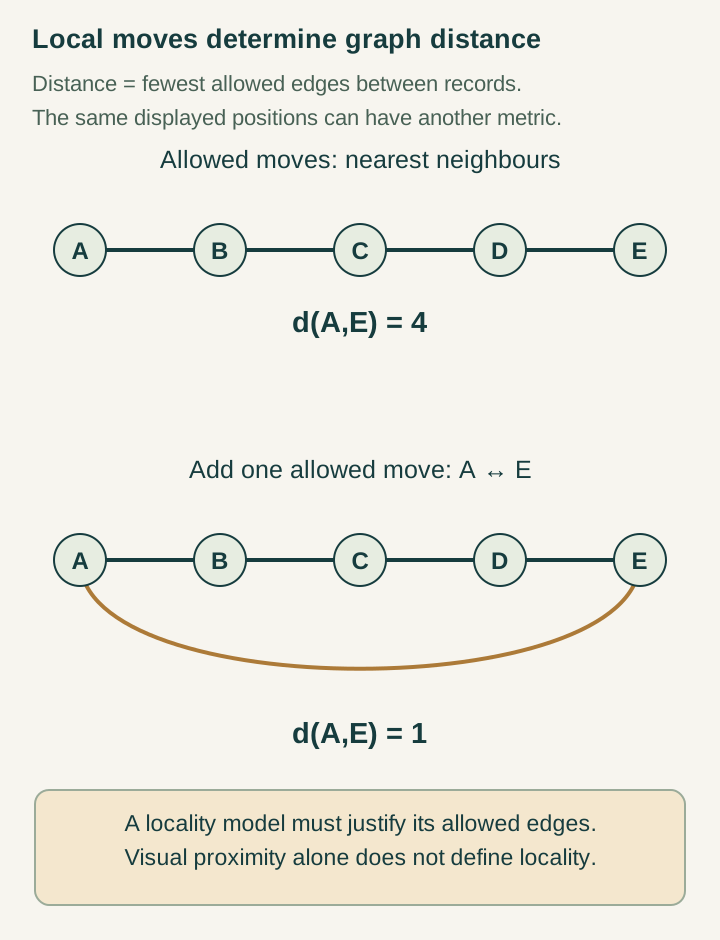
A direct sum of normalized edge blocks gives a commutator seminorm equal to the largest edge slope. Its state distance is exactly weighted shortest-path distance on a connected finite graph.
- A finite regulator for spectral experiments
Finite eigenvalue and heat-trace sums provide a reproducible test of spectral scaling. Comparing them with a separate graph-distance calculation exposes cutoff effects and prevents a numerical plateau from standing in for complete geometry.
- What spatial readout forgets
Different inner states can share one spatial readout and still have different successors. A concrete counterexample and a kernel-preservation criterion identify the memory needed for autonomous completed evolution.
Sources and reading
Read the original source for its exact formulation and edition. The examples on this page are explanatory reconstructions.