
Hubble radius is an instantaneous expansion scale; particle and event horizons depend on past and future light-travel integrals. A shared source does not by itself make inaccessible regions operationally connected.
Start from the light trajectory
Use a flat FLRW metric with dimensionless scale factor a(t), comoving radial coordinate χ in length units, and metric null propagation at local speed c. A radial light ray obeys |dχ/dt|=c/a(t). The total comoving distance it can cover between two times is therefore the integral of c/a.
This is the basic calculation behind cosmological horizons. It depends on a propagation law and an expansion history, not merely the present value of H. In SMM/DTT, the clock and physical signal cone must already be matched before the same horizon construction can be applied to generated records.
The Hubble radius is an instantaneous scale
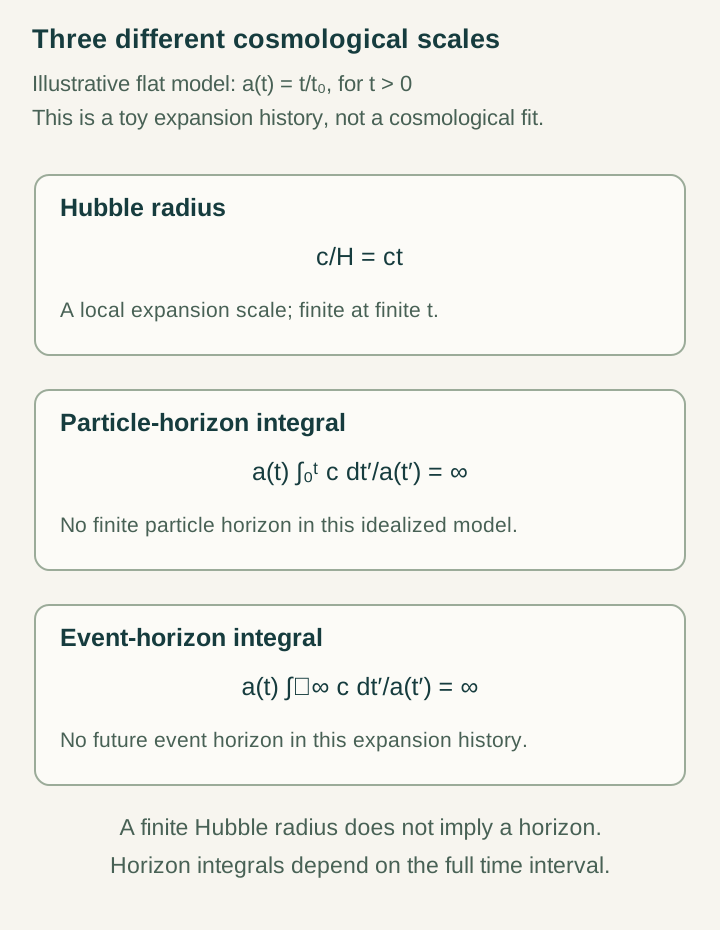
For comoving markers, proper separation D=aχ changes at rate HD. The radius RH=c/H is where this recession rate equals c when H>0. This compares separations on a cosmic-time slice, rather than measuring one object overtaking a local light ray.
The Hubble radius is not generally a boundary beyond which no signal can reach an observer. Its future motion matters. An inward photon may initially increase its proper distance while its comoving distance decreases; a changing expansion history can later allow it to approach in proper distance too.
Open the full-size diagram →
The particle horizon asks about the accessible past
Given an earliest boundary ti of the assumed cosmological history, the particle-horizon comoving distance is χp(t)=∫t_itc dt′/a(t′), if this integral is finite. Its proper distance on the current slice is Rp=a(t)χp. It describes the maximum causal reach from that past boundary under the adopted signal law.
The boundary is part of the model. Extending the cosmological history to an earlier phase can change the answer. Also, a particle horizon is not the same as the last-scattering surface: opacity can prevent electromagnetic observation of events that lie within a broader causal past.
The event horizon asks about the available future
For a comoving observer whose future extends to tf, define χe(t)=∫tt_fc dt′/a(t′). When finite, Re=a(t)χe gives the event-horizon proper distance on that slice in this symmetric setting. It limits signals emitted now that can eventually reach the observer.
This horizon depends on the entire future continuation. Present acceleration alone does not fully determine it. Light received now from a distant object was emitted earlier, so observing that object does not imply that a signal emitted by it today can ever arrive. The two statements concern different events.
Worked example: a power-law universe
Take a(t)=(t/t*)p for all t>0. Then H=p/t and RH=ct/p. For 0<p<1, the past integral converges and gives Rp=ct/(1−p), whereas the future integral diverges: there is no event horizon in this indefinitely continued model.
For p=2/3, RH=3ct/2 and Rp=3ct. They differ by a factor two despite arising from the same expansion. For p>1, the future integral instead gives Re=ct/(p−1), while the idealized past integral from zero diverges. Changing the earliest phase changes that last conclusion.
A special case where two radii coincide
For a(t)=exp(Ht) with constant H>0 and an indefinitely continued future, direct integration gives Re=c/H. The event horizon and Hubble radius coincide in this special case. That equality should not be transferred to arbitrary accelerating histories.
If the same exponential history begins at a finite ti, its particle-horizon distance is (c/H)[exp(H(t−ti))−1], which varies with age and the initial boundary. This example makes all three notions explicit within one model. Specifying a cosmic scale as simply the horizon leaves an essential physical choice unresolved.
Common origin does not equal signal access
A Single Monad origin can motivate correlations among completed regions, but it does not automatically permit an observer to transmit information outside the physical causal cone. The underlying source schedule, a correlation in a prepared state, and an operational signal are distinct objects. A model must identify which interventions alter another observer’s accessible records.
The six nested inner roles can assemble relations before outer completion without becoming six channels of superluminal communication. If a new causal connection is proposed, its propagation equation and clock law must be stated and used to recalculate the horizon integrals consistently.
Use the correct horizon in vacuum proposals
A proposed vacuum density proportional to L−4 is extremely sensitive to the meaning of L. Choosing the Hubble radius, particle horizon, or event horizon generally gives different time dependence and can introduce dependence on future boundary conditions. These are different physical models, even when their lengths happen to be comparable at one epoch.
A constructive SMM/DTT proposal should derive the length from its state and accessible operations, then show which cosmological quantity it approaches. The power-law examples provide immediate consistency tests. Matching one selected cosmic length numerically does not by itself establish the causal or dynamical origin of that scale.
Continue with the articles
- Summary of Modern Theories of Cosmology
Modern cosmology connects gravitation, expansion and the formation of structure. These established questions provide concrete targets for an SMM/DTT account of generated space and physical clocks.
- Why normalized response misses absolute vacuum offsets
Normalized responses erase source-independent offsets even when those offsets matter to an absolute functional. The exact obstruction explains why stiffnesses, spectral ratios, and temporal averaging do not alone determine gravitating vacuum energy.
- A finite-update cone
A stated quadratic update bound produces a candidate cone and an integrated speed limit. Its interpretation as physical causality also requires calibrated readings and dynamics that keep every relevant signal inside it.
- Limiting speed as update scale times projection rate
The limiting-speed factorization c=κρ combines a spatial update scale with a phase-to-clock rate. It is dimensionally consistent but does not independently select either microscopic factor or a numerical speed.
- Why light must share the same cone
Light follows the constructed null cone if its electromagnetic constitutive law uses the same metric. A countermodel with another field speed shows why common geometry does not alone establish universal propagation.
- Calibrating a conformal geometry
Causal order fixes a conformal class of metrics; an independently calibrated record density fixes the local scale. A reproducible clock then sets any remaining overall unit, provided the source supports the required protocol agreement.