
In this article
- What the formalism changes
- What the SMM/DTT distinction contributes
- An operational expression
- The direct comparison with DTT
- Different kinds of nonclassical order
- A further conceptual benchmark


Quantum theory admits operational frameworks in which a fixed global order of laboratory operations is not assumed. This challenges simple pictures of time as one universal sequence. SMM/DTT can respond by distinguishing nested generative dependency from observable causal order, while specifying whether its completion rules actually reproduce or restrict such quantum processes.
Oreshkov, Costa and Brukner’s process-matrix framework assigns joint probabilities to local quantum operations without assuming a pre-existing global causal order. The key object is a process W combined with the local instruments. Positivity and normalization constrain the allowed probabilities. This is a defined mathematical generalization, not permission to assign arbitrary correlations or to infer unrestricted communication into the past. [1]
SMM begins with one nonspatial generative source. DTT distinguishes its inner production from the outer order in which completed results become accessible. The six inner levels are nested functional dependencies within that production; the seventh denotes outer completion. They are not six independent clocks, six spatial directions, or six simultaneously occupied temporal axes. This distinction makes the framework more specific than a general claim that everything changes: it asks how a world of persistent relations can be generated before its spatial representation is taken for granted.
Two events being available in one record does not imply that they happened simultaneously. A photograph can combine light emitted at different times; an archive can collect reports made in different places; a later observer can compare events that were never in causal contact. DTT’s outer completion is most naturally understood first as availability of a record. Identifying it with a universal simultaneous present would be a further physical claim, requiring a synchronization rule and an account of its relation to relativity.
Relativistic simultaneity is defined relative to a chosen inertial frame for spatially separated events. Local coincidence is different: two clocks meeting at one event can compare readings without convention about distant simultaneity. A source-based theory may contain a deeper ordering, but if that order selects an observable preferred frame it has physical consequences. If it never affects any observable, it functions as underlying explanatory structure. Keeping these alternatives distinct prevents a metaphysical unity of source from silently becoming an absolute laboratory time. [2]
For local instrument elements MA and MB in a compatible Choi convention, probabilities take the form p(a,b|x,y) = Tr[W(MA(a|x) ⊗ MB(b|y))]. The choices x and y specify local procedures, while a and b are their outcomes. A candidate W must yield valid normalized probabilities for every allowed instrument. Consequently, a diagram with two arrows pointing in different directions is insufficient to define an indefinite-order process. The operational constraints carry the physical content.
DTT’s six nested inner levels order dependencies in generation. An outer observer’s causal order concerns accessible operations and records. These orders need not be identical, but their relation must be specified. If the source implements a fixed sequential circuit with ordinary local access, it may restrict the resulting process class. If coherent control or a different completion structure is used, the model must calculate the resulting W and verify its constraints. Calling the source nonspatial does not by itself produce indefinite causal order.
A coherent quantum control of alternative operation orders differs from a classical lottery choosing one order and hiding the choice. Demonstrating the former requires evidence of coherence, not merely uncertainty about which operation occurred first. DTT’s inner phase memory could be useful if it yields an explicit operational construction. A distinctive result would be a source-derived restriction or realization of a process comparable with the standard framework. This connects temporal ontology to a concrete quantum question while preserving the distinction between theoretical process possibilities and physically implemented experiments.
In an inertial frame, let two events be simultaneous and separated by distance L along x: Δt = 0 and Δx = L. A second frame moving at speed v assigns Δt′ = −γvL/c², with γ = 1/√(1−v²/c²). Unless v or L vanishes, the events are not simultaneous in that frame. Their eventual inclusion in the same notebook does not change this result. For timelike-related events, however, all inertial frames preserve their causal order. A DTT record relation should therefore distinguish causal ancestry from the order imposed by a particular display or coordinate system.
THE SAME QUESTION, DIFFERENT STARTING POINTS
| Question | SMM/DTT | indefinite causal order |
|---|---|---|
| Order of events | DTT must distinguish the order of source operations from causal relations reconstructed by accessible laboratory records. | Process-matrix frameworks describe correlations without assuming one fixed global order of laboratory operations. |
| Observable consequence | An inner order gains physical content when it imposes a constraint on the completed correlations available to observers. | Indefinite causal order is not equivalent to a macroscopic causal loop or unrestricted communication into the past. |
KEEP THE CONNECTION
Connects this comparison with the author’s discussion of simultaneity.
Connects this comparison with the author’s discussion of simultaneity.
Connects this comparison with the author’s discussion of simultaneity.
Connects this comparison with the author’s discussion of simultaneity.
Connects this comparison with the author’s discussion of simultaneity.
References support the comparator and the specific mathematical or interpretive claims indicated. SMM/DTT connections are developed in the analysis above.
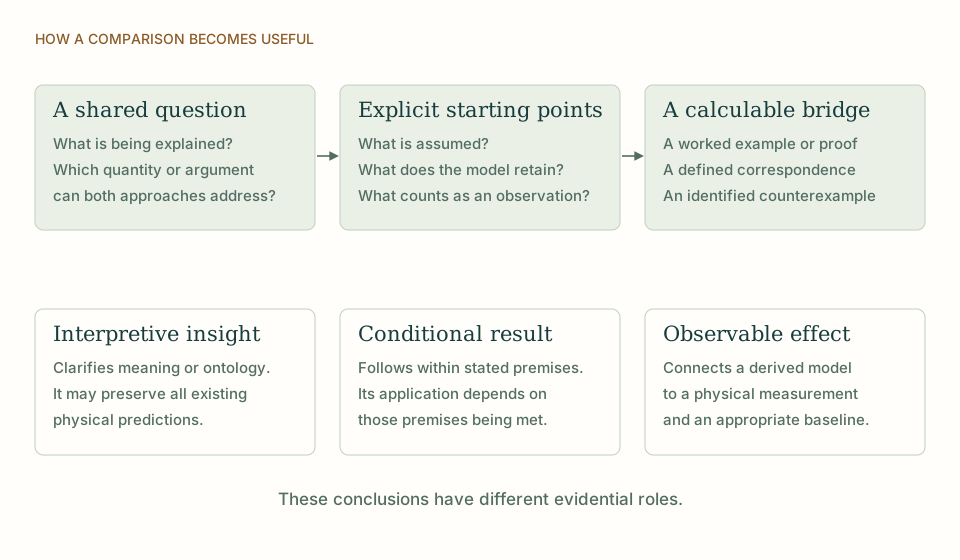
How these comparisons distinguish premises, results and physical claims
SMONAD
Share this page, or keep a clear reference to the work you are reading.
Use this reference for the explanation on this page. “n.d.” means its first publication date is not specified; the update date is recorded separately.