Quantum reference frames ask how physical descriptions change when the reference system is itself quantum. DTT asks how an accessible record is produced from inner generation. These questions can meet in an explicit observer map, but neither a change of frame nor a superposed clock automatically establishes two independently measurable physical times.
A classical frame is often idealized as an external coordinate system. Quantum reference-frame approaches instead include the reference object in the quantum description and transform relational states and observables when another object is used as reference. The transformation can redistribute which subsystem is described as uncertain or entangled while preserving the physical content of the model.
DTT's outer observer similarly accesses completed relations rather than an absolute external view of the source. The potential connection is therefore a map between accessible records associated with different physical references. The six inner levels organize production and completion; they are not six reference systems. A claim of quantum relativity becomes concrete when these maps preserve probabilities and compose consistently. [1][2]
02Worked relational example
Let two particles A and B have positions xA and xB in an external description. Their relative position is r=xB−xA. If both coordinates shift by the same amount a, then r′=(xB+a)−(xA+a)=r. This elementary invariance is the classical core of a relational observable.
Now let A be in a superposition of two well-separated positions while B is localized in the external frame. Relative to A, B's position becomes correlated with A's branches. The physical state has not acquired an extra spatial dimension; the description of uncertainty has changed. In a full quantum treatment the frame transformation acts on the joint Hilbert space and on observables, not merely on displayed coordinates. A DTT record map would need the same discipline: changing the observer record must preserve the probabilities of relational experiments. [1]
r=xB−xA; a common translation leaves r unchanged.
The quantum extension requires a defined joint state and transformation; the displayed subtraction is a classical illustrative identity.
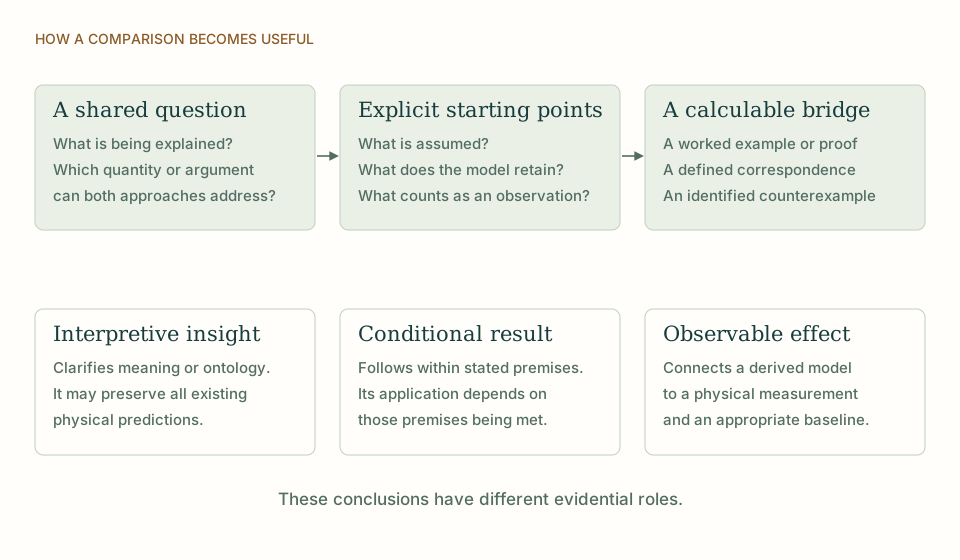
A comparison that reaches a definite conclusion. Begin with the same question, identify what each approach assumes, and compare a shared result. An interpretation, a conditional theorem and an observable deviation have different evidential roles. View full size ↗
03The source origin of the observer’s clock
SMM/DTT can frame this universality as a common origin of clock production and motion. The same nested generative process would determine both a completed material transition and the geometry against which that transition is compared. The seventh, outer role is the readable clock record; the six inner levels are not six separately observable clocks.
The constructive issue is protection. If the model simply assigns each species a frequency ωₛ and rescales it by a chosen function of potential, universal redshift has been assumed. A stronger model derives a common multiplicative response from a symmetry or a shared conserved source quantity, while allowing different transition energies. That would explain how clocks differ in their natural periods yet agree on elapsed proper time after calibration.
04What inner and outer time contribute
The DTT distinction can be valuable if different completed observer records arise from one common generative history and the source determines how they are compared. This would give a physical role to retained memory: it carries the correlations needed to transform one observer's account into another. A common source is not enough if the comparison maps are chosen independently.
A quantum clock can be uncertain or entangled with a gravitating system. Its reading can therefore correlate with different conditional dynamics. This does not automatically imply that there are two freely accessible time coordinates. The correct observables are joint or conditional probabilities involving the clock and the measured system. DTT would need to identify which of those probabilities depends on an inner variable that cannot be eliminated by a change of reference or by including more memory.
The strongest result would show that source generation, observer change and completion commute in the appropriate operational sense: whichever admissible reference is chosen, the same relational experiment has the same probability. A residual disagreement could be a new physical prediction only if it is consistently defined, rather than an inconsistency in the frame map. [2][1]
05A benchmark for the classical inertial limit
Write z=ct+jx and apply z′=e^(−jη)z, with e^(−jη)=coshη−j sinhη. The real components become ct′=ct coshη−x sinhη and x′=x coshη−ct sinhη. Multiplication gives (ct′)²−(x′)²=(ct)²−x², so the interval is preserved algebraically.
If tanhη=v/c=0.6, then coshη=1.25 and sinhη=0.75. A clock moving with x=vt has t′=t/1.25. This reproduces the standard time-dilation factor after identifying the coordinates with physical inertial measurements. Without that identification, it is only a norm-preserving transformation. The example isolates exactly what a temporal-source derivation has supplied and what its matter-and-clock dynamics must still establish. [3][4]
c has velocity units, η is dimensionless, and j²=+1. The quantum phase unit i is a different algebraic object.
06The physical boundary of the analogy
Quantum reference-frame covariance is a property of a specified quantum model. It does not establish the Single Monad ontology, and the Single Monad ontology does not automatically supply quantum reference-frame transformations. Their productive intersection is a constructive observer map generated by the same dynamics as matter and clocks. Such a map could clarify how outer relativity emerges from inner production while preserving the known classical limit.
07Why this matters for quantum relativity
The phrase quantum relativity can otherwise cover several unrelated claims: Lorentz covariance, quantum uncertainty in a frame, superposed geometries or a temporal origin of measurement. A source-based article becomes stronger by stating which claim is proved. The comparison here identifies an attainable unifying target: one source model in which physical clocks, relational positions and observer transformations arise together, with all probabilities defined on the same state space.
THE SAME QUESTION, DIFFERENT STARTING POINTS
The comparison at a glance
Question
SMM/DTT
Quantum reference-frame transformations
Observer
An accessible observer record is produced by source completion.
A reference frame is a quantum subsystem with relational observables.
Transformation
The source should determine consistent maps between completed descriptions.
Joint states and observables transform under defined frame changes.
Time
Inner generation and outer readings need an operational distinction.
Clock uncertainty and conditioning do not by themselves add time coordinates.
KEEP THE CONNECTION
Key ideas
An accessible observer record is produced by source completion.
The source should determine consistent maps between completed descriptions.
Inner generation and outer readings need an operational distinction.
Develops the source construction or operational distinction used in this comparison.
Sources and further reading
References support the comparator and the specific mathematical or interpretive claims indicated. SMM/DTT connections are developed in the analysis above.