
In this article
- Why freezing parameters changes the strength of a claim
- Define the calibration set before the test set
- A simple algebraic example
- Freeze the operator as well as the numbers
- Connection to the constants program
- A concrete freeze record
A spectroscopy test becomes predictive when its operator family, coefficients and calibration data are fixed before the reserved transitions are examined. The freeze record makes the dependency between constants and atomic predictions auditable.
A model can often reproduce a chosen spectral line by adjusting a coefficient. Its explanatory value increases when the same coefficient is fixed independently and successfully predicts other lines. The post-freeze strategy in Paper 13 makes this distinction explicit. For SMM/DTT, upstream quantities might include a source-selected coupling, an action normalization and particle masses. If these are still empirical inputs, that is acceptable for a conditional atomic test, but they must be labeled. The crucial rule is that the target transition must not silently choose the parameters used to predict itself.
List every datum used to set a parameter, including indirect inputs. A Rydberg constant or nuclear radius from an adjustment that included the target lines can carry those lines into the prediction even when they are not explicitly fitted again. The clean approach is to use independently determined inputs or an adjustment that excludes the reserved tests. Record the parameter covariance, units and theory conventions. A parameter freeze is a versioned numerical and conceptual specification, not simply a promise not to change one decimal after seeing the answer.
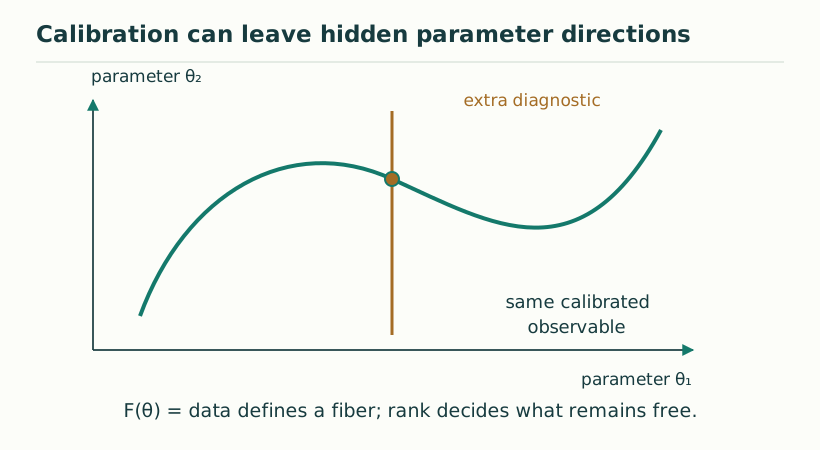
Suppose a toy spectrum has residuals ri=A si, where the shape si is fixed by a derived operator. If A is obtained from one designated calibration line, every other residual is predicted relative to that line. Two additional independent lines can then test whether the shared shape works. If instead each line has its own Ai, any collection can be matched and the model has lost cross-line predictive power. The distinction is not whether fitting is ever allowed; it is which data determine which parameters and how many independent consequences remain.
A model can also overfit by changing its functional form after every discrepancy. For a contact correction, the nS pattern is 1/n³. For a spin-sensitive operator, matrix elements depend on angular labels. Choosing among many shapes after inspecting all data consumes information even if the final model has only one amplitude. State the operator family and model-selection rule beforehand, or use a separate exploratory set and a fresh test set. This keeps the physical claim tied to a source mechanism rather than to a retrospective arrangement of residuals.
The broader SMM/DTT program seeks noncircular derivations of α, action scale and masses. Spectroscopy can test that program only if the dependency direction is respected. Deriving α from a structural receiver and then checking hydrogen differs from choosing a receiver normalization using hydrogen and reporting the resulting agreement. Both can be useful stages, but only the first is an independent prediction of the coupling. The same care applies to outer-time calibration: a frequency standard imported from the target transition cannot simultaneously be evidence that the model predicted its absolute frequency.
A publishable analysis should save a compact manifest with the source revision, equations, fitted or derived parameters, calibration observations, reserved transitions and covariance convention. It should specify the approximation order and how theoretical remainders enter the error budget. If a failure leads to a revised model, the old prediction remains a documented test result and the revision gets a new validation set. This practice makes successive SMM/DTT papers accumulate evidence rather than erase unsuccessful attempts. The dependency is explicit: independent source derivation and calibration determine one frozen Hamiltonian, whose shared levels produce the reserved spectral predictions.
KEEP THE CONNECTION
Scope of the argument. A proposed analysis protocol; no calibrated data set or successful DTT spectroscopy comparison is asserted.
Working manuscript. Article-level references identify the consulted sections and the scope of the interpretation. No public URL was supplied for this exact manuscript version.
Source register →