
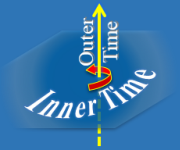

In Mohamed Haj Yousef's reading of Ibn al-Arabi, time is understood through relations, presence and the renewal of created existence. It need not be an independently existing thing in order to organize meaningful distinctions among events and conditions.
Read the question in context
When a historical author questions the existence of time, it is tempting to hear the modern slogan “nothing is real.” That can conceal the actual argument. The relevant question may concern whether time exists independently, whether it names a relation, or how a created thing receives its present existence. These are different inquiries.
The online “What is Time?” section of The Single Monad Model presents time as lacking a separate existence of its own in Ibn al-Arabi's account. It connects ordinary questions about when something happens with the conditions and relations of existing things. The point is therefore not exhausted by denying the usefulness of dates or clocks. It concerns the status of the temporal description itself.
Presence and relation
Yousef translates a formulation associated with chapter 390 of the Futuhat as “the time of a thing is its presence.” Read within that discussion, the phrase invites attention to the condition in which something is present and to the relations through which it is identified. The book's examples of relational names help explain why a term can depend on its counterpart rather than name a self-sufficient entity.
A contemporary illustration can clarify the distinction. “Earlier than” describes a relation between events; it is not an extra event inserted between them. Yet changing the sequence can change the truth of the description. Relations can be consequential even when they are not treated as independent substances. This illustration is an explanatory comparison, not a quotation from Ibn al-Arabi.
Readers should also preserve the distinction between a relation's meaning and its measurement. An account of what temporal relations are does not, by itself, specify how a particular clock realizes them. The essay on duration and order develops that separate question.
The origin of a comparison
The book's discussion of the origin of time distinguishes asking when time began from asking how temporal distinctions arise. The first question already uses the temporal language it is attempting to explain. The second can investigate the conditions under which an ordered or measurable comparison becomes available.
In the cosmological account discussed there, motion and its recognizable determination are distinguished through the imagery of orbs and fixed stars. The astronomical and theological setting belongs to the historical text. A modern reader can nevertheless recognize the general methodological issue: a process and the means of identifying its progress are not automatically the same thing.
Imagine a perfectly uniform rotating disc viewed through an interface that reveals only its unchanged outline. This restricted observation would not show its angular position. A visible mark would make new comparisons possible. The modern example illustrates the role of distinguishability; it does not translate the historical cosmology into an experimentally established model.
Waqt as a present condition
In the section on moments, waqt receives particular attention as a person's or entity's present condition. This use is richer than a numerical timestamp. It concerns what characterizes the entity in its present encounter and situation.
That helps explain why translating every temporal term simply as “time” can obscure distinctions. A reading may move between ordinary duration, a present condition, a cosmic day and an encompassing account of existence. The interpreter's task is to identify the function of the term in the passage before comparing it with another author's vocabulary or a modern technical concept.
Renewal and dependence
The book's treatment of ever-renewed creation connects temporality with the continuing dependence of created forms on their source. In that interpretation, existence is not explained merely by referring to an event at a remote beginning. The dependence concerns the world as it is present.
Renewal makes persistence an especially interesting question. If a form is continually renewed, what makes a later manifestation a continuation of an earlier history? The theological account establishes a setting for that question. A proposed physical realization must additionally describe the relations that support recognizable objects, memory and reproducible observations.
The identity-through-change essay offers a simple mathematical example of preservation under transformation. Its update rule is a modern teaching construction. Keeping that attribution explicit allows the historical reading and the mathematical inquiry to contribute different kinds of understanding.
A path from text to research
The later Single Monad programme develops a generative interpretation motivated by these questions. That development adds choices about models, operations and physical interpretation. A careful reader can therefore keep three levels in view: Ibn al-Arabi's text, Yousef's documented interpretation, and a particular contemporary mathematical construction.
This sequence is a productive reading route. Begin with the passage, identify its terms and argument, then ask what a proposed modern counterpart preserves or changes. The result can be a substantive conversation across disciplines without making historical influence or scientific equivalence depend on a shared word.
Sources and edition note
This introductory essay follows the linked online edition of The Single Monad Model. It is an original reading guide, not an excerpt from the Routledge edition of Ibn ‘Arabî—Time and Cosmology. References to the Futuhat within that online book should be checked in the cited edition for detailed textual work.
For direct Arabic reading, Futmak provides chapter 59, on existing and estimated time, and chapter 390, on the time of a thing and its presence, in the Maymaniya/Cairo text. Read the argument surrounding a phrase as well as the phrase itself.
- Mohamed Haj Yousef, chapter II, “What is Time?”.
- Mohamed Haj Yousef, chapter II, “The Origin of Time?”.
- Mohamed Haj Yousef, chapter II, “Moments”.
- Mohamed Haj Yousef, chapter V, “The Principle of Ever-renewed Creation”.
- Ibn ‘Arabî—Time and Cosmology: edition record. Use this record when identifying the separate Routledge publication.