
For a nonzero oriented orthogonal flow, polar decomposition selects a compatible quarter-turn on the dynamic sector; kernel and composition data remain separate.
What the journal paper addresses
Real-commutant phase selection from real Hilbert representations is the Physics Letters A paper identified by the DOI below. The existing article guide and public publication record frame its central issue: classify complex structures compatible with a real representation, then ask how an oriented flow chooses one.
This is a kinematical question with physical importance. It explains how the familiar imaginary unit can appear as part of a representation of dynamics. It does not require interpreting a second real coordinate of a state vector as a second laboratory time.
Two rotating planes make selection explicit
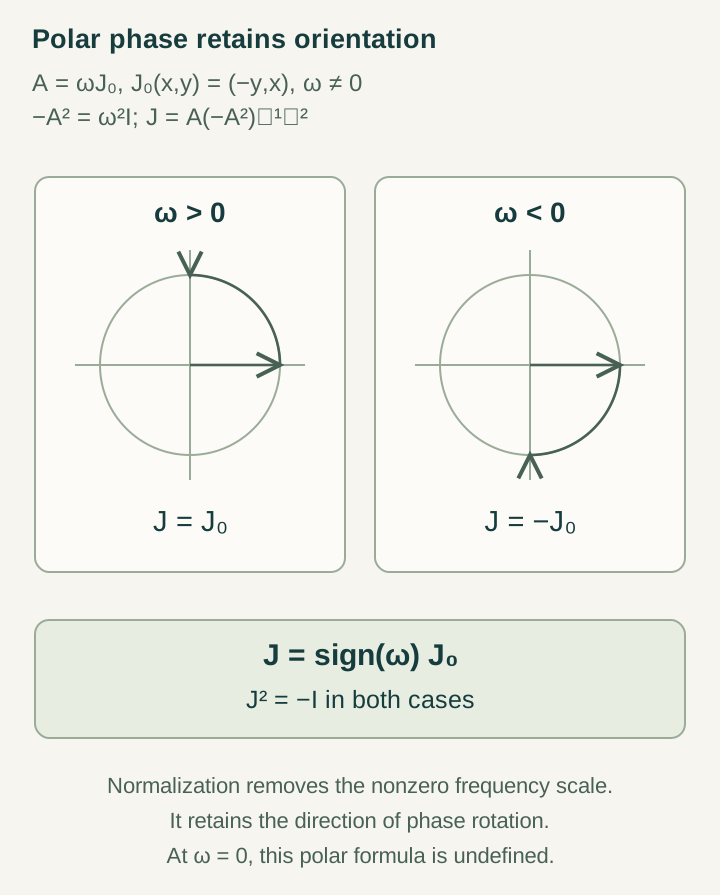
Choose A=diag(2J₀,−3J₀), where J₀(q,p)=(-p,q). Squaring gives A²=diag(−4I,−9I), so |A|=sqrt(−A²)=diag(2I,3I). The selected factor is therefore JA=diag(J₀,−J₀).
The absolute frequencies, two and three, remain in |A|; their orientation is recorded in JA. Thus differing rates do not require different scalar fields. Each dynamic plane becomes a complex line with the orientation selected by its actual generator. A change of basis changes the matrix expression but preserves the operator relation.
Open the full-size diagram →
What happens to stationary directions
Append a real stationary plane with zero generator. The flow fixes every vector there, so it cannot distinguish J₀ from −J₀ on that plane. If a compatible extension exists, another input must select it. A stationary real line illustrates a stronger obstruction: no real one-dimensional operator squares to −1.
This example separates three questions: existence of a compatible complex structure, uniqueness under supplied flow data, and extension to the whole carrier. Treating them separately avoids making a zero-frequency condition do more work than it actually can.
Time reversal and scalar action
On the rotating plane define K(q,p)=(q,−p). Direct substitution yields KJ₀K−1=−J₀. Consequently K(iψ)=−iKψ once i means J₀. A real-linear norm-preserving map has become antilinear in the selected complex description.
This gives a simple interpretation of antiunitary language. It depends on how a transformation acts on the selected phase. In a physical application, one must additionally establish which operation reverses the experimentally assigned evolution and how it acts on spin, momentum, and the apparatus.
Why two selected phases need balancing
Two complex lines tensor over the complex numbers to one complex line, which has two real dimensions. Their underlying real planes tensor over the reals to four real dimensions. A rule is needed to identify the shared phase action and recover the intended complex composite.
This balancing relation says that moving the common scalar phase from one factor to the other does not create a new composite state. It is a construction of composition, not a consequence of choosing J₁ and J₂ independently. The SMM ambition of one source makes this compatibility an especially natural question to investigate.
DTT interpretation and reading questions
Read A202 alongside the explicit polar calculation in A154, then compare the circular phase with the split-complex temporal pairing in A141. The latter uses j²=+1, while the operator here obeys J²=−I. They serve different mathematical roles.
The DTT connection is that oriented generation can constrain phase before completed observations are introduced. The next question is whether the same source fixes the record instrument and composite rule. Ask which conditions select orientation, what survives in the kernel, and whether proposed experimental differences survive an equivalent ordinary complex description. These questions locate where a reconstruction could become a new physical restriction.
Continue with the articles
- Real-commutant phase selection: a paper guide
An oriented real orthogonal flow can select an ordinary complex structure on its dynamic sector. Planar examples explain residual zero-mode freedom, time-reversal antilinearity and the extra balancing rule needed for composite systems.
- Selecting phase by polar decomposition
Polar decomposition of an oriented real dynamical generator selects an ordinary complex structure on its nonzero-frequency sector. Zero modes, symmetry compatibility, and discrete logarithm branches remain separate inputs.
- Split-complex time and ordinary quantum phase
Split-complex temporal pairing and ordinary complex quantum phase use different algebraic units. The record construction keeps those roles distinct and obtains its Lorentzian determinant only after additional completion assumptions.
- Quadratic completion and phase-insensitive records
Additive quadratic completion retains each packet's intensity and direction while discarding inter-write phase. Comparing it with coherent addition makes the observation rule and its predictive limits explicit.
- Hermitian records from complete tests
Complete quadratic tests identify histories with positive two-by-two Hermitian records. Spectral decomposition, finite tomography, and noise conditioning show both what the record retains and what the apparatus must supply.
Sources and reading
Read the original source for its exact formulation and edition. The examples on this page are explanatory reconstructions.
Cite this publication
Mohamed Haj Yousef (2026). Real-commutant phase selection from real Hilbert representations. Physics Letters A, 594, Article 132085. https://doi.org/10.1016/j.physleta.2026.132085