


The answer in brief
A physical readout is realized by an apparatus with reproducible preparation, comparison and calibration rules. Spatial meaning requires more than three components: the resulting geometry must agree with accessible operations and transport.
Go to the research challengeA physical readout connects states to an apparatus
A readout is a specified map from source states or histories to retained results. It becomes a physical readout when a preparation and detector procedure realizes that map, with stated calibration and error. Assigning three numbers to each history is mathematically easy. Showing that those numbers describe measured spatial relations is a separate task.
In SMM/DTT, the readout is the interface through which completed generative work becomes observable. This makes it a natural place to seek geometry. The source may generate relations before assigning locations, but the retained operations must explain how an observer compares those relations. A physical interpretation should identify what can be prepared, what can be measured and what remains hidden.
The source and relations guide introduces this route. Its strongest target is a common mechanism for generating a record, measuring its geometric role and preserving its response to later interaction.
Three components leave multiple geometries possible
Let a detector output x=(x₁,x₂,x₃). One candidate squared distance between two records is d₁²=(Δx₁)²+(Δx₂)²+(Δx₃)². Another is d₂²=(Δx₁)²+4(Δx₂)²+9(Δx₃)². Both are positive metrics on the same three-component space. They assign different lengths to the same displayed displacement.
For Δx=(0,1,0), the first distance is one and the second is two. The number of components and their algebraic rank have not changed. A physical comparison protocol must select which quadratic form, or which other metric structure, the apparatus realizes. An overall length unit remains another calibration choice.
A coordinate change can describe the same metric differently, so the question is not which formula looks Euclidean. The question is which invariant comparison procedure is implemented. A reconstruction should distinguish active changes in the physical detector from relabeling the coordinates used to describe it.
Operational comparisons can define distance directly
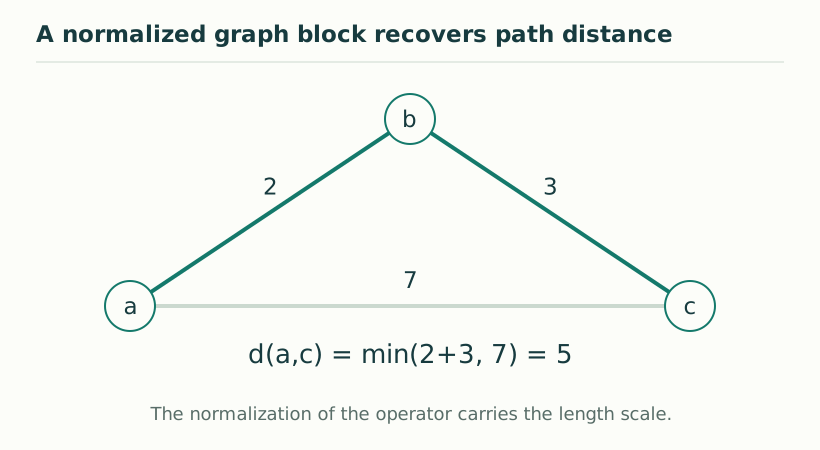
Take three completed records a,b,c with reversible elementary transitions. Assign measured costs two to the a–b transition, three to b–c and seven to a–c. Define distance as the minimum total cost among allowed paths. The shortest route from a to c uses b and has cost five, not seven.
Positive edge costs and connectedness guarantee positive separation for distinct vertices in this finite graph. Reversibility gives symmetry. Concatenating a shortest a–b route with a shortest b–c route gives an allowed a–c route, so minimization proves the triangle inequality. The metric properties follow from the operation and cost assumptions rather than from the way the graph is drawn.
The costs still need a physical meaning. They might be calibrated durations, resource expenditures or lengths measured by another procedure. These choices need not agree. Calling a minimum elapsed time a distance in meters requires a conversion justified by the apparatus, not an assumed speed introduced solely to recover the desired result.
Test the dictionary before treating it as geometry
Suppose direct measurements report costs one for a–b, one for b–c and three for a–c. If these are direct-channel costs, they are perfectly compatible with a shortest-path distance of two between a and c. If they are claimed to be the already minimized distances of one metric, they violate the triangle inequality. The interpretation of each measurement matters.
A useful protocol reports raw comparisons separately from the geometric reconstruction. It checks reversibility, path composition and reproducibility. If a comparison depends on the route or source state, that dependence may call for a connection, a dynamical metric or a memory variable rather than a single static distance table.
The six nested inner roles can organize acquisition of these comparisons and their completion certificate. Their ordering does not by itself guarantee metric consistency. The retained output should include enough information to distinguish a changed geometry from an incomplete or stale comparison.
A useful spatial interpretation survives finite error
Suppose the measured readout is y=Cx+η, where η is bounded detector noise. If C has a tiny singular value, small noise can conceal a large change in one latent direction. Exact rank three is then a poor guarantee of reliable spatial access. A reconstruction should bound the smallest and largest singular values over its admissible states.
For graph measurements, let each relevant edge cost have error at most ε. A specified path containing m edges has total cost error at most mε by the triangle inequality. If two competing routes have nominal costs five and seven and both contain at most two edges, sufficiently small errors preserve which route is shorter. Near-degenerate routes require an uncertainty interval rather than a unique path claim.
Such estimates make a physical readout useful at finite resolution. They also identify the data a collaborator can check: raw comparisons, detector response bounds and the reconstruction algorithm. A geometric picture can then be accompanied by a quantitative statement of its accuracy.
Require transport and readout to agree
A final check compares the geometry with an independently defined matter operation. Generate the distance table without fitting it to a chosen propagation result. Then calculate which transitions the matter law permits and how their timing relates to the measured geometry. If a hidden controller can move a state between distant records through an uncounted channel, the displayed metric does not yet govern physical influence.
A finite demonstrator can begin with a small graph, a retained detector register and one transported excitation. Include all scheduling memory and permit declared perturbations of the source. The target is a common update that gives reproducible comparisons and respects them during subsequent motion.
The achievement need not be a smooth spacetime immediately. A robust finite operational geometry is already a useful result. It supplies the concrete foundation on which refinement, clock comparisons and a continuum approximation can be investigated.
Develop the argument
Questions to take further
- Which raw comparisons select the proposed metric rather than another metric on the same labels?
- Does an independently specified matter update preserve the distance and adjacency reconstructed by the detector?
A concrete next step
Calibrate a finite spatial readout
Choose a finite source, detector map and raw comparison protocol; reconstruct a metric before fitting any propagation result.
What to share
The comparison table, metric proof, uncertainty bounds and an independent transport check.
I welcome collaboration with experts in physics, mathematics and philosophy. Get in touch with a question or proposal.