A mobile carrier, stationary dual, and supplied singlet-binding Hamiltonian reduce to one exact resolvent equation. Its unique physical root determines the holonomy-dependent ground response and a conditional completion-cost candidate.
The four-position singlet-loop model isolates one response that can be calculated exactly. A stationary dual makes the root singlet basis independent, and the supplied hopping and penalty reduce the ground energy to a scalar resolvent equation. This furnishes a precise target for a temporal completion mechanism without assuming that source unity already selects the Hamiltonian or its parameters.
02The supplied finite system
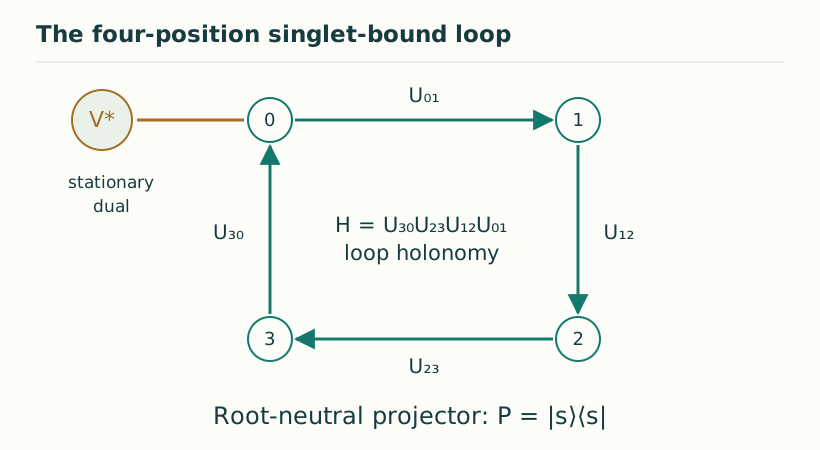
Place a mobile rank-m carrier at four positions around a loop and a stationary dual carrier at the root. Their root contraction defines the normalized singlet s=m^(−1/2)Σ_a|0,a⟩|ā⟩. The Hamiltonian H=Δ(I−|s⟩⟨s|)−K penalizes every state outside that root singlet and lets the mobile carrier hop with real amplitude t through unitary links. The stationary dual makes the contraction basis independent. The penalty, graph and hopping law remain physical inputs.
dim H_aux=4m²
H=ΔI−(K+Δ|s⟩⟨s|), Δ>0
Figure 1. The four-position singlet-bound loop. A mobile carrier hops around four supplied positions while its stationary dual remains at the root. The root singlet penalty and the link holonomy determine the finite model response. This construction presupposes the lattice and carrier data. View full size ↗
03Reduce the spectrum to one equation
Gauge-transform three links to the identity and diagonalize the remaining holonomy W with eigenvalues e^(iθ_a). The free twisted-ring energies are λ_ak=2t cos[(θ_a+2πk)/4]. The singlet has spectral weight 1/(4m) in each displayed mobile mode. Rank-one resolvent algebra shows that the ground energy is E=Δ−z, where z lies above the largest λ and solves 1=ΔR_W(z). The branch condition is essential: clearing denominators can produce other algebraic roots.
R_W(z)=(1/4m)Σ_(a,k)(z−λ_ak)⁻¹
1=ΔR_W(z), z>max λ_ak
04Why the physical root is unique
Above the largest free eigenvalue, every term in R_W is positive and strictly decreasing. The sum diverges at the upper spectral edge and tends to zero at infinity. It therefore crosses 1/Δ exactly once. At t=0 all λ vanish, so R_W=1/z, z=Δ and E=0. This limiting case checks both the normalization and the energy convention. For nonzero hopping, the root gives the exact static ground response at arbitrary holonomy.
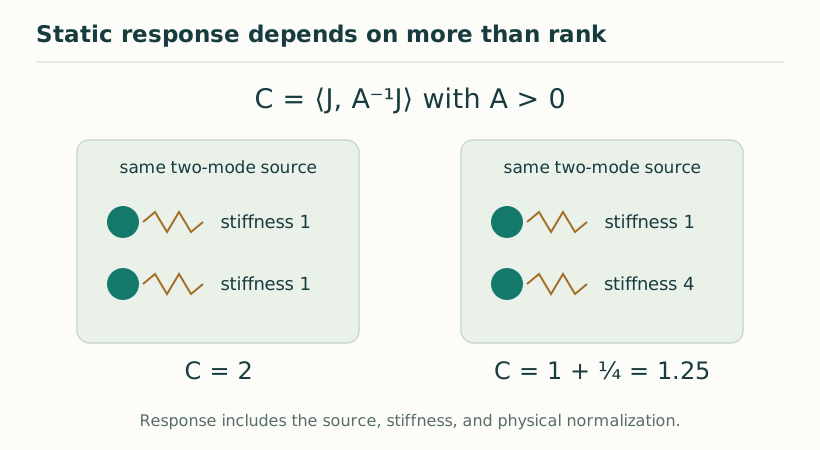
Figure 2. Static response depends on more than rank. With a positive response operator A and source J, capacity is C = ⟨J,A⁻¹J⟩. Equal dimensions can have different capacities; the displayed diagonal two-mode examples are exact illustrative arithmetic. View full size ↗
05What the response means for temporal completion
A closed mobile excursion compares the carrier with its stationary dual after accumulated transport. The resulting energy dependence on W is a precise loop observable under the specified Hamiltonian. It can be interpreted as a candidate completion cost if a source model physically realizes the carrier, reference and singlet penalty. The static theorem does not require that interpretation and does not derive it. Its value for SMM/DTT is that it supplies an exact target, including normalization and parameter dependence, against which a proposed temporal completion mechanism can be tested.
06Static minimization favours trivial holonomy in this model
At nonzero hopping the exact resolvent gives E_m(W)≥E_m(I), with equality only at identity holonomy. In the rational expression, nontrivial eigenangles increase positive denominators at the identity root, lowering the resolvent and hence lowering z, which raises E=Δ−z. This is a concrete energetic preference generated by the chosen auxiliary. It does not mean that a full gauge theory must be globally flat: competing electric terms, matter, topology and other interactions can change the state. The result identifies one contribution to an effective completion cost whose physical relevance depends on how the auxiliary is realized.
07What a physical identification would require
A frame group, an invariant tensor and a loop response are mathematical structures. Identifying them with observed particle charges, interaction strengths and spacetime forces additionally requires matter statistics, chirality, dynamics, normalization and controlled scale matching. A connection can be flat even when its allowed structure group is large. A finite auxiliary gap can be positive without establishing a continuum Yang–Mills mass gap. The SMM/DTT programme becomes sharper when these distinctions are retained: a proposed temporal source law can then be asked to reproduce specific carriers and coefficients rather than receiving credit for empirical physics merely because familiar group labels appear.
Gauge-invariant density matrices and neutral amplitudes are different notions. Averaging a density matrix over frames can leave a maximally mixed state in a nontrivial charged representation. Averaging amplitudes coherently projects onto invariant vectors and can instead select a singlet sector. A completion mechanism must specify which operation it implements and where its reference carrier resides. This distinction matters when interpreting a static singlet calculation as a physically generated neutral sector: symmetry of the Hamiltonian preserves a chosen sector but does not automatically prepare it.
KEEP THE CONNECTION
Key ideas
A stationary dual gives a basis-independent root singlet.
One monotone secular equation determines the exact static ground energy.
The Hamiltonian’s physical selection remains separate from its solution.
Scope of the argument. Exact finite static model with supplied carrier, hopping, links and penalty; no derivation of those inputs from source ontology.
Sources & further reading
Gauge_Structure_Temporal_Completion_v20(2).pdf — working draftpp. 8–10, §2.2, Theorem 2.1
Source editions and catalogue entries
Working manuscript
Gauge Structure from Temporal Completion in SMM/DTT — Version 20
Working manuscript. Article-level references identify the consulted sections and the scope of the interpretation. No public URL was supplied for this exact manuscript version.