A078Public article topicExpanded article4 min read
Human teeth and elementary particles: a numerical analogy
A numerical resemblance between dentition and particle organization depends on counting conventions. The example clarifies why a physical correspondence needs defined rules, preserved structure and predictions beyond the original match.
The source draws a correspondence among tooth patterns, particle classifications, dimensional layers and symbolic counts. This article treats that proposal as an opportunity to explain how a numerical analogy can be assessed constructively. The interesting question is not whether two lists can be made to share a total, but whether an independently specified structure explains their organization and predicts additional facts.
02Counting depends on definitions
A collection can be counted by objects, types, pairs, positions or internal states. Different choices can produce different totals without changing the underlying collection. In particle physics, counting field types, charge-conjugate states, colors and polarizations answers different questions. In anatomy, counting positions differs from counting a particular individual's present teeth.
Before comparing totals, the counting convention must therefore be fixed on both sides. Otherwise a match can be selected after trying several incompatible conventions, making it less informative than it first appears.
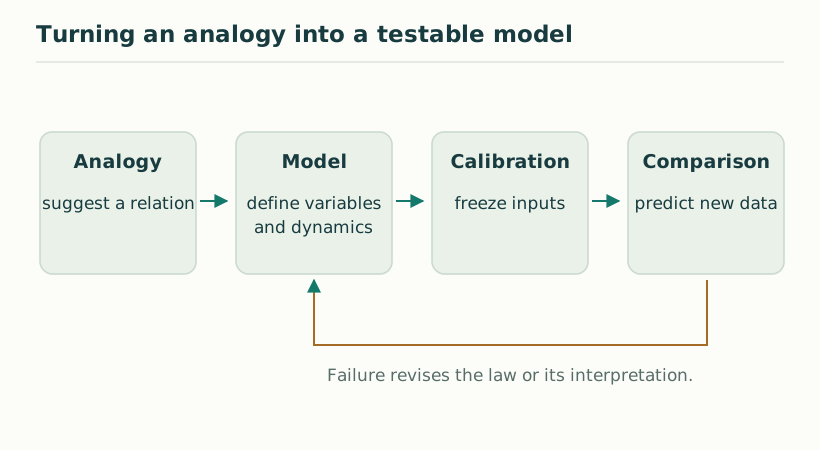
Figure 1. Turning an analogy into a testable model. A numerical or symbolic correspondence motivates a question. A physical claim needs a specified model, independent calibration, and a result that could disagree with observation. View full size ↗
03A simple example of accidental matching
A bookshelf with twelve books and a clock face with twelve hour labels share a number. The match does not establish that books and hours arise from the same physical mechanism. Additional structure is needed: perhaps a relation that preserves ordering, pairing or transformation rules.
Even a structural match can have several explanations. A designer may choose a pattern for convenience, a biological process may generate it through development, and a mathematical model may admit it through symmetry. Shared form does not determine a shared cause.
04What a stronger claim would require
A strong correspondence fixes its rules before inspecting the target, identifies which properties are preserved and predicts a feature not used to construct the match. It should also explain exceptions. If every mismatch can be repaired by regrouping categories, the proposal has little risk of failure and correspondingly little predictive force.
A useful audit lists the entities counted, the equivalence relation that groups them, the resulting number and the independent prediction. This makes the proposal inspectable without dismissing the possibility that a genuine common structure could eventually be found.
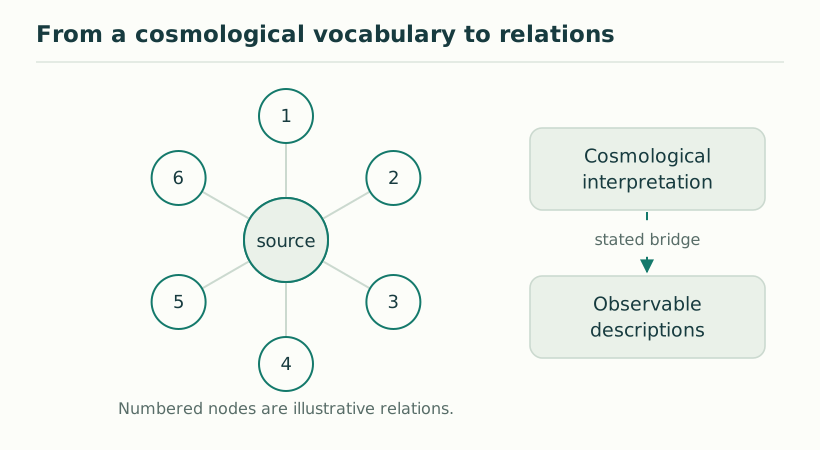
Figure 2. From a cosmological vocabulary to relations. The diagram is a reading aid for the SMM vocabulary: source, relations, manifested plurality, and observation. The arrangement does not assign physical locations to metaphysical terms. View full size ↗
05The SMM/DTT connection
SMM's common-source ambition naturally motivates searches for recurring patterns. DTT's nested organization may suggest specific combinatorial structures. The scientific task is to derive those structures from the source dynamics and then connect them to a well-defined physical classification.
The six inner roles should not be identified with six particle types solely because the numbers agree. Particle classification requires transformation laws, interactions and state content. Likewise, a biological arrangement requires an account of development. A shared model would need to explain both interfaces rather than simply repeat their counts.
06A correspondence should survive a change of representation
Suppose a particle list has a particular total only when certain internal states are counted separately, while a tooth list has that total only when positions are grouped into pairs. The equal numbers then depend on different equivalence rules. A stronger comparison would specify a map preserving the relevant relations under equivalent descriptions of each system. If the match disappears when the same physical content is represented another way, it is likely a feature of the bookkeeping. This gives numerical analogies a constructive test: look for representation-independent structure and a reason that the proposed grouping is physically preferred before treating the common total as explanatory.
07From totals to consequences
The numerical comparison can remain a philosophical illustration of a search for unity. Its scientific strength increases only when counting conventions are explicit and additional relations follow independently. The productive sequence is from totals to structure, from structure to a mechanism and from that mechanism to new consequences. This allows an analogy to be developed seriously without treating a chosen match as sufficient evidence.
KEEP THE CONNECTION
Key ideas
Matching totals depend on counting conventions.
A useful correspondence predicts structure beyond the initial match.
SMM/DTT needs derived classification rules before numerical analogies become physical evidence.
Scope of the argument. Conceptual interpretation with explicit mathematical examples; a source proposal is not presented as an established physical identification.
Historical public topic address, redirected to this edition’s revised explanation. It identifies the topic’s provenance; the revised page supplies its own reading locators and claim scope.