A059Public article topicExpanded article4 min read
The Greatest Element
The Greatest Element names a foundational role within a metaphysical account. The discussion separates a basis from its organizing law and identifies why symbolic counts need an independently specified physical counting problem.
01A foundational element in a metaphysical account
The source presents the Greatest Element as underlying the Monad and subsequent manifestations, using a building, brick and clay analogy. It also discusses symbolic luminous links and their association with a cubic count based on 360. The term element here is metaphysical; it does not denote a member of the chemical periodic table or an experimentally identified constituent particle.
02Levels of explanation
A building can be described through rooms, bricks or materials. Each level answers different questions. The arrangement of rooms explains circulation through the building; the material composition helps explain thermal or mechanical behavior. Moving to a more elementary level does not automatically explain the organization at a higher level.
This is the useful lesson of the source's analogy. A proposed ultimate basis must still be accompanied by rules of organization. Knowing that every brick is clay does not determine the floor plan. Likewise, a common foundation of manifestations does not by itself determine their geometry or dynamics.
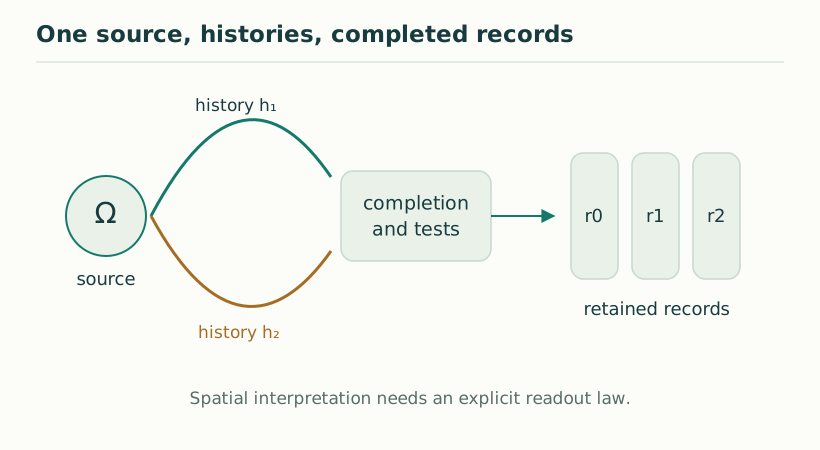
Figure 1. One source, histories, completed records. Conceptual reconstruction: composable source histories are tested and completed before a retained record becomes available. The source is not depicted as a point already located in space. View full size ↗
03Substrate and generative law
Suppose a model begins with a single kind of elementary state. It also requires a law for combining or transforming states. Different combination laws can yield different structures from the same elementary vocabulary. Thus a foundational element and a generative mechanism are logically separate specifications.
SMM seeks to explain their relation: why should one origin yield the particular relations experienced as space and matter? A convincing account would constrain the combination law through properties of the source rather than choose it independently to reproduce a target.
04A numerical illustration and its limit
The arithmetic 360³ = 46,656,000 is exact. It becomes a physical result only after the counted objects and their independence have been defined. A cubic count typically describes three independently selectable labels, each with 360 possibilities. If the labels are constrained or equivalent under a symmetry, the number of distinct states changes.
This illustrates a general rule for interpreting symbolic numbers: a correct calculation does not determine what nature is counting. The connection to a physical quantity requires an explicit state space, equivalence relation and measurement prescription.
360³ = 46,656,000
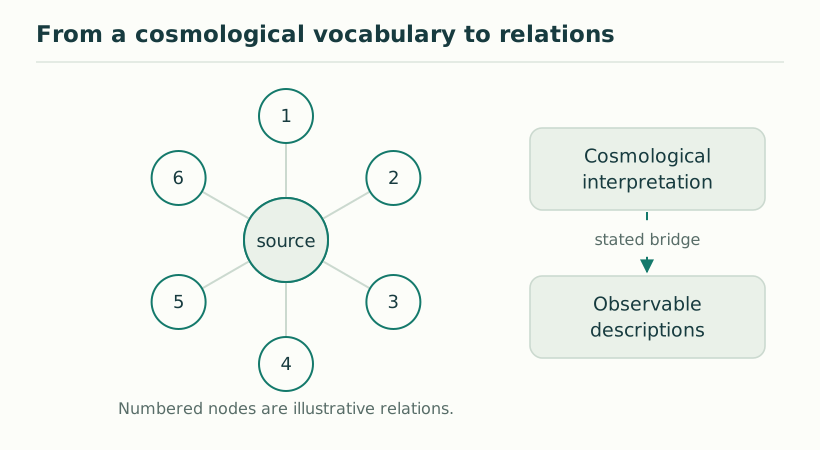
Figure 2. From a cosmological vocabulary to relations. The diagram is a reading aid for the SMM vocabulary: source, relations, manifested plurality, and observation. The arrangement does not assign physical locations to metaphysical terms. View full size ↗
05DTT and pre-spatial structure
A pre-spatial source cannot be understood simply as a smaller object located inside ordinary space. In DTT, the proposed priority is generative: spatial relations arise through inner organization and completed records. The foundational structure must therefore be specified without quietly assuming the geometry it is meant to produce.
For example, an adjacency graph can be supplied as an initial assumption or derived from allowed interactions. These are different achievements. If the graph is supplied, its dimensional properties have partly entered the model already. If it is derived, the proof must show which source constraints determine it.
06A primitive must be distinguished from a fitted parameter
A theory may introduce a foundational object together with a numerical scale. If that scale is selected to reproduce one measured quantity, the result is calibrated. The object can still support useful predictions, but the calibrated quantity has not been independently derived. The same distinction applies to a proposed elementary duration or length associated with a pre-spatial source. Its units and measurement connection must be supplied. A stronger result derives dimensionless relations or fixes several scales through one independently justified condition. This is how a foundational concept can acquire quantitative power without allowing its unspecified properties to absorb every empirical requirement.
07Basis and organization
The Greatest Element directs attention to the distinction between an ultimate basis and its first organized manifestation. Its scientific translation concerns minimal primitives and the laws that make them productive. A basis, an organized carrier and an observable record structure are explanatory levels connected by laws. The physical theory must justify those laws; the existence of a common basis alone does not determine their form.
KEEP THE CONNECTION
Key ideas
A foundational basis does not determine organization by itself.
Exact symbolic counts need a defined physical counting problem.
Pre-spatial generation must avoid assuming the geometry it seeks to explain.
Scope of the argument. Historical interpretation and original conceptual analysis; illustrative mathematical constructions are not identifications of theological realities with physical objects.
Historical public topic address, redirected to this edition’s revised explanation. It identifies the topic’s provenance; the revised page supplies its own reading locators and claim scope.