A033Public article topicExpanded article4 min read
Eternity
Eternity can mean beginninglessness, endlessness or freedom from temporal dependence. Distinguishing these meanings prevents an infinite line, a closed cycle and a foundational law from being treated as the same temporal structure.
The source article distinguishes beginninglessness, expressed by azal, from endlessness, expressed by abad. It emphasizes Ibn al-Arabi’s treatment of eternity as the negation of a temporal limit rather than an indefinitely extended interval measured by a clock. The account therefore resists placing divine existence on an ordinary timeline before creation.
This distinction is important for SMM/DTT because a foundational source is intended to explain temporal structure. If that source is simply assigned an infinitely old clock, the theory has preserved the temporal background it set out to reconstruct.
02Three mathematically different pictures
An unbounded line, a closed circle and the absence of a temporal parameter are not the same structure. A line can extend indefinitely while supporting ordered distances. A circle has no distinguished endpoint but can have finite circumference. A timeless description does not contain a duration coordinate at all.
Each can illustrate one aspect of a philosophical discussion, but none should be substituted for another without argument. Saying that a structure has no beginning does not establish whether it is infinite, circular or outside temporal ordering. The geometry and the interpretation must be specified separately.
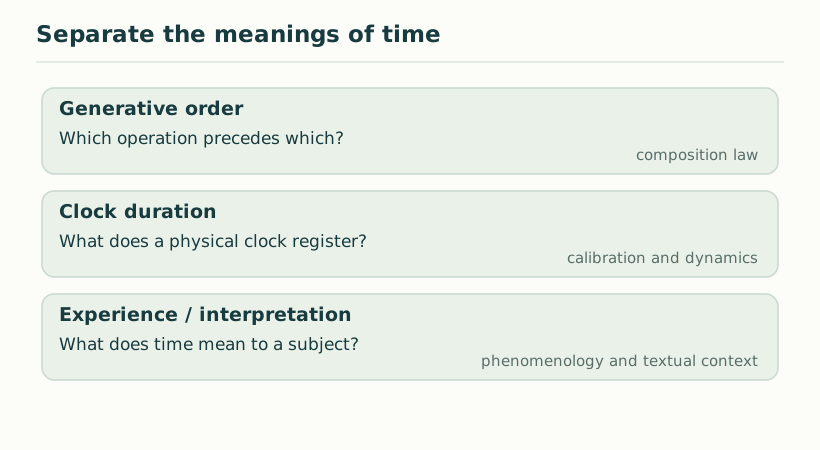
Figure 1. Separate the meanings of time. An interpretive map separates generative order, measured duration, and experienced or theological meanings. A relation between them is a question to formulate, not an automatic identification. View full size ↗
03Negative attributes and explanatory limits
A negative attribute states what does not apply. Calling something beginningless denies a first temporal boundary; it does not provide a positive measurement of its age. Calling a foundation non-spatial denies ordinary location; it does not specify a hidden coordinate with an unusual value.
This discipline helps the monadic programme. A non-spatial source cannot be characterized fully by negations, but the negations prevent misleading pictures. The constructive work then supplies positive mathematical structure: admissible histories, composition, completion and observation. These definitions explain what the model does rather than only what it is not.
04An eternal law and a history are different
A mathematical rule can be stated without assigning it a date inside the process it describes. Its solutions can nevertheless possess temporal order. The distinction between a rule and a history illustrates how a description can generate time-dependent behaviour without itself being another event in that history.
The analogy does not prove that physical laws are metaphysically eternal. It simply clarifies a logical possibility. SMM/DTT can use an atemporal specification of source dynamics while investigating how observers within its histories acquire clocks. The specification’s logical role should not be mistaken for an additional hidden physical time.
05Avoiding the infinite regress of containers
If every temporal order must be located inside a larger temporal container, the explanation can continue indefinitely without identifying what makes any order physical. A generative approach instead asks whether the relevant ordering can be defined from relations among states and records.
For example, a completion relation can determine which events are admissible successors without being embedded in an externally measured duration. A clock observable can then be introduced and justified within that structure. This does not settle every metaphysical question, but it prevents an unexplained outer clock from doing the central explanatory work.
06What eternity contributes to the programme
The conceptual contribution is to separate dependence from chronological precedence. SMM can propose a source of the whole temporal order without claiming that the source waited through an immeasurable past. DTT can then focus on how measurable order arises in the manifested structure.
The physical achievement would be a reconstruction with explicit observables and constraints. The theological meaning of eternity remains a distinct interpretive matter. Holding the distinction carefully allows philosophical motivation to guide the model while preventing an infinite duration, a circular phase or an abstract mathematical rule from being presented as a measured account of divine eternity.
KEEP THE CONNECTION
Key ideas
Beginninglessness, endlessness and absence of temporal dependence are distinct.
A circle without endpoints is not the same as an infinite line.
SMM/DTT can distinguish a foundational specification from the clock order of its histories.
Scope of the argument. Philosophical clarification using mathematical analogies, without identifying divine eternity with a physical variable.
Sources & further reading
Eternity ↗Main article text, accessed 16 October 2026
Historical public topic address, redirected to this edition’s revised explanation. It identifies the topic’s provenance; the revised page supplies its own reading locators and claim scope.