A031Public article topicExpanded article4 min read
The Moment
The moment can mean an instant, a present condition or an observational event. These distinctions connect the source’s vocabulary of presence with detector resolution, retained history and the limits of a universal now.
The source article explains waqt in a technical Sufi sense as the condition in which a person presently stands. The term concerns the received state and its demand, rather than merely a tiny quantity displayed on a clock. It also examines the difficulty of deciding whether the smallest moment should possess duration.
This gives the moment two distinct roles: it can name an event boundary in a temporal description, or the present state through which an observer participates in a history. Keeping those roles separate is essential for a precise SMM/DTT account.
02An instant is not automatically a short interval
In a continuous mathematical description, an instant is represented by a point, while a duration is represented by an interval. The point can mark a boundary without being a finite piece of elapsed time. It is therefore mistaken to infer that a continuum must have zero total duration because each individual point has zero length.
Length is not computed by an ordinary finite sum over all points of an interval. Conversely, in a finite discrete model, summing finitely many zero durations does give zero. The two constructions are different. A theory should state whether its moments are continuous boundaries, discrete updates or intervals with a positive duration.
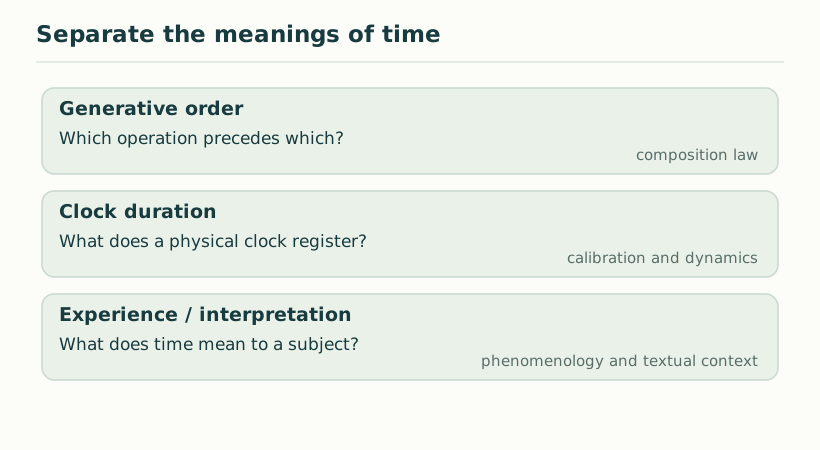
Figure 1. Separate the meanings of time. An interpretive map separates generative order, measured duration, and experienced or theological meanings. A relation between them is a question to formulate, not an automatic identification. View full size ↗
03A detector has temporal resolution
An actual record is produced through an interaction with finite resources. A detector may assign an event to a time bin even when the microscopic interaction has internal structure. The assigned timestamp is not necessarily the exact duration of the process that creates it.
For example, a camera frame records information accumulated over an exposure interval. Treating the frame as one event is useful, but it does not imply that nothing happened within the exposure. DTT completion can likewise be a unit of public registration without every internal operation becoming separately visible.
04The present state and retained history
A present record can contain traces of earlier events. A notebook page exists now while describing yesterday; the described event need not still be occurring for the record to carry information about it. Thus a theory emphasizing present manifestation must still explain how present structures encode a past.
For SMM, continued renewal cannot erase all relations between appearances if observers are to possess memory. DTT can formalize the required retention through a predictive state or record algebra. The moment then includes more than a bare snapshot of spatial positions: it includes the information relevant to subsequent observable evolution.
05A local moment is not automatically a universal now
An observer can identify a local event or a current clock reading. Extending that reading to a universal present across distant locations requires a synchronization structure. Relativistic physics does not supply one observer-independent simultaneity surface for all inertial descriptions.
A DTT model may use an internal generation order, but it must explain how that order relates to observable clock comparisons. If it is physically hidden, the model must show why; if it has observable consequences, those consequences must be consistent with tests. The phrase single moment cannot by itself settle this interface.
06The constructive meaning of a moment
A useful modern definition is a completed event together with the records available at that event. This is a modelling choice, not a translation of every use of waqt. It directs attention to what an observer can distinguish and how one completion supports the next.
The conceptual connection with the spiritual term is the emphasis on a determinate present condition rather than an empty temporal container. The scientific extension concerns the structure of that condition: its memory, observables and update. Clarifying these ingredients makes the moment a precise component of SMM/DTT rather than a mysterious indivisible duration invoked whenever a derivation becomes difficult.
KEEP THE CONNECTION
Key ideas
An instant, an interval and a present condition are different concepts.
Finite sums of zero durations and continuous interval measures are not the same construction.
A completed moment must carry the records needed for observable continuity.
Scope of the argument. Conceptual and mathematical clarification; no minimum duration or universal simultaneity is assumed.
Sources & further reading
The Moment ↗Main article text, accessed 16 October 2026
Historical public topic address, redirected to this edition’s revised explanation. It identifies the topic’s provenance; the revised page supplies its own reading locators and claim scope.